Lansing — Michigan residents, are you ready to talk (or spot) wild turkeys?
The Michigan Department of Natural Resources needs your help to tally wild turkeys this summer.
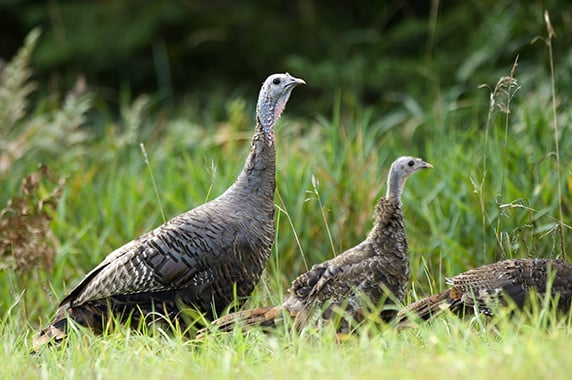
From July 1 through Aug. 31, the DNR will run its annual wild turkey brood survey – a community science effort for people statewide to report sightings of wild turkeys and turkey broods (hens with their young).
By taking just a few minutes to report any turkeys you see, you’ll be contributing valuable data to track the health of the state’s turkey population.
Conservation success
Wild turkey numbers in Michigan rebounded from near extinction in the early 20th century to now being found in every county across the state.
“This bird’s comeback is something to celebrate, and now we need the public’s help to keep tabs on our turkeys going forward,” said Adam Bump, the DNR’s upland game bird specialist.
The DNR’s goal with the turkey brood survey, according to Bump, is to get a clear picture of how turkeys are doing across Michigan.
“Each report from the public, whether it’s a single turkey or a big flock, is like a piece of the puzzle that helps us understand turkey reproduction and survival,” Bump said. “We have a great hunting and wildlife-watching community here in Michigan, and we’re excited to see everyone pitch in and share their turkey sightings.”
MORE COVERAGE FROM MICHIGAN OUTDOOR NEWS:
Coyote lawsuit against the Michigan Natural Resources Commission dismissed
Commentary: The Voyageurs Wolf Project’s perspective on wolf hunting and trapping
‘Reserved hunts’ in Michigan offer meaningful opportunities for many
Turkey trends
Now in its third year, Michigan’s wild turkey brood survey is part of a multi-state initiative to monitor turkey populations. The survey follows a standardized protocol used by many other states, supported by the National Wild Turkey Federation.
By participating, Michigan joins a larger conservation effort to identify regional trends in turkey populations and address potential declines seen in other parts of the country.
“In Michigan, our turkey population is currently stable, but we know that in many states, turkeys have been declining,” Bump said. “This survey is an important way for us to detect any changes here at home and make sure our turkeys remain a success story. It’s also a chance for the public to be directly involved in wildlife science.
“When you report a turkey brood, you’re contributing to conservation – it really does make a difference,” Bump said.
How to participate
Anyone in Michigan can help by reporting wild turkey sightings between July 1 and Aug. 31, using the online turkey brood survey form to submit observations.
The survey asks seven short questions about what observers saw (number of hens, poults, and gobblers or jakes in each sighting, as well as the date and location. It takes only a minute or two to complete a report.
The DNR uses an email address login for the survey to ensure each observer is counted only once, which helps in analyzing the data.
“Linking each sighting to an email simply lets us tally how many individual people are contributing,” said Caitlin Ott-Conn, a laboratory scientist with the DNR Wildlife Division. “This way we know if we’re hearing from 100 people once each, or one person 100 times – it makes the data stronger.”
Ott-Conn oversees the survey data collection and analysis. After the survey period, the DNR Wildlife Division’s biologists will compile all public submissions to calculate measures like the average brood size (number of poults per hen) – a key index of turkey reproductive success.
Since the turkey brood survey began in 2023, Michiganders have submitted more than 11,500 reports, tallying over 25,000 hens, 65,000 poults and 11,000 males.
“We were thrilled with the response,” Bump said. “It shows how much people care about our wildlife. We’re hoping to see that enthusiasm continue and even grow this year. If you missed the survey before, now’s your chance. If you reported turkeys last year, we’d love to have you back telling us what you’re seeing in 2025.”
Learn more and submit an observation on the turkey brood survey page.
“Together, let’s see how many turkey families we can find this summer,” Bump said. “Your sightings will help guide turkey conservation for years to come.”