




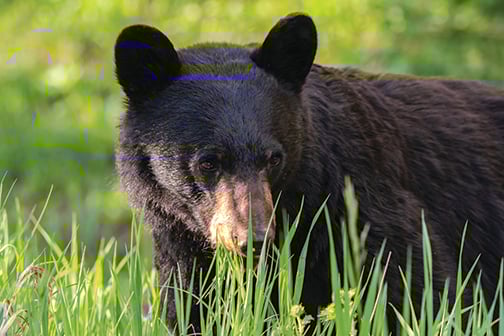
A bear crossed the road in front of me the other day, and something was different.
In the past, if a bear was spotted along the road, in the neighborhood – or anywhere – it was a big deal. And harvesting one in hunting season was like the apex of big game hunting in Pennsylvania.
But now, at least in my area, seeing a bear just isn’t that big of a deal anymore. It has nothing to do with the species itself, as I still find bears to be impressive.
 I think the fact that bears aren’t uncommon, at least in my area, makes seeing one a bit anticlimactic.
At least that’s how it felt when I saw one – around 150 pounds I would guess – cross the road the other day. I slowed down and watched as the bear meandered up a hillside and then continued on with my day. I didn’t even remember to tell my wife and kids when I got home that I had seen a bear.
The whole encounter was similar to seeing a deer along the road – it happens all the time.
However, the fact that bears are so common where I live makes seeing them somewhat routine doesn’t mean that a bruin sighting isn’t big news in other areas of the state.
In the southeast, for example, seeing a bear is a big deal, and harvesting one in hunting season is a once in a lifetime event.
In fact, 2024 marked the first time a black bear was taken by a hunter in Lancaster County. It turns out the harvest was illegal due to trespassing issues, but it still marked the first time a bear was killed in Lancaster County.
For someone who lives in the Poconos or Northern Tier, that’s hard to fathom.
MORE COVERAGE FROM PENNSYLVANIA OUTDOOR NEWS:
Pennsylvania law set to remove abandoned, derelict boats
Lawmaker grills Pennsylvania Game Commission on land swap
Popular access on Pennsylvania’s Susquehanna River still open, at least for now
Considering Pennsylvania has one of the most abundant bear populations in the country, it’s easy to assume they’re everywhere. That’s especially the case if you live in bear country, where bruins can be so numerous it can be an issue.
Still, despite our abundance of bears, the population is really concentrated in certain parts of the state – the northcentral, northeast and part of the northwest. It makes me wonder, since bruin numbers vary drastically throughout Pennsylvania, should we have a wildlife management unit system for bear hunting?
After all, that’s how we manage deer, so why not bears?
Better yet, perhaps it’s even more important to manage bears and bear hunting through WMUs as a means to focus hunting pressure where the population is greatest.
Push hunters to the areas where there are plenty of bears with the hope of reducing conflicts with people. That was one of the goals when the bear archery season was implemented.
The hope was that archery hunters – who aren’t restricted by the 150-yard safety zone in place for rifle hunting – could infiltrate the suburban areas where bears raid dumpsters and bird feeders and harvest some of them.
It’s a concept that makes sense, just like allocating licenses through a system of WMUs that’s dictated by habitat, population and nuisance complaints.
Yet there’s another factor to consider when it comes to making the case for WMUs for bears.
The Game Commission routinely traps nuisance bears and relocates them to more distant and wild locales. Get them out of the suburbs and into the big woods where they can’t cause any problems.
It’s an approach that makes sense from the standpoint of addressing conflicts with people, but is there an ecological impact to consider?
I know of one area where a fellow hunter has witnessed an enormous increase in the number of bears turning up on his trail cameras. It started a few years ago and the number has continued to increase.
Just recently, he counted six different bears on one trail camera, and this is in an area that’s not considered a stronghold for the bruin population.
So where did all the bears come from?
Turns out the Game Commission has been releasing nuisance bears in the area, which is likely the reason why so many are now appearing on trail cameras.
The area in question is very remote and sparsely populated, so the relocated bears are unlikely to cause problems with people.
But what about the natural balance of things? After all, you’re releasing Pennsylvania’s apex predator – apparently quite a few of them – into a new area. All of these new bears need to eat, putting a demand on prey species (fawns, for example) and habitat.
I don’t have a problem with the Game Commission relocating nuisance bears to remote areas. But if you’re going to artificially inflate the bear population in a particular area, why not do something to steer hunters there to help keep things in check?
Something like a wildlife management unit, perhaps.
Illinois DNR hits pause on CWD meetings as strategy evolves
Illinois hunters, landowners and others concerned about chronic wasting disease will have to wait until next fall for another opportunity
WI Daily Update: Submit a proposal for the 2027 spring hearings
Wisconsin residents can propose changes impacting the state’s natural resources through the 2027 Conservation Congress. Here’s how to submit a

New York State Big Buck Club banquet: A collection of deer stories
Every buck hanging on a living room, den, or hunting camp wall carries a story. The New York State Big

2 thoughts on “Tom Venesky: Should Pennsylvania have a wildlife management unit system for bear hunting?”
I believe that bear can move large distances following food sources … so late frost and summer drought conditions can result in bear populations by area being far different then when a WMU limit might be established. Let hunters figure out where the bear are located.
I am from Wisconsin we have 4 or 5 different zones this seems to work pretty well