





It is high time that Ohio’s deer hunting community return to being the “Buckeye Doe-Nation.”
Our state’s much heralded deer herd is breeding and eating itself out of house and home, reaching record numbers, and without concerted action and imaginative management tactics the lid will blow off what is becoming a can of worms.
 This is about the repeated failure annually to kill enough antlerless deer. Taking them indisputably is the key to population management, and modern-era deer hunting here evolved so successfully because killing antlerless deer was baked into management strategies all along.
From the mid-20th century on, Ohio was far ahead of traditional “deer” states like Michigan and Pennsylvania, where old “bucks-only” hunt management led to big herds full of undernourished does and too-small numbers of mostly spindly antlered bucks. The well-managed taking of antlerless deer annually led Ohio to become the nationally known “Big Buck” state that it has become.
But consider recent worrisome trends.
MORE COVERAGE FROM OHIO OUTDOOR NEWS:
Commentary: Where are we headed with Ohio’s outdoors future?
Ohio budget wrangling could cost DNR funds
Deer killed under crop damage permits has nearly tripled statewide in the last six years – this according to the Ohio Division of Wildlife. And the Ohio State Highway Patrol says that some 110,000 deer-motor vehicle collisions have occurred during the same period, resulting in 45 motorist deaths and millions of dollars in vehicle damage.
Roadkills are not just piling up during the high-activity November rut and crop-harvest season, either. The roadways have been littered with carcasses all during the current fawning season and even beforehand. Ever more deer on the landscape also means more chances for spread of diseases, including tick-borne infections that affect humans.
What? We killed 238,000 deer in the 2024-25 season, and 214,000 and 211,000, respectively, the two prior years. Isn’t that enough? No. Not even close.
Last season, the antlerless kill accounted for just 57% of the total take, or about 136,000 deer. But for years the management benchmark for a stable – not growing – deer population was 60%, which would have meant a kill of about 143,000.
“We may need a good bit higher (antlerless kill) than 60% to achieve stability,” said Clint McCoy, deer biologist with the Ohio Division of Wildlife, in a lengthy interview about the state of deer management and regulations in the face of record numbers.
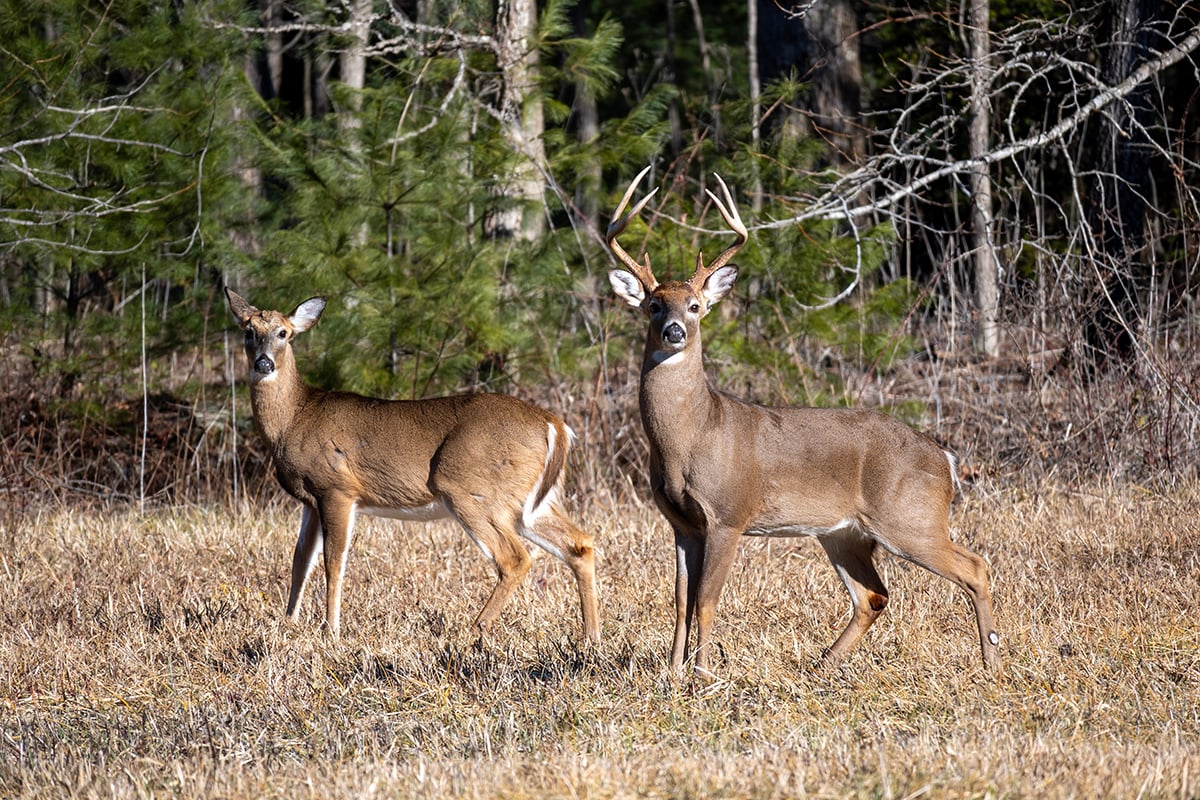
Note that stating an estimated “number” is little more than an indefensible guess, which is why biologists – scientists – shy away from listing them, however popular with the public and outdoors news media.
Ohio’s first modern deer hunting season was a shotgun-slug affair in just three southeast counties for a few days in 1943. It came after deer had been all but wiped out in the state by around 1900 by unregulated hunting and habitat losses and destruction.
Thanks to sound modern management, however, by the early 1970s an annual statewide gun season was allowed, with limited antlerless permits issued by county.
In any case, hunting antlerless deer was woven into the fabric of Ohio deer culture. Today you can take up to six deer statewide during a license-year, including three or four in most counties. But only one buck.
The trouble is most hunters quit hunting after killing one deer, occasionally two. McCoy says that the average runs 1.2 to 1.4 deer per successful hunter. One conclusion to draw is that hunters have become more selective, waiting on a buck during that long four-month archery season – and a good buck at that, not just any buck. The deer-take data confirm it, the biologist said.
Thirty years ago, most hunters took deer during “gun week” and they mostly killed whatever came by. A short season encouraged being less selective. A record 60,000 bucks were taken in 1995, when deer numbers were considered high, but the tally pales to the 100,000 bucks taken in the last season – a 68% increase, with fewer hunters afield.
Some of it is related to hunting tactics and style. When gun-week ruled the hunting roost 30 years ago, no one anticipated the astronomical expansion of archery hunting, including a seemingly unending, four-month-long season to an explosion of technological innovations – first the compound bow and then the crossbow.
Today’s typical deer hunter is toting a scoped compound crossbow, not a slug gun. Moreover, he sits in a treestand, often over a pile of corn or other bait, or a carefully planted food-plot. And waits. The days of hunting on your hind legs on large landscapes are all but a historical footnote, great fun though it was.
Come “gun season” today, that same hunter simply switches out his “stick-and-string” for a modern firearm, very often a scoped rifle shooting a straight-walled cartridge. All but gone are short-range smoothbore shotguns with rifled slugs, the mainstay of the ’80s, and arms-makers scratch their heads to improve shotguns into “rifles” for deer with ever-better saboted bullet loads in shotshells and rifled shotgun barrels.
Parallel developments have made the modern muzzleloading rifle nearly unrecognizable from traditional wood and steel sidelocks. The old short-range slug gun with just a bead front site occupies about as small a niche as archery hunters using longbows and recurve bows and shooting arrows fletched with turkey feathers.
Another part of the mix is changing demographics. In 1995, my hunting crew was anchored by four “old guys” in their 40s, their sons, and nephews. Today, I am the last old guy standing, and deer hunting. Death and aging infirmities took a toll.
The “boys” of 1995 have grown, married, or moved out of state, have demanding jobs and spouses, and their kids often more attracted to sedentary social media games or school sports than to hunting or fishing. With less leisure time than ever. Now the ranks of third-generation hunters – the boys of 2025 – are even thinner.
Biologist McCoy can show you extensive, solid scientific data, charts, and graphs that illustrate just that point. But it should be obvious; just look around. The results? A 20% decline in deer permits issued, and fewer deer hunters going afield.
Forestlands have matured in 30 years, with less deer cover. Landowners have taken to leasing to deep pockets rather than permitting free hunting to a polite “ask” at the back door. Baiting to hold “your” deer on your plot has become typical, as happened 40, 50 years ago in Michigan. Unregulated guides and big money after big bucks also are factors.
What to do? Perhaps create a “Doe-Nation Day” of antlerless deer hunting, with free or discounted permits and free transport of antlerless deer killed to processors for distribution to food pantries and such? Or set up a deer-processing facility at a state prison, with venison distributed to the needy?
Or knock a month off the archery season, ending it in early January with the end of muzzleloader season, to encourage hunters to fill tags earlier? Changing late muzzleloader to an any-firearm season? And how about an early any-firearms antlerless season, which would be popular with youth and seniors? These are among ideas floating around out there.
McCoy admits that a lot of them are “big asks” of hunters and managers. “It will require a bit of marketing and cooperation.”
But it’s a big problem. “We’ve been warning of (an overpopulation) crisis for the last four-five years. It’s setting off alarm bells. The writing is on the wall, and we’ve already crossed the red line,” McCoy said.
The biologist adds: “I appreciate a set of antlers as much as any person, but it’s become too important for many.” He’s right.
We need to get serious about tackling this issue. And to be bold with implementing sound if novel ideas, from the wildlife administrative level and rules-making Ohio Wildlife Council all the way to you, the average deer hunter. We all need to start thinking and acting like deer managers, not just deer (buck) hunters.
Advisory group to youths rebrands as Outdoor Mentors
A mentoring group has unveiled a shorter name as part of a shift in identity that includes a new logo
Dissecting why duck hunters are disappearing from Minnesota marshes
The decline in waterfowl and waterfowl hunters is apparent to most hunters. In contrast, I don’t see any obvious drop-off

Mike Schoonveld: Fishing via vintage reels
saw a post on social media recently made by a person who had found a box of old fishing reels

1 thought on “Steve Pollick: Time for Ohio’s hunters to act like deer managers, not just big buck hunters”
I’m a western Pa. non-resident and I stopped hunting in Ohio after the license went up to $260.00 to deer hunt and now is proposed to go to $400 later this summer/fall. There is no way you’ll see me pay that to harvest an antlerless deer.