




Crop damage caused by wildlife in Pennsylvania, particularly deer, has been at the forefront for years, yet a solution has yet to be found.
The Sunday hunting bill, which is also known as the “crop damage mitigation” bill in some circles, has language that attempts to fix the problem, but in reality it doesn’t even put a dent in the issue.
 Supporters of the bill claim it “streamlines” the process for dealing with crop damage, which is supposed to help. What it means is when deer are shot for crop damage, the farmer – or the designated person doing the shooting – can call the Game Commission to report the harvest and then take the deer to a processor.
It’s a change from having to wait for a game warden to show up to take the deer away, or check them before they go to a processor.
While the attempt to streamline the process sounds nice, it really doesn’t help. Crop damage is a serious issue to farmers – one that won’t be solved by streamlining anything.
Farmers need a solution, and there is one – but it’s not in the Sunday bill.
MORE COVERAGE FROM PENNSYLVANIA OUTDOOR NEWS:
Pennsylvania Game Commission mulls ways to address crop damage complaints
Pennsylvania’s Sunday hunting bill awaits House vote
Charges filed against three Chester County, Pa., men in huge deer poaching case
As of Oct. 11, the bill (Senate Bill 67) was pending a vote on the House floor, and that could’ve happened by the time you read this. The ability to self-report crop damage harvests and allow farmers to take deer directly to the processor overlooks one of the root causes of the issue.
That is, before a deer can be taken to a processor, the entrails have to be removed by the farmer or the person doing the shooting.
That’s a problem.
Deer can be shot for crop damage year-round, day or night. Summer is when most crop damage occurs, as deer love to feast on crops during the growing season.
If farmers are going to shoot deer to protect their crops, they’re going to do it prior to harvest, in the summer. The last thing a farmer wants to do after shooting deer in the summer heat is gut them out and wait for a game warden to pick them up.
Nor does a farmer want to transport a bunch of deer carcasses to a processor in the summer, if you can even find one willing to take crop damage deer shot during the hottest months of the year.
The requirement of gutting deer and taking them to a processor is burdensome and unrealistic.
If we want to get serious about streamlining the process for dealing with deer shot for crop damage, do away with the “gutting” requirement and provide an alternative to taking them to a processor.
And there is another option – one that is currently commonly practiced in agriculture.
Perhaps the best remedy to the crop damage issue is to let farmers compost the deer they shoot for crop damage. No more gutting deer in the summer heat, and no more wasting time trying to find and transport them to a processor.
Just bury them, let the carcasses degrade and eventually produce a composted fertilizer that can be spread on the fields, feeding the crops from which the deer used to feast.
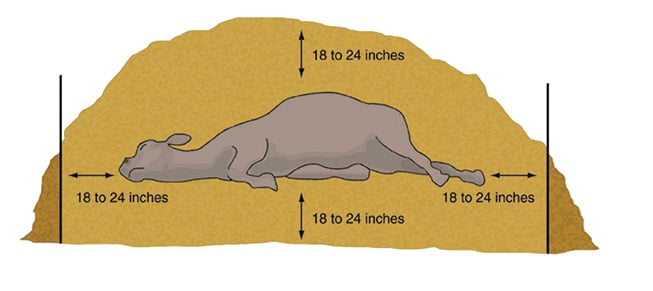
Composting is a proven option that farmers currently utilize for dead livestock, including cattle. Penn State Extension has drafted the steps for which to properly compost dead cattle, and it’s pretty simple. Ultimately, it takes 10-12 months for an entire cow to break down to the point where even the largest bones become brittle and easily crushed.
Allowing farmers to compost deer would provide them an efficient option that has been proven to work with other livestock.
And here’s another benefit: Pennsylvania law already allows composting as one of four options (in addition to rendering, burying and burning) for properly disposing of livestock mortalities. It shouldn’t be difficult to allow it for deer as well.
The Game Commission is already doing it – sort of – by disposing of roadkill deer in pits on game lands. But the utilization of composting is more beneficial because the carcasses aren’t left exposed in an open pit.
With composting, carcasses are buried in multiple layers of sawdust or wood chips and bedpack manure (laden with straw). The layers of high carbon sources heat up quickly, and the carcasses degrade almost completely in a matter of months into organic matter.
And that, organic matter can then be spread on fields as fertilizer.
But what about chronic wasting disease? Is it safe to spread compost created by deer carcasses that could have CWD?
It might be.
According to a 2016 report from The Center of Food Security and Public Health, Iowa State University, USDA and others, composting deer “may reduce or eliminate CWD and other prions,” and soil microorganisms could degrade prions in buried carcasses.
Ultimately, the best use of deer shot for crop damage is human consumption. No one wants the venison to be wasted. But there are times when it’s just not feasible to salvage crop damage deer.
And being required to do so, even during the hot summer months, is the biggest issue for farmers trying to address crop damage.
The process needs to be streamlined, but it won’t happen with the language in the Sunday hunting bill.
If legislators and the ag community truly want to make it easier for farmers to more effectively deal with crop damage, let them compost the carcasses.

Minnesota artist Bob Hautman wins federal duck stamp contest for fourth time
Minnesota’s own Bob Hautman, from Delano, won the 2026 Federal Duck Stamp Art Contest today with his acrylic painting of
Confirmed cougar makes an even dozen sightings over 25 years
A mountain lion was spotted moving through southern Illinois, and this time wildlife officials believe the big cat crossed west

Illinois bow season opens Oct. 1 with few changes
The DNR has floated the idea of establishing additional Restricted Archery Zones in other parts of the state, but this

1 thought on “Tom Venesky: Let Pennsylvania farmers compost the deer they shoot for crop damage”
There is the problem that CWD prions have been known to persist in the soil, having been detected early in syndromic characterization at Fort Collins. Composting won’t get rid of the prions.
https://pmc.ncbi.nlm.nih.gov/articles/PMC5584314/