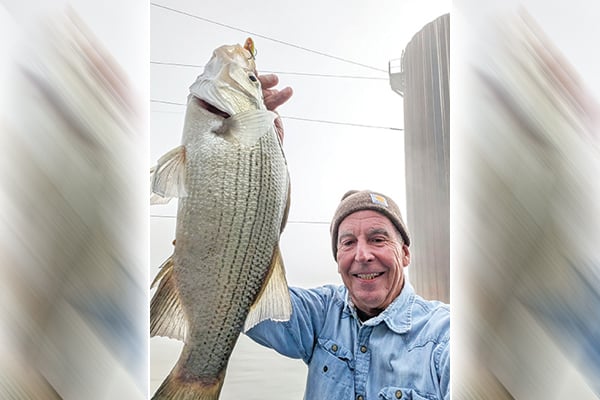
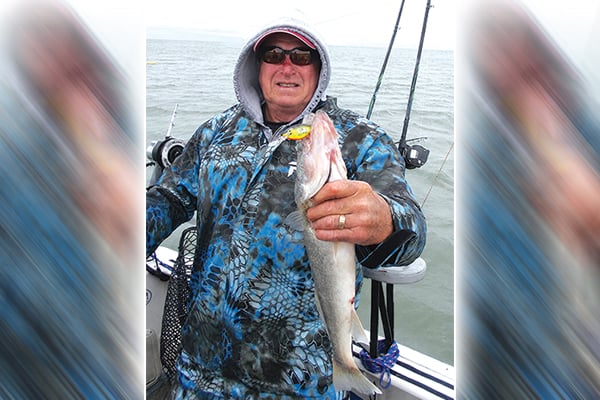
A quick conversation with Larry Michael is all you need to realize you are talking to a fishing-obsessed individual. He lives to go fishing.
Holding licenses for up to seven other states at any given time, an average year for him can mean 30 trips to lakes and reservoirs. And then there is the Ohio River, about 20 trips there is routine. As are 15-20 trips to Canada.
Michael started young, as many of us did. Six years old in his case. An older brother would take him to the nearby Little Miami River in southwest Ohio. The day he caught a smallmouth bass, his young life had just begun, but it was not quite the same after that. He had been hooked more than the fish.
From then on, he could not get enough. He taught himself by reading whatever he could get his hands on, wanting to learn more. He studied the work of Buck Perry, considered the father of modern structure fishing. Perry published books on spoonplugging in 1965 and 1973, followed by a nine-volume set for home study in 1981.
Before Perry, freshwater fishing away from the bank was not a common practice. Perry perhaps used his background in physics and mathematics to troll his spoonplugs over the bottom, to determine the shape of a lake, through changes in contour.
FISHING FEATURES FROM OUTDOOR NEWS:
Glenn Sapir: A little more qualified for that first job after decades hunting, fishing
Michigan’s November fishing: Anglers should try to capture ‘marina magic’
Understanding phases of the muskie and cisco autumn nexus
As the years passed, Michael became a multispecies angler. The smallmouth bass still holds a chunk of his heart, but if pressed to pick one species only for the rest of his life, it would have to be the muskie.
His fishing journey included a short stint in Florida as a bass guide. Then a guide on the Ohio River. It is here his expertise in multispecies angling soared.
Trolling is one of his specialties. If the works of Perry introduced him to trolling, the Ohio River showed him the benefits. He caught endless numbers of white bass, and all the other species living there, too. That was 40 years ago.
Not opposed to fishing for himself, he prefers to have a friend on board. Another interest is teaching younger anglers what he has learned.
He trolls about 60% of the time. As any who has been fishing knows, there are nuances to becoming good at a presentation. Trolling adds boat control to the presentation.
Michael’s beliefs in general often counter those of more popular opinion. Barometric pressure for one. Who does not expect poor catches when the barometer is high? Not him, he feels the barometer has nothing to do with fish behavior.
A high barometer does not shut them down, it just sends them deeper, 20 feet or more. Clear, high-pressure days mean nothing to him. Moon phases are another notion he ignores.
What concerns him is light intensity. He believes fish behavior is governed more by the inability for a fish to deal with sunlight in their eyes. A fish has two options after the sun rises: go deeper or go under something such as a log or undercut bank. Some species are not going to avoid direct sunlight by going under something. Instead, they head to deeper water where sunlight intensity dissipates.
Michael often trolls at a consistent depth, 8 to 10 feet. He finds the active fish at this depth. For this reason, he is on the water at dawn. The fish tend to be there first thing in the morning.
If he is trolling a breakline, he will run one rod at 8 feet and another rod at 12 feet. He does this to follow his most important rule, “Keep your line digging the dirt.” He is convinced there is nothing better than a lure banging the rocks and logs as it goes along, often triggering strikes when it does.
Bottom banging lures is not always necessary. Some fish suspend from time to time, such as the crappies he finds in lakes and reservoirs or the walleyes in Lake Erie.
Speed is not a concern, either, unless he is after crappies. The slower you go, the more crappies you catch, he contends.
The preferred tackle begins with a Johnny Morris Platinum series rod and reel; the 4000-reel spooled with Trilene XL, 14-pound test. He does not use planer boards.
His favorite baits include Money Badger, Flicker Shad, Frittside, and the Shad Rap (affiliate links). Favorite colors include perch, chartreuse, silver and black, and purple.
He looks for schools of fish, then trolls through the school. Some days require looking for schools of bait to do the same.
Often trolling until mid-November, it depends on the weather. After that, he often relies on vertical jigging until winter arrives.