




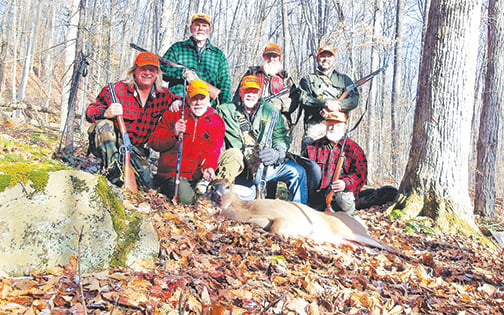
Late in the 2024 deer season our hunting party, the Iron Sight Gang, caught up with a beautiful 10-point buck toward the end of a very simple and relatively short deer drive.
There were only five of us that morning and a couple of the guys, both who were in their 70s or 80s, took watches not far from where the trucks were parked. Had the buck not circled back and ran straight into my cousin, Joe Stevenson – who was making the drive with me, it may have headed for one of these “veteran” hunters, as I like to call them.
That hunt prompted me to study the area in more detail, mainly in hopes of finding similar situations where we can move deer, and most importantly, keep these older guys and others who are less mobile, in the woods.
Looking at maps and aerial photos, I found another ridge nearby we’d neglected in the past, but one where any of our hunters who were less mobile could sneak into a stealthy watch with minimal effort while our more leg-worthy hunters could make the drive. We gave it a try in the afternoon on opening day of last year’s Northern Zone rifle season. No bucks were encountered, but we liked what we saw and tried it again a few weeks later, making a few adjustments.
MORE WHITETAIL COVERAGE FROM OUTDOOR NEWS:
New York’s youth deer hunters, mentors enjoy solid weekend
Solve for where the bucks are pre-rut, and tag out before the chaos kicks in
Ryan Rothstein: Knock, knock, knocking… on the door of whitetail prime time
Come Thanksgiving weekend, despite a handful of the gang hunting the Southern Zone, we had a solid crew. With three veteran hunters in the lineup that morning we decided to make both of the aforementioned drives. We never got to the second one, as a fine 8-pointer ran by Don Currie, who at age 75 shot his first buck since the 1960s. That fact alone was very gratifying, but so was having quick success on a newly-designed hunt.
For this coming season, we’ve got a third drive in the works nearby, which should be just as easy, if not easier, to pull off.
Let’s face it, many of us out there simply can’t travel the way we used to in the woods when it comes to climbing or even walking a considerable distance. Sometimes it’s age and the complications that come with it. Other times it’s injuries. Ironically, members of our crew are dealing with all of that this season.
If you’re hunting public land such as that in the Adirondack Forest Preserve, ATVs are not an option. Like many hunting groups, again, some of our long-time hunters are facing these situations, but they still want to be out there taking part in the action, as they should be.
Adjustments
Adaption is the key, and on different levels. First, the group, as a whole, needs to implement ways to make things work for less-mobile hunters. And they too, need to realize their limitations and adjust accordingly. Again, staying home and not hunting should not be the option.
We have a series of three productive Adirondack drives you could say lie in a triangular pattern that take nearly and an entire day to pull off. Getting to the watches on the first one is challenging, but doable for most of our crew, even the less mobile. It’s the second one that’s a bit out-of-reach. Therefore, a few of the guys will sit that one out. If we kill a buck on the second drive, these guys can quickly get back to the vehicles and pick us up at a more convenient location after our long drag. Otherwise, they’re already in position when we come back around to make the third drive. This makes for an action-packed day of hunting for all of us, and keeps everyone in the game.
A few years back while hitting these three hills, one of our senior hunters ventured a short distance into a valley and sat there while we worked the second hill. Not only did we kill a buck, but he had one come by him from another direction that he missed. The point is that the opportunity presented itself, and it would not have if he hadn’t made that extra effort to be there. The only regret is that he didn’t get the buck.
If you hunt private land, then using an ATV or UTV is a handy option. We do employ this in one of our areas, but it’s a rarity. Still, it’s fun to have a few guys hop into the UTV and get them to quality watches. From there, anything can happen and we’re still able to get some productive hunting in.
Yet another option is to just try something a little different than what you’re used to. There are two sizable hills we hunt by pushing one up from the road, and the other back towards it. What I’m suggesting to the crew this year is some changes that would put our less mobile hunters in position on both hills, especially the second one, and we slightly alter the direction of the drive and actually include more terrain. This would allow everyone to be part of both drives. There are also a few hills we push that if done in reverse would be much more accessible for the watchers.
Downsize
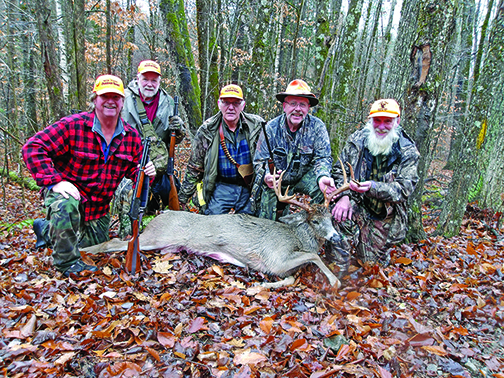
Having a smaller crew typically means smaller drives. Sometimes we’ll hunt small hills, like those where we killed the two aforementioned bucks, or, we’ll hunt parts of bigger drives. The latter might be the side of a mountain close to a road or parking area where a watcher or two can easily slide into position. The former is just a simpler and easier hunt, in general. The main thing is that we still focus on areas that we feel are holding deer, not just places to go because they’re easier to hunt.
Making smaller drives does require some stealth. You want to make less noise setting them up on both ends, and not push through too fast. Sometimes, just a few guys can be productive. We’ve had successful two- and three-person drives just by putting the watchers in the right place. I once pushed a beautiful 9-point buck to my brother on a drive that paralleled the main road. He only had to walk a few hundred yards to get to his spot. I later made the same drive to one of our older guys and it remains an ace-in-the-hole for such situations.
Yet another hunt I used to like to do with one of my elderly uncles was a circle drive. It’s been a while since I’ve tried this, but it involves slowly hunting – almost still-hunting – in a circle around one or two watchers. This is a common technique in states that have group size limitations. If you have an area you know deer like to head for when pushed, consider a circle drive with the watcher(s) in the right location such as near thick cover.
Finally, its not just elderly hunters or the walking-wounded that may need some consideration. Youth, women and any adult hunter who might not be accustomed to the walking and climbing that comes with mountain hunting shouldn’t feel overwhelmed. You may need to break them in slowly, or at least choose some easier pushes.
For all of this, where you hunt and what you have available for terrain will determine the options you and your crew have. The point is for hunters to again, not stay home or in camp, but to get out in the woods and be part of the day’s activities; and maybe even tag a buck. It won’t happen if you’re not out there, and when it does, there’s nothing better.
Video: Maximize your efficiency during the whitetail rut
Eric Morken just got back from his annual trip during the whitetail rut where he filled three buck tags with
Be aggressive when trying to tag a big-woods bruiser buck
It’s been tough sledding for deer hunters in northern Minnesota in recent years, although deer numbers seem to be creeping
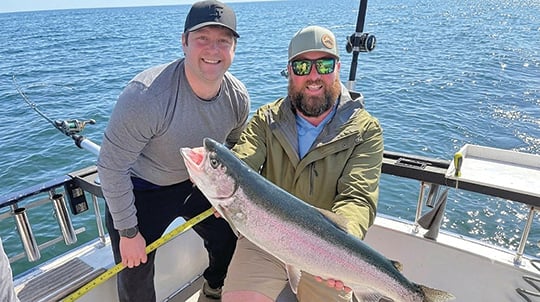
Bloomington angler tops Minnesota’s C&R steelhead record
Duluth, Minn. — Minnesota has a new steelhead catch-and-release record after Ryan Pierce of Bloomington reeled in a 33-inch fish
