Anchorage — Chris Andrews was working the belt at the Anchorage airport last fall, watching international cargo arrive.
“An employee said, ‘Hey, this box stinks, Chris,’” Andrews recalled.
The box was labeled “car parts.”
Other stinky boxes came down the belt. When opened, Andrews found they were filled with thousands of shark fins headed to Hong Kong, likely intended for shark fin soup. Eventually, officers confiscated 1,600 pounds of shark fins — from nearly 17,000 sharks — around the country. It was a major case, all linked to those first boxes Andrews found in Anchorage.
“We wouldn’t have gotten that shipment if it didn’t stink,” he said.
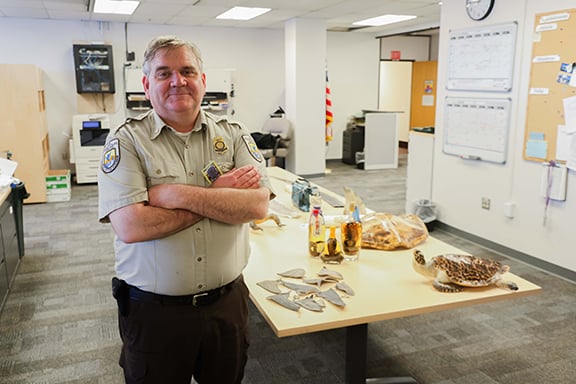
Andrews is a wildlife inspector for the U.S. Fish and Wildlife Service. He and his team are in charge of intercepting trafficked wildlife. They enforce international conservation treaties that protect more than 40,000 species and national laws like the Marine Mammal Protection Act.
It’s weird work, and he loves it.
MORE COVERAGE FROM OUTDOOR NEWS:
Commentary: The Roadless Rule is under attack
Ron Schara: How about dock owners pay for use over public water?
Josh Haiar: An interview with a South Dakota outdoors leader about upcoming priorities
They find things every day at airports and docks around Alaska. They’ve intercepted commercial shipments of designer bags made of crocodile or python leather and also ill-advised international souvenirs. Once, Andrews stopped a passenger carrying two taxidermied lizards, each as long as a skateboard. The passenger had walked off a plane carrying a big garbage bag over his shoulder. Andrews said the tails sticking out made him suspicious.
“I walked up to him. I was like, ‘Sir, what’s in that bag?’” he said.
The man didn’t have permits for the protected reptiles, so he had to give them up.
Live animals are less common, Andrews said. They find those maybe a dozen times a year.
“We had some monitor lizards that were smuggled inside speakers,” he said. “They put them in socks and, like, tried to conceal them inside speakers.”
Some of this traffic is driven by people trying to acquire specimens to complete unusual collections, Andrews said.
“I mean, we’re seeing cockroaches, we’re seeing pill bugs, we’re seeing ants,” he said.
The work is important for the preservation of ecosystems and protected animals, Andrews said. But the day-to-day work is fun for him, too. He never knows what’s going to be in the next box.
That also makes it terrifying.
“There’s these spiders out of India that are the size of dinner plates that are really aggressive,” Andrews said. “I hesitate every time I open a box, like, ‘Please don’t be the one!’”
Finding a live animal, Andrews said, creates a challenging, time-sensitive problem: “How do we keep this thing alive? Is it poisonous? Where does it come from?”
Like the day they found 400 baby turtles smuggled inside of a pair of snow boots, Andrews said. There were 12 different species.
“I didn’t know what they ate,” Andrews said. “I didn’t know if they liked heat. I didn’t know if they liked water. I was in here with a terrarium book, just trying to figure out what they were.”
It’s not what he expected when he took a job with the U.S. Fish and Wildlife Service. He studied forestry in college.
“It was a wildlife position in Alaska,” Andrews said. “I thought I’d be dealing with, you know, bears and moose. I’ve never dealt with a moose.”
Three decades later, the job still excites him. But his teenagers are bored of the work stories he brings home.
“Sometimes I think, ‘Oh yeah, they’ll love this one!’” he said. “And then they’re just, you know, ‘OK, yeah Dad, another dead monkey or whatever you found.’”
Andrews said his team can sometimes put confiscated goods to use. A few years ago, the department intercepted 10 electric guitars made of protected Brazilian rosewood. Now those guitars are in the possession of Anchorage School District jazz bands. But it’s often not that easy.
“What do you do with 50,000 shark fins?” he wondered.
This story was originally published by Alaska Public Media and distributed through a partnership with The Associated Press.