




Home » National Hunting » National Elk Refuge CWD discovery calls for talk of reducing nation’s largest herd
National Elk Refuge CWD discovery calls for talk of reducing nation’s largest herd
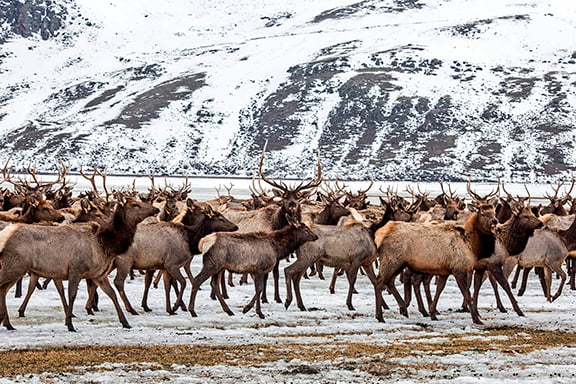
Jackson Hole, Wyo. — The discovery of chronic wasting disease on the National Elk Refuge in Wyoming adds urgency to a 2021 plan to reexamine the size of the 11,000-strong Jackson Elk Herd, the nation’s largest migratory herd.
The discovery also raises questions about the annual Scouts’ antler collection and auction, other traditions and practices, and even the safety of nearby Jackson’s water supply.
The diagnosis of CWD came after officials killed an ailing cow elk on the refuge just north of Jackson on April 15. Field workers sent biological samples to a Wyoming Game and Fish Department lab, a second lab confirmed the results, and federal and state officials announced the infection Monday.
The lab results document the first case of CWD in an elk on the refuge. Game and Fish tested 50 hunter-harvested elk from the refuge in 2025 and 14 elk that died after the hunt.
“National Elk Refuge staff will increase monitoring and surveillance of herds for CWD, re-evaluate some existing programs and implement additional bio-security protocols to keep people and wildlife safe,” the U.S. Fish and Wildlife Service and Wyoming Game and Fish Department said in a joint statement last week.
MORE COVERAGE FROM OUTDOOR NEWS:
Professor uses underwater drone to study river reef on Monongahela River near Pittsburgh
New Minnesota muskie plan puts an emphasis on bettering existing fisheries
Despite dip from 2025, Minnesota turkey hunters on pace for top-three harvest
The disease is now embedded in what Game and Fish called “one of the largest and most well-known elk herds in North America … that holds significant ecological, cultural, and economic value for Western Wyoming.”
Concentration of elk at feedgrounds is believed to promote the spread of CWD. The National Elk Refuge supplies supplemental feed to wintering elk and Wyoming Game and Fish operates 21 of its own feedgrounds west of the Continental Divide, stretching from the Gros Ventre River drainage to the southern end of the Wind River Range.
Environmental activist Lloyd Dorsey, who has lived for 50 years in Teton County surrounded by elk feedgrounds, acknowledged foreboding as he tracked the disease over decades from its epicenter in Fort Collins, Colorado, and the Laramie region.
“It is not unexpected, of course,” he said of CWD’s arrival on the National Elk Refuge. “But it’s a shame that the wildlife management agencies allowed the feeding programs to continue this long when they could have, should have, been phased out long, long ago as they were virtually almost everywhere else in North America.”
State and federal officials did not immediately answer questions about whether the discovery so close to Jackson threatens the town’s water supply. The municipality draws drinking water from several wells on the south end of the refuge, where officials said the ailing elk was identified and euthanized, in accordance with protocol.
Always fatal
The always-fatal neurological chronic wasting disease is caused by a malformed protein known as a prion. It is easily transmissible among ungulates; the prions persist in the environment and are only destroyed by very high temperatures or precise application of chemicals, including bleach.
It is akin to Creutzfeldt-Jakob’s disease in humans. Although there’s been no confirmed case of CWD infecting a human, scientists suspect it could jump the species barrier just by a person consuming the muscle meat of an infected animal. Scientists warn against eating infected game.
Dorsey called continued feeding “the height of malfeasance and irresponsibility.” Game and Fish operates its feedgrounds to ensure an abundance of elk for hunters, to separate elk from cattle that could be infected with brucellosis and to keep elk off private property and highways.
Wyoming’s elk feedground program is unique to three counties, generally drawing several hundred elk to each feedground site. As winter begins, feeders, often in horse-drawn sleighs, dole out hay that’s been stacked in anticipation of snow.
Before the feedground program and development of ranches in western Wyoming, elk from the greater Yellowstone area would migrate to natural wintering grounds — frequently windswept hillsides and often desert country south of Jackson Hole.
This winter, the National Elk Refuge biologist Eric Cole reported a high count of 6,970 elk on the 24,700-acre refuge. Because of a lack of snow, refuge workers did not dispense supplemental feed to the herd, one of 11 winters since 1912 when no feed was distributed.
The bulk of the Jackson Elk Herd winters on the refuge. Although CWD was detected in an elk from the herd that was killed in Grand Teton National Park, the disease has now crossed the Rubicon that is the Gros Ventre River, and having arrived on the refuge, will prompt new action.
State and federal officials were not available for interviews but pointed to the refuge’s response strategy adopted in 2021. The strategy calls for the federal agency to request that Wyoming consider decreasing the state’s population objectives for the Jackson herd.
The plan also recommends that the agency review the traditional antler collection on the refuge taken on by Scouting America scouts – previously called the Boy Scouts – and the sale of some 8,000 pounds of antlers annually. This year, Scouts took to the field on April 18.
“Considerations should be made for antler material entering medicinal or food chain,” the strategy states.
Some antlers are used as nutritional supplements, others are crafted into buttons and other items and also sold as chewies for dogs.
Under the refuge strategy, hunters who use horses need to pick their horses’ hooves before the animals are trailered off the refuge. Other measures call for using protective personal gear and incinerating parts of elk that die on the refuge.
News of the refuge infection comes as Wyoming Game and Fish detected CWD at the Muddy Creek feedground at the southwestern end of the Wind River Range. The agency announced that discovery May 4, making Muddy Creek the fifth state feedground where the disease has been discovered.
The agency detected the disease in a grid search for elk skulls containing testable brain matter conducted after the end of the feeding season.
The agency first discovered CWD on a feedground in 2024. The disease was discovered first in a deer at a wildlife lab in Colorado in 1967 and is a type of transmissible spongiform encephalopathy.
Story by Angus M. Thuermer Jr. Rebecca Huntington also contributed to this story, which was originally published by WyoFile and distributed through a partnership with The Associated Press.
SUBSCRIBER CONTENT
Read this article now.
Create a free Outdoor News account.
Create a free account below to get instant access to this article, thousands of Outdoor News stories, and our digital editions. Your 1-month trial starts the moment you sign up.
No credit card required
No credit card required
Subscriber? Login Here.
Share on Social
Hand-Picked For You
Lake Amelia’s walleyes stealing the panfish spotlight in this Pope County, Minn., water
Minnesota’s Outdoor Calendar
Minnesota Cuffs & Collars: Buck, geese left to waste near Northome
Steve Carney: Getting lost after a bowhunt… the sequel
Minnesota Mixed Bag: Apply now for annual Outdoor News Foundation scholarships
Minnesota Letters to the Editor: We need more sandhill crane hunting in state
Related Articles

Lake Amelia’s walleyes stealing the panfish spotlight in this Pope County, Minn., water
Pope County’s Lake Amelia is the southern-most basin in a chain of three lakes, which includes lakes Levin and Villard.
Minnesota’s Outdoor Calendar
A look at upcoming outdoor-related events from across Minnesota published in the Oct. 16, 2026 edition of Outdoor News.

Minnesota Cuffs & Collars: Buck, geese left to waste near Northome
Minnesota cuffs and collars are field reports from DNR conservation officers. These reports are from the Oct. 16, 2026 edition
