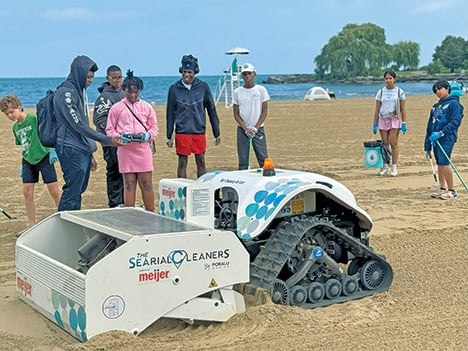
Cleveland — Ohio Sea Grant recently completed another successful season deploying its trash-trapping robots – BeBot and PixieDrone – through partnerships with the Great Lakes Plastic Cleanup (GLPC) and funding and support provided by Midwest retailer Meijer.
From April to October 2025, Ohio Sea Grant worked with several partners, including Cleveland Metroparks, Cuyahoga Community College Youth Technology Academy, Eriesponsible, and Ohio Clean Marinas, to deploy the BeBot and PixieDrone to clean up marine debris across Ohio’s Western and Central Lake Erie basins. Through this work, 856 identified pieces of debris were removed from the coastline.
In 2025, Ohio Sea Grant reached more than 1,700 people at 17 different outreach events focused on BeBot and PixieDrone. Eight of those events included beach cleanups, with 754 student and adult volunteers assisting in cleanup efforts throughout the course of the season. Ohio’s BeBot was also officially named Sir Cleans-A-Lot through a community naming competition sponsored by Meijer.
MORE COVERAGE FROM OHIO OUTDOOR NEWS:
Ohio Insider: DNR Director joins anglers in an opportunity to ice fish Mosquito Creek Lake
Much-anticipated walleye runs underway on Ohio rivers
Ohio conservancy marks 80,000 acres preserved
The Great Lakes Plastic Cleanup (GLPC), a joint effort between Pollution Probe and the bi-national Council of the Great Lakes Region (CGLR), is the first-of-its-kind using innovative technology to quickly remove plastic litter and marine debris at sites across the region, including Lake Erie. The litter collected was analyzed and categorized throughout the season, and the valuable data collected will be published to the GLPC website and used to identify litter sources and pathways, helping to protect the Great Lakes region, now and for future generations, according to Ohio Sea Grant.
The Great Lakes region makes up 84% of North America’s surface freshwater, providing water for more than 40 million people, and habitats for thousands of species, many unique to the region. Keeping this vital water resource clean and free of litter is essential, yet the Great Lakes face an alarming waste and plastic litter issue. Models estimate as much as 22 million pounds of plastic could be entering the Great Lakes every year through a variety of sources and pathways, polluting the lakes and their surrounding watersheds – something that will cost hundreds of millions of U.S. dollars annually to combat.
The technology deployed as part of this important work includes the BeBot and the PixieDrone. The BeBot is a 100% electric, eco-friendly beach cleaning robot that mechanically sifts sand, rakes seaweed, and levels sandy areas to remove plastic waste and other debris without harming the local environment, Ohio Sea Grant says.
The PixieDrone is a floating, remote-controlled mobile waste collector. The PixieDrone targets floating waste in all forms: organic, plastic, glass, metal, paper, rubber, etc. This drone can be operated in salt, fresh, and brackish waters.
The first retailer to support this beach and water cleaning technology in the Great Lakes, Meijer is proud to preserve the many vital waterways within its six-state footprint and first announced its partnership with the CGLR in 2022 with the deployment of the BeBot and PixieDrone. Since 2022, Meijer has donated nearly $2 million to the charitable arm of Council in the United States, the CGLR Foundation, to expand deployment of two types of innovative litter capture and clean-up technologies, the BeBot and Pixie Drone, to 18 new locations along Michigan, Ohio, and Wisconsin lakeshores as part of the council’s Great Lakes Plastic Cleanup Program.