




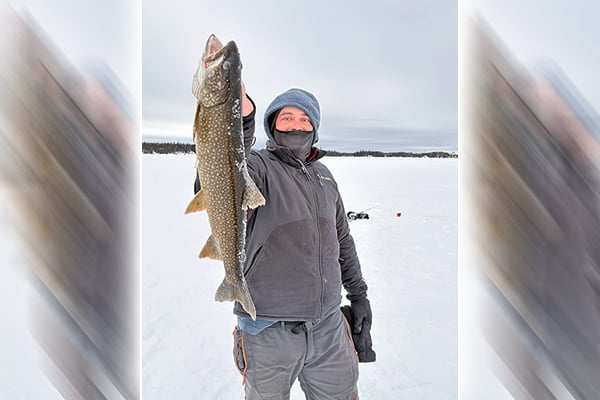
Gunflint Trail — He prefers the role of camp cook.
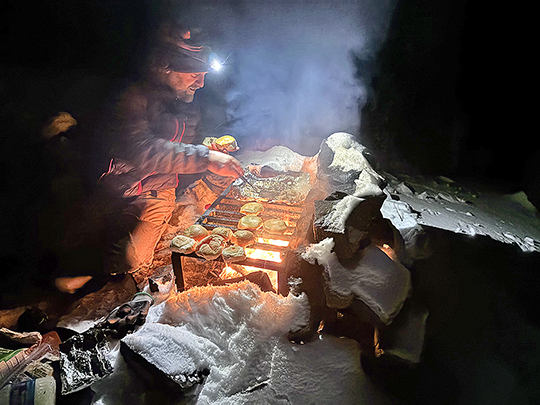
As we fish for lake trout, he’ll be mashing burgers and preparing them for the fire grate later that evening. Onion is the key, he’ll say. And a good bed of coals from a fire built with cedar collected in the surrounding forest.
“We need a glowing bed of coals,” he demands.
His name is Kyle Busacker, though we know him in our circle of Boundary Waters fishing enthusiasts as “Oregon Bill.” He travels more than 1,500 miles every January to go winter camping in the Boundary Waters Canoe Area Wilderness.
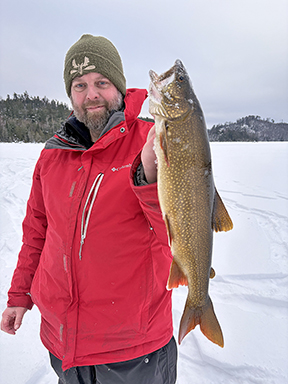
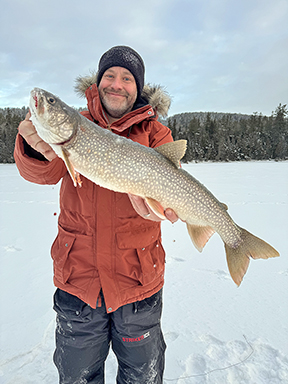
It’s here in the deep, clear lakes that lake trout swim. Lake trout are the king of all fish targeted by ice anglers on the border lakes, including many found in the BWCA Wilderness.
Located in the far reaches of northeastern Minnesota, the BWCAW offers the most rugged ice-fishing experience an angler can find in the state. The lake trout season runs from Jan. 1 to March 31 in the wilderness.
These aggressive predators swim in lakes nearly 200 feet deep, though we find most of our fish in the winter in about 30 feet of water. “Stay shallow” is something we practice when it comes to catching trout in the winter. It’s not uncommon for us to catch trout in 10 feet of water on BWCA lakes in the winter.
We use white or chartreuse tube jigs on the end of a simple rod and reel that can be found at any place that sells decent tackle. We fish with orange paddletails tipped with a minnow head. We use live fatheads under tip-ups. We carry Vexilar FL-8 SE models.
Our gear and approach to fishing lake trout is simple. And it works.
RELATED STORY:
Want to try winter camping? Here’s the must-have gear and knowledge to make it a great experience
Don’t overthink how to catch lake trout in the BWCA. The fish are out there and they are aggressive. They chase your lure and fight with tenacity. Their meat can be white like a pike or orange like a salmon. They’re delicious, and can be smoked, grilled, baked, or fried.
Our first trip this winter started Jan. 2 on Clearwater Lake. We traveled – some members of our group prefer snowshoes, others backcountry skis – about 6 miles across the massive lake, crossing the wilderness line along the way. The trout season on Clearwater didn’t start for another two weeks, as it is only partially inside the wilderness.
We then portaged to a lake nearby and continued for several more miles before finding a suitable site and spot to chase lake trout. This is where Oregon Bill found himself cooking burgers on a cold January evening, the coals finally glowing to his satisfaction.
“Medium or medium-rare on the burgers OK with you boys?” he inquired.
Indeed.
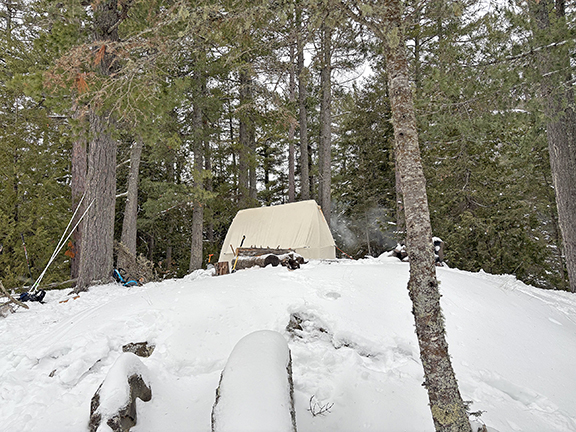
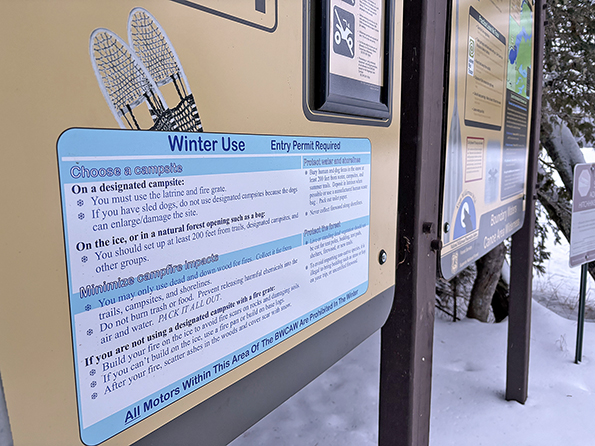
We camp in Snowtrekker hot tents in the wilderness. The canvas wall tents are ideal for the cold nights of winter, and there have been plenty of those to start 2026. A hot tent while winter camping in the BWCA also helps to dry out and warm your fishing gear. Frozen spools of line on the reel or a tip-up make for a hard start to the new day in the backcountry.
Such a tent is also key when it comes to good conversation during the long nights. Cold campers often are cocooned away by 7 p.m. during the winter. Unacceptable, particularly when someone like Oregon Bill travels across the country to be here.
MORE ICE FISHING COVERAGE FROM OUTDOOR NEWS:
Examining the finer details of tip-up fishing
Hit the road for big trout, other species at these ice-fishing destinations
Ice fishing for Minnesota lake trout… where patience actually pays off
It’s more than fishing on these trips. It’s about camaraderie at the campsite.
You don’t get to hear visitors from the West tell stories of catching trout on the Metolius or Deschutes back in central Oregon when you’re buried deep in your sleeping bag shivering through the night in a cold tent. That’s survival. It doesn’t need to be that way.
And while lake trout are indeed the primary target for our group, brook trout are high on the list too. We’ll be happy with a walleye early in the season. Sometimes a rogue pike or whitefish will take a minnow dangling beneath one of our tip-ups. That’s fine. We keep a few fish to eat a meal or two, but mostly we’re out here for the experience.
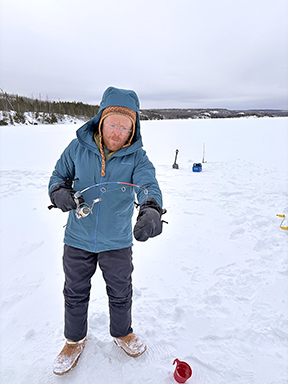
Our second trip of the winter took place Jan. 30 and carried over into the start of February.
Duluth writer Ryan Rodgers joined this expedition. Rodgers has a new book coming out this year about Minnesota paddlers who travel to the Far North, places like the Barren Lands of Canada and the Northwest Territories and Hudson Bay. The name of the book is “Where the Green Light Shines.”
Rodgers isn’t much of an ice angler, but he was curious enough to join our fishing crew on a lake at the end of the Gunflint Trail for this adventure. We fished in 45 feet of water for most of the trip, catching some beautiful lake trout over the course of a few days. We ate steaks cooked over glowing coals and explored a nearby island in search of the oldest known cedar trees growing in the Boundary Waters.
A fishing trip to the BWCAW during winter isn’t about how many fish you catch, though it’s likely you’ll catch plenty if you follow the advice of keeping things simple. It’s about the experience of sharing a challenge with a group of people.
It’s a place where anglers of different political persuasions can work together to determine if the trout are hitting better at 30 feet suspended in the water column or if they are hugging the bottom of the lake.
Oregon Bill knows this. He has two children and his wife, Rachel, and they never travel to the wilderness on these adventures. They support him though, all the same.
They understand that he more or less requires these BWCA winter trips as part of an annual routine of some kind. It’s the glowing coals that matter the most, he says.
That’s what this is all about.

Why fall walleye fishing is a different game – video
Five tips for catching those fall walleyes, and now.
Mike Raykovicz: Add purslane to the list of nature’s bounty worth foraging for
Foraging goes back for as long as man has inhabited the earth. I’m a forager of sorts and I’ve searched
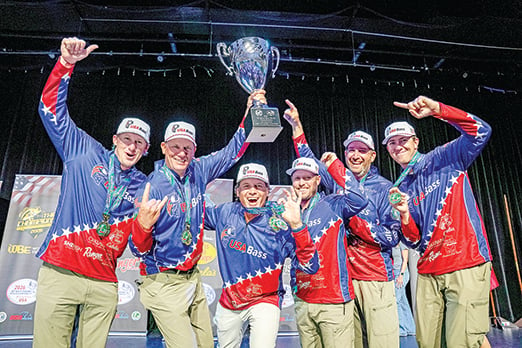
USA Bass Team hooks second straight title at World Championship
The USA Bass Team cruised to its second straight gold medal at the 20th World Black Bass Championship, which was
