




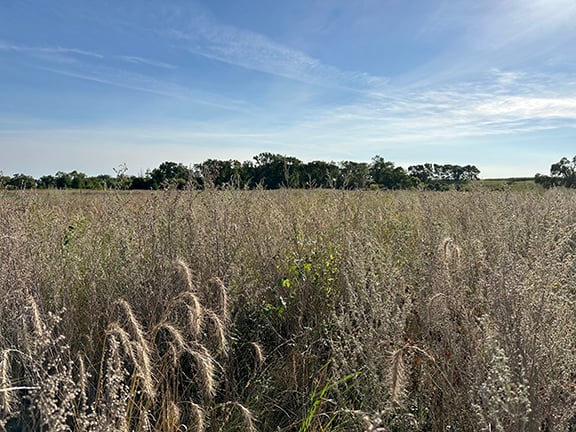
St. Paul — U.S. House Agriculture Committee Chairman Glenn Thompson (R-Pa.) informed his Republican colleagues that he hopes to mark up a new federal Farm Bill the last week of February, a development that has national conservation officials cautiously optimistic that a new bill could pass this year.
The blueprint is expected to be similar to the bill approved by the agricultural committee in spring 2024, conservation officials say. It included language for what’s been described as a modern version of the popular Conservation Reserve Program (CRP), as well funding for other conservation initiatives important to hunters, anglers and conservationists.
“Passing a full, long-term Farm Bill is critical for America’s farmers, ranchers, and rural communities,” said Andrew Schmidt, director of government affairs for St. Paul-based Pheasants Forever and Quail Forever. “Now more than ever, the programs authorized in the farm bill’s conservation title are a vital part of the economic and ecological safety net for rural America.”
Farm Bill history
Roughly every five years, Congress has passed legislation that sets national agricultural policy in several areas, including “titles” for programs on nutrition assistance, crop subsidies, trade and farmland conservation.
The Farm Bill, conservation officials say, is the single largest annual investment the federal government makes in land and water conservation. The voluntary CRP has been a boon to hunters and conservationists in particular. The program pays agricultural producers annual rental payments to idle environmental sensitive areas and plant them to grass.
Conservation officials say the program has created wildlife habitat and improved water quality and soil health, while supporting rural economies through hunting and other outdoor recreational activities.
But a new Farm Bill has not been passed since 2018. That bill expired in September 2023. One-year extensions have been passed ever since. The current extension runs through the end of September.
MORE COVERAGE FROM MINNESOTA OUTDOOR NEWS:
Will hook-and-bullet issues get lost during Minnesota’s 2026 legislative session?
Minnesota DNR’s electronic licensing revamp expected to go live this spring
White Earth, Minnesota DNR enter accord on managing White Earth State Forest
Schmidt said the most-recent Farm Bill extension was needed to keep CRP, which is administered by the federal Farm Service Agency, operational and accepting new enrollments through September 2026. In fact, a general signup by FSA last year accepted 1.8 million acres into the program.
That, Schmidt said, “effectively brought CRP to full enrollment,” at 27 million acres nationwide. However, another 1.5 million is set to expire this year, including acres in Minnesota. The state currently has roughly 963,000 acres enrolled. However, tens of thousands of CRP acres are set to expire annually over the next several years, including roughly 82,000 acres by the end of September.
The expirations have conservation officials calling for a new general signup this year. “We’re hopeful the FSA will announce something this spring,” said Schmidt, of a new CRP signup. “We’ve had productive dialogue back and forth.”
New CRP
But for Schmidt and other conservation officials, a new Farm Bill should include a new modern CRP in its conservation title. In fact, it’s a top priority for several conservation groups, including PF and QF, Delta Waterfowl, and the Theodore Roosevelt Conservation Partnership.
Schmidt said provisions in the bipartisan CRP Improvement and Flexibility Act, introduced last year by both the House and Senate, provide the framework for a new CRP. Schmidt said it would make the program more attractive to private landowners by making rental rates more competitive and increasing flexibility for emergency forage use in times of drought. It would also provide cost-share funding for contract maintenance and adjust payment limitations to account for inflation and changes in land values.
“By law, landowners and producers enrolled in CRP cannot receive more than $50,000 in rental payments in a year,” said Schmidt. “This number has not changed since CRP was first authorized in 1985. The CRP Improvement and Flexibility Act would increase this limitation to $125,000… providing landowners with more CRP enrollment options for their operations.”

Access program
Another priority for conservation groups is the Voluntary Public Access and Habitat Incentive Program (VPA-HIP), a federal grant initiative administrated by the Natural Resources Conservation Service (NRCS) to help states start or strengthen walk-in access programs nationwide.
For example, Minnesota’s state walk-in access program began in 2011 with a $1.67 million federal grant, which covered roughly 9,100 acres on 87 tracts of private lands. During the past few years, program enrollment has hovered around 30,000 acres. The Minnesota DNR pays landowners roughly $18 an acre to participate. The program is funded through state dollars and grants from VPA-HIP, among other sources.
Last year’s One Big Beautiful Act provided $70 million for VPA-HIP. Conservation officials asked for $150 million, a shortfall they hope to remedy in a new Farm Bill.
“It’s the only federal program designed to provide public hunting access on private land, and access is always cited as a major obstacle for hunter recruitment and retention,” said Aaron Fields, director of private lands conservation for the TRCP. “The good news is that there is wide bipartisan support for VPA-HIP.”
John Devney, chief policy officer for Delta Waterfowl in Bismarck, N.D, agrees. “It would be difficult to find anyone who doesn’t like the program,” he said. “It has the flexibility so individual states can tailor their own programs the way they see fit.”
Conservation group leaders are also keeping close tabs on Swampbuster, a wetlands-protection provision authorized in every Farm Bill since 1985. The provision, which farm groups generally oppose, appears safe in the House bill, at least for now.
According to published reports, the full House could vote on a new Farm Bill before the Easter holiday recess. The Senate Agriculture Committee, meanwhile, has yet to schedule a Farm Bill markup.
Schmidt and other conservation officials say they the need the help of hunters and anglers to get a new Farm Bill passed.
“Contact your elected officials and make your voice heard,” Schmidt said. “We’re fighting for polices that support working lands and agricultural operations… that deliver quality habitat and access on the ground for hunters and other outdoor recreationists.”
Tori J. McCormick can be reached at torimccormick33@gmail.com.

USFWS announces new duck season framework process
The Department of the Interior recently announced that the U.S. Fish and Wildlife Service (USFWS) is finalizing a streamlined process
Making sense of this year’s waterfowl report for Ohio hunters
For some duck hunters, the early September U.S. Fish and Wildlife Service (USFWS) annual fall waterfowl flight forecast is an

WI Daily Update: State stamp contest winners announced
Three Wisconsin artists have earned a place on the 2027 turkey, pheasant and waterfowl stamps. Here are the winners and
