




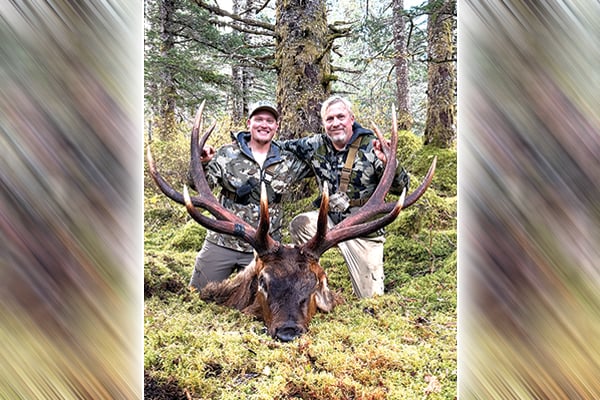
Afognak Island, Alaska — A day after traveling from Minnesota to Afognak Island in Alaska for the opening day of hunting for Roosevelt’s elk on the island, Chase Parker, of Barnum, took down a 6-by-6 elk.
And it wasn’t just any elk. The animal’s rack scored 313-5⁄8 inches, making it a contender for the Boone & Crockett Club’s highest-scoring Roosevelt’s elk from Alaska.
Official Boone & Crockett measurer Carey Ferrell said that once B&C accepts the measurement, Parker’s elk will unseat the previous Alaskan Roosevelt’s record-breaker of 291-5⁄8, set in 2016.
Parker’s elk is also set to beat out another 2025 harvest that scored a few points lower. The current B&C world record Roosevelt’s elk is a bull harvested by Timothy Carpenter in Humboldt County, California, in September 2023, scoring an official 455-2⁄8 points.
According to the Alaska Department of Fish and Game, two subspecies of elk have been introduced to the state. Roosevelt’s elk are larger, slightly darker in color, and have shorter, thicker antlers than do Rocky Mountain elk.
The hunt
After securing a tag through a lottery system in February of 2025, Parker and his hunting party that included Lucas McLeod and Isaiah Johnson researched the species, previous similar hunts, and that region of Alaska during the months leading up to the trip.
The time arrived in early October. While they planned to arrive two days before the opener, the trio got to the island one day prior due to a travel delay.
Following an early start before sunrise on the opener, adorned with headlamps, the trio hiked to a nearby peak, where they had seen elk on their flight to the island the previous day. In Alaska, hunters may not hunt on the day that they fly into an area.
Spotting the Roosevelt’s elk from above gave them a lead on an island they had been researching and remote-scouting for months. And while that hunch to approach that location on the mountain seemed like a good idea, the trio ascended and descended the peak empty-handed.
“We found out that, living in Minnesota, doing the training that we try to do – hike in the hills, the ravines – was nothing that the terrain on Afognak could prepare us for,” Parker joked.
MORE BIG GAME COVERAGE FROM OUTDOOR NEWS:
From Alaska to Africa: Bucket list hunting adventures to target for 2026 and beyond
The story of the heaviest bear taken during Pennsylvania’s 2025 season
Remembering the first modern bighorn hunt in North Dakota 50 years later
Once they got to flatter terrain with minimal action coming from bugling, Johnson decided to go back toward camp to grab his bow to potentially harvest Sitka black-tailed deer, for which they also had tags.
“We split up, and me and Lucas started walking this game trail that we found, and we’re walking, not even two or three minutes of us splitting up from Isaiah, we walk up on this elk,” Parker said.
Not anticipating the surprise, McLeod grabbed Parker’s gun, which was attached to his pack, and in a matter of minutes, the pair discerned it was a bull, and Parker shot it from about 50 yards away.
“All you could see clear as day were his vitals and the tip of the antlers, but you couldn’t really see how big it was,” Parker said.
Parker and McLeod realized how big the elk was at different moments.
After Parker shot it, they watched it take a few steps and then go down in thick brush.
They waited for about 30 minutes before Parker approached it. As he approached, it lifted its head.
“I was just like, oh my gosh, OK this thing is huge. … Just kind of speechless,” Parker said.
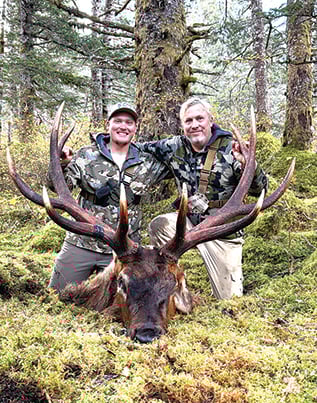
It started to walk away again, and Parker lined up another shot that took it down for a final time in a more open, mossy area.
“We’re like, this could not have been a better scenario,” Parker said.
They were excited but quickly realized they’d probably need Johnson’s help handling the animal because of how big it was.
“We’re trying to move it so we can get at it to start gutting it out, quartering up, and process the animal. We were so tired, we both look at each other and we’re like, we are not going to be able to do this, just us,” Parker said.
So, Parker went back to camp, which was about a half-mile away, as McLeod began field-dressing the elk.
“It literally looked like the size of a moose, like a bull moose. It was such a huge body,” McLeod said.
The size of the trophy elk really sunk in when they were extracted by the bush pilot two days later, who was also dropping off another party of Roosevelt elk hunters.
“The pilot and the three hunters had all done this hunt multiple times before. We saw the look on their faces – that’s really when it was validated – this is a big elk,” McLeod said.
He added that the bush pilot, Willy Fulton, who has been operating in the area for decades, said he had never flown anyone who had taken such a large Roosevelt elk.
McLeod is Johnson’s uncle and lives in Homer, Alaska, where he co-owns and operates Bear Cove Retreat and a fishing guide service in the area. So even though he wasn’t the one who harvested the animal, being a part of the hunt was meaningful.
“The look on their faces and how excited they get, and all of those emotions. I wouldn’t trade that for the world,” McLeod said.
Once all three were at the kill site again, they worked to field-dress the animal but lost daylight fast and didn’t finish butchering it until about 10:30 p.m. After a long day, they left the carcass where it was and hoisted their packs full of meat into trees, hoping no bears would come by for a meal overnight.
“We’re looking around, there’s no bear sign. Nothing was touched,” Parker said.
A day earlier on their trek up the mountain in search of elk, they had encountered a Kodiak bear – so they knew bears were in the area, and it was a relief everything was where they left it the following day, they said.
Once the animal was harvested on opening day of the season and getting picked up a few days later, the trio went to McLeod’s cabin near Kodiak, where they spent some more time hunting black-tailed deer.
While this was the first time the three of them had hunted elk, they say they’re going to pass on applying for the lottery next year and instead will focus on a different Alaskan adventure.
“The three of us are planning this big caribou hunt out on the Alaskan peninsula this fall,” McLeod said.
Michigan DNR clarifies rule changes in effect for trout, salmon, sturgeon
Michigan anglers have some additional fishing regulations to keep in mind this fall after the DNR clarified several changes that

Michigan Letters to the Editor: There are some advantages of the Roadless Rule removal
Reader-submitted letters to the editor published in the Sept. 25, 2026 edition of Michigan Outdoor News.
Ralph Loos: Michigan’s reliable hunting traditions got an update (upgrade?) this season
More than any other collection of like-minded individuals, hunters tend to get stuck in their ways — and I say
