





Springfield — DNR fisheries biologists are collecting live Christmas trees to be used as fish habitat in local lakes. Several sites around the state have been designated as drop off points, and each have detailed deadlines and instructions. A list of the sites can be found on the DNR website.
The collected trees will be bundled together, weighted, and submerged at lakes, providing critical habitat for multiple fish species and promoting algae growth for insects that attract fish for anglers.
Maps and coordinates of the tree habitat locations putting the donated trees to use are also available on the DNR website.
Trees donated to the program must be free of stands, lights, ornaments, and tinsel. Wreaths and garlands will not be accepted.
MORE COVERAGE FROM ILLINOIS OUTDOOR NEWS:
No bighead or silver carp discovered during fall monitoring in Chicago Area Waterway System
Black carp $100 bounty program expanding to cover more waters
Ralph Loos: Deer meat, deer urine getting own (but separate) spotlight
IMTT Awards Scholarships to Fisheries Student

Macomb, Ill.— Olivia Salrin, a technician at the Illinois River Biological Station and a graduate student at Western Illinois University, has been awarded a $1,000 scholarship by the Illinois Muskie Tournament Trail. The IMTT Board announced the award after its annual meeting in December.
Salrin, who is studying biology and focusing on river ecology studies at WIU, has been working on a project using IRBS data from monitoring programs to help inform management of invasive carp in the Illinois and Mississippi rivers
In all, the IMTT awarded $2,000 in scholarships. Along with Salrin, the IMTT also elected to sponsor two $500 scholarships through the American Fisheries Society – Illinois Chapter. These two scholarships also will contribute to the IMTT’s goal of improving the state’s fisheries.
Since 2019, the IMTT has now awarded $14,750 in scholarships to upperclassmen and graduate students who are studying within a fisheries field.
Youth Goose Hunt Jan. 19 in Fulton County
Springfield — Youth between the ages of 10 and 17 are invited to participate in the annual Central Illinois Youth Goose Hunt, scheduled for Jan. 19 in Fulton County.
To participate, youth hunters must go online for additional information and to register.
The hunt will be hosted at private waterfowl hunting clubs near Canton in Fulton County, and hunters selected to participate will be pre-assigned to hunting locations.
A lottery drawing involving all youth hunters who register will be conducted, and those who are selected will be notified by email. First-time applicants will be given priority over previous participants.
All applicants must possess a valid Illinois hunting or sportsman’s license, have a Harvest Information Program (HIP) registration number, and have a 20 gauge or larger shotgun. Youth hunt participants must be accompanied by a parent or guardian who must possess a valid firearm owner’s identification (FOID) card. For more information or to register for the hunt, call 217-785-8060.
Wisconsin Trims Lake Michigan Whitefish Quota
Madison, Wis. — Wisconsin’s Natural Resources Board (NRB) approved commercial whitefish harvest quotas for Lake Michigan and Green Bay, reducing the amount of fish that can be caught from Lake Michigan by commercial fishermen in that state. The most recent quotas had been in place for two years. The quotas are reviewed every three years and new population models are now available.
Commercial quotas for whitefish for the 2026 license year will be 1.1 million pounds for Green Bay, which is no change from 2025, and 534,955 pounds for Lake Michigan, which is a reduction from 874,385 pounds in 2025. There was no change to the quota for hook-and-line anglers.
Whitefish had been extirpated from the rivers of western Green Bay, but interestingly, whitefish began to recolonize the west shore of Green Bay about 30 years ago. Basically, the Green Bay fish stay in Green Bay and the North Moonlight Bay stock stay in Lake Michigan, allowing the Wisconsin DNR to develop two models to manage the two stocks of fish.
While the Green Bay population has more year-classes, with large year-classes in 2003, 2009, and 2015 which built the population, the population trend is downward.
Canada’s Remote Border Crossing System Changing
Grand Marais, Minn. — The Canadian Border Services Agency announced it would discontinue the long-standing remote area border crossing permit program by Sept. 14, 2026. In lieu of the program, the CBSA will expand its telephone reporting options for travelers who still want to enter Canada in remote areas without traveling out of their way to check in at an office.
The CBSA announced “the location of the new telephone reporting sites will be decided in the coming months in consultation with indigenous communities, local businesses, and law enforcement partners.”
As of Sept. 16, 2026, “all travelers entering Canada through remote areas of northern Ontario or from the Northwest Angle into southern Manitoba must report to the CBSA at a port of entry or a designated telephone reporting site,” said the CBSA in a news release.
Remote area border crossing permits currently allow U.S. and Canadian residents to enter the other country without officially checking in with border protection, either at an office or via telephone. According to the CBSA, 90% of the permit holders are Americans, and about 11,000 RABC permits are issued annually.
At $30 a piece, the program brought in about $330,000 a year.
Pennsylvania Mixed Bag: Docks removed early at Lake Wallenpaupack
The Pennsylvania Fish & Boat Commission recently announced that public boat docks at the Mangan Cove Access on Lake Wallenpaupack,
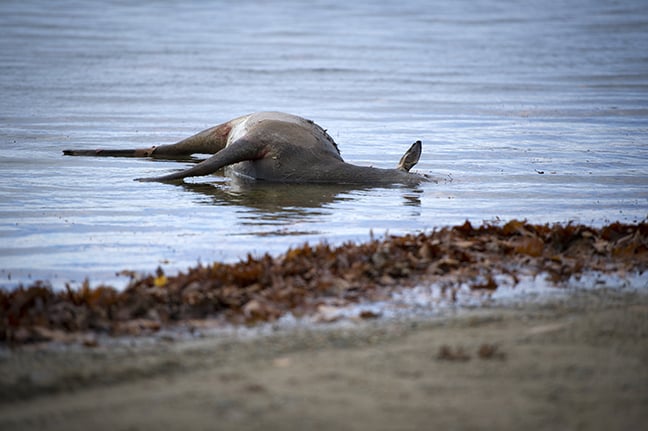
EHD in Michigan’s deer herd concentrated to four counties so far
The Michigan DNR has confirmed epizootic hemorrhagic disease in four counties so far in 2026, with plenty more tests pending
Dan Small Outdoors Radio: Show 2138
Indiana hunter scores a huge black bear in northern Wisconsin. Jeff heads to Cass Lake, Minn. for a Masters Walleye
