Milladore, Wis. — The possibility of using trailing hounds to move wolves away from farms and other problem areas in Wisconsin cleared its first hurdle when the Conservation Congress wolf study committee passed Corky Meyer’s resolution with just one dissenting vote.
Meyer, who passed away earlier this year, had been a strong conservation advocate for decades.
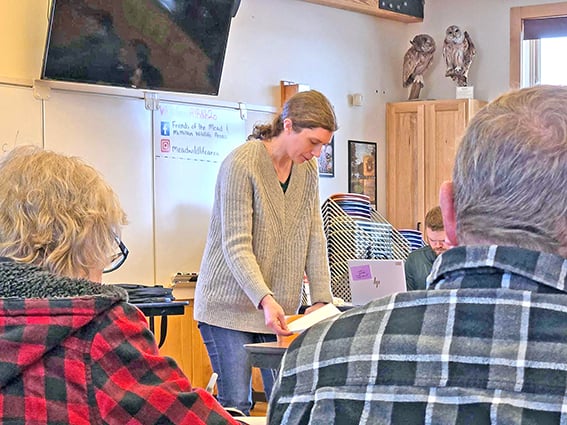
Meyer, a hound hunter, had been working on a citizen resolution to allow the use of trained hounds to target specific wolf control situations when he passed away. Meyer’s resolution, presented by his daughter, Tashina Peplinski, was the only citizen resolution before the committee during its meeting at the George W. Mead State Wildlife Area.
The committee approved the resolution; it now moves up the ladder to the Conservation Congress District Leadership Council (DLC). With support from congress leaders, the resolution would appear on the spring hearing questionnaire the second Monday of April.
MORE COVERAGE FROM WISCONSIN OUTDOOR NEWS:
Breaking down Wisconsin’s gun deer harvest as buck kill is down, doe harvest up from ’24
Reflecting on half a century of Wisconsin deer hunting
Wisconsin bear hunt could see more tags in 2026
Edgar Harvey, of Waldo, chairs the Conservation Congress Wolf Study Committee. Harvey is now rewriting the resolution into a question format for possible addition to the spring hearing questionnaire.
“After circulating to the committee and Tashina Peplinski for accuracy, it will go to the District Leadership Council. They will decide if it will be included as an advisory question in the 2026 questionnaire,” said Harvey, adding the DLC meeting is set for Jan. 10.
Meyer’s resolution briefly reviewed the use of many dog breeds to protect livestock and human health and safety for centuries. Trained hounds and handlers, Meyer’s resolution stated, could be used to move wolf packs out of conflict areas and into more suitable areas.
The 2021 wolf hunt, Meyer had stated, showed the efficiency and target specific control of wolves that came about by using dogs. Further, no necropsies during or after the 2021 season showed any contact between wolves and trailing hounds, which nullifies claims by some people that hunters allowed their hounds to fight with wolves.
Peplinski brought the resolution to the committee before wolves are again federally delisted in this region because she knows the rule change process can be lengthy. The idea was to have this control measure in place so if wolves are ever federally delisted, hounds could be used to target specific problems in specific areas, she said.
While other non-lethal deterrents lose their effectiveness over time, Peplinski said, it has been shown that using dogs to relocate problem wolves can be repeatedly effective and would not require lethal control measures.
Randy Johnson, of Rhinelander, is the Department of Natural Resources (DNR) large carnivore biologist. Johnson said this type of control has been used in other places with species such as bear and mountain lions.
The committee advanced this resolution, with the only dissenting member being Genevieve Adamski.
Other business
Johnson provided congress wolf committee members with updates on wolf management in the state, mostly talking about the DNR’s new wolf advisory committee that has met twice so far, with another meeting expected early in 2026. Congress wolf committee members aired some of their concerns of the DNR’s committee at the meeting.
The DNR wolf committee has 24 seats, Johnson said. One seat goes to a Conservation Congress member. Eight seats are filled by DNR employees. There are three federal and/or county seats, and two seats for Chippewa tribal members. The other 10 seats are for stakeholder groups, with two seats each allocated to: hunting/trapping, agriculture/ranching, conservation/education, environmental and “at large,” which are citizens who applied for the seats.
Johnson said there were far more applications than seats, and the determination on who to include on the committee was a difficult one. He said there will be periodic reviews to see if committee members still want to sit on the committee, or whether Johnson still felt that person provides value to the committee and is helping move things forward.
Several congress committee members commented on the makeup of the DNR wolf committee. In particular, the Wisconsin Trappers’ Association is unhappy about being left off of the roster. Trappers, several pointed out, have been the most involved and are often called upon by the DNR for help with trapping and collaring wolves.
There also were other issues that have been brought up in the past regarding the DNR committee, including the geographical range of the participants, with many coming from outside of wolf range, as well as the idea that all committee members had to fully agree with the state’s wolf management plan in order to be considered.
The DNR wolf committee began to form in April. Interviews for open seats were conducted, with applications reviewed in June and July. Members were announced in August. The first meeting took place in September; the second in October.
The first meeting was largely conducted by a facilitator, with the main focus being team building. The next meeting date has yet to be determined, but will be in early 2026.





1 thought on “Wisconsin Conservation Congress group passes hound/wolf resolution”
You can staff all the comities and panels you wish but the facts are known by the hunters/outdoorsman…and they are seldom listened to… resulting in perpetual mismanagement… wolves are destroying northern forest ecosystem and beurocratic BS let’s it continue…I have spent 55 years hunting the same wilderness and have witnessed the desamation of numerous species… mostly by wolves and other predators…whose populations are controlled by over educated beroucrats.. meanwhile…the woods that I hunt is dead… nearly empty… except for predators… thanks DNR