




Outdoor News may earn revenue from products shown on this page by participating in affiliate programs. This comes at no extra cost to you. Click here to learn more.
Hunting predators is an excellent way to keep tuning your hunting and shooting skills during the off-season for whitetails and other big game.
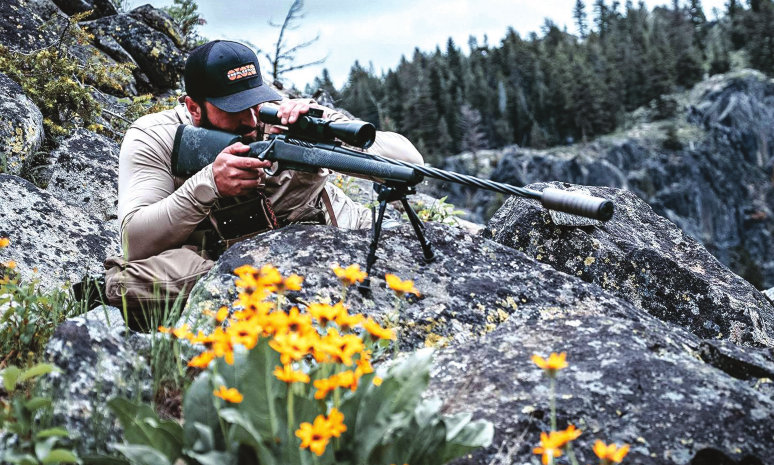
One of the best ways to improve your odds for success is to install a sound suppressor on your predator rifle. A suppressor, more commonly known as a silencer, will not only help protect your hearing, but in low-light conditions it also helps protect your eyes from painful muzzle flashes.
A suppressor will mute the sound of a rifle shot by 20 to 35 dB. while also reducing the recoil and muzzle blast of a stout centerfire cartridge. Adding a suppressor may also improve the rifle’s accuracy, sometimes shrinking groups by up to .5 inch.
According to industry sources, suppressors are legal to own in 42 US states, and legal for hunting in 41. They are illegal to own in Illinois and New York. Currently more than 3 million suppressors are in use in the United States.
Picking a suppressor
To fully benefit from hunting predators with a suppressed rifle, you’ll need to match the suppressor with the rifle caliber and the size of the predator.

For example, a .223 Remington or .243 Winchester rifle is sufficient if hunting coyotes, bobcats, foxes and animals of similar size. If you’re targeting bears, you might do better with a .308 Winchester or .30-06 Springfield.
Although there are suppressors for rimfire rifles, including .22 Long Rifle, .17 HMR, and .22 WMR, serious suppressors for centerfire rifles begin with the .223 Remington and 5.56 mm.
The 5.56/.223 suppressors are very popular and are often the one suppressor category that is only used for the designated caliber. In other words, folks who buy a .223 can are most likely to only use it for a .223 variant.
In general, the bulk of .30 caliber suppressors are intended for use on rifles chambered in .308 Winchester or 7.62 NATO. By default, they will handle everything that a .223 silencer can handle, with the addition of .300 Blackout in supersonic and subsonic loads, as well as .30 caliber rifle cartridges with lower pressures, such as .30-30 Winchester and 7.62×39.
Usually, rifle calibers with smaller diameters, such as .270 Winchester, 6.5 Creedmoor, 6.5 PRC, 6.5 Grendel, 7mm Remington Magnum, 7mm-08, and even the newer 7mm Backcountry can be fired safely through a .30 suppressor.
After you’ve determined the caliber basics, check the suppressor’s pressure rating. Silencers with lower pressure ratings are for more specialized, and limited, applications. These suppressors are also often lighter and shorter.
Suppressor size
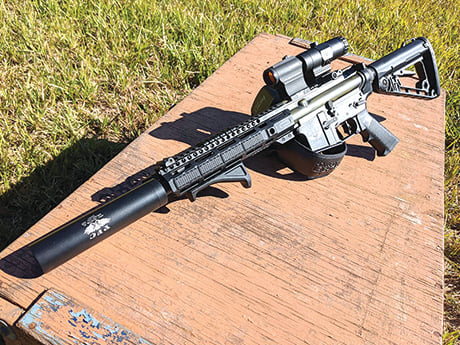
Although many suppressors have fixed lengths, some offer long and short configurations. In its long configuration, the suppressor will provide more noise reduction. Reconfiguring the can to a shorter length will save a couple of inches, and also reduce weight without giving up too much noise-reducing capability.
Many rifles feature barrels 22 to 26 inches in length. Some suppressor-ready rifles will likely have shorter barrels, ranging from 18 to 22 inches. Most rifles built on the AR-15 platform, which are often used for predators, have 16-inch barrels, which will put the overall barrel length at around 22 inches with a suppressor installed.
Suppressors must be light and strong. They must resist corrosion and extreme fluctuations of heat, too. Steel and aluminum are tried-and-true, work exceptionally well, and – from a raw material perspective – are readily available. Steel is strong and aluminum is light.
Titanium is strong and light, and offers exceptional performance properties. Titanium is a go-to for weight conservation, making this a top choice for silencers designed to be carried in the field for long periods of time.
Snug mount
If you don’t have a good way to attach a suppressor, you are liable to seriously damage it with bullets hitting the internal baffles from a suppressor not properly concentric to the rifle bore.
Today most rifle makers offer several semi-auto, bolt-action and even lever-action models with threaded muzzles. The most common thread pattern is 5/8×24, but different suppressors do have different threads. So, it’s relatively easy install a suppressor on these rifles.
However, if you have a favorite rifle that isn’t suppressor ready, companies like Silencer Central can thread the barrel for you. They started Threading Central, a company that uses state-of-the-art CNC cutting machines and highly trained machinists.
You can literally mail in your barrel or stripped action to Threading Central, at 4901 N. 4th Ave. Suite A, Sioux Falls, SD 57104, and have it mailed right back to you. They can cut a standard thread pattern or something custom.
Top choices
Several high-quality suppressors for predator hunting are available, but some products outclass the rest. Below are top hunting suppressors and the features that set them apart.
The Banish 30 is a highly adaptable titanium silencer for .22, .24 and .25 caliber rifles. You can adjust the modular suppressor to be 7 or 9 inches and attach it via its direct thread mount. Also, it works with popular hunting calibers, such as 6.5 Creedmoor, .308 Winchester, .270 Weatherby Magnum, 7mm Remington Magnum, and.300 Winchester Magnum.
Yankee HillResonator R2 is a durable stainless steel suppressor. It’s 7.8 inches and works with calibers between .17 HMR and .300 Winchester Magnum. Since the Resonator R2 is steel, it weighs more than aluminum or titanium silencers. If you don’t mind the extra weight, this suppressor is a good option.
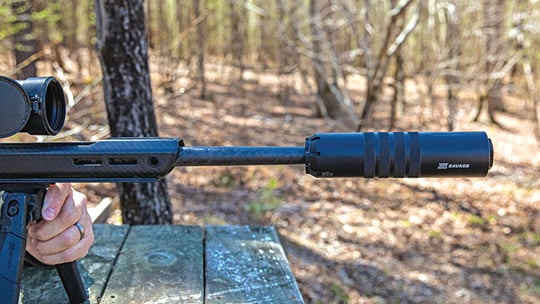
Griffin Armament, based in Watertown, Wis., offers a variety of suppressors along with AR-15 rifles and several accessories. The Savage AC30 B.O.B. is a back-over-barrel suppressor that improves balance and adds internal volume without adding as much length by partially enclosing the barrel, unlike traditional suppressors mounted at the muzzle.
Target multiple predators
If you’re still uncertain about whether to suppress your predator rifle, remember predators, like coyotes, often come to a call, or travel in packs of two or more animals, and a suppressed rifle will help you target a second or third animal due to its muffled gunshot and hidden muzzle flash.
Hunting predators can be thrilling and rewarding if you have the right gear. A suppressed rifle will help you turn predators into prey.

Dan Small Outdoors Radio: Show 2139
Lake of the Woods fall fishing is on fire. Prepare now to bowhunt the rut. Expert tips for recovering a
$10,000 bond set for Wisconsin deputy in shooting that injured turkey hunters
Bond was set at $10,000 for the Racine County Sheriff’s Department deputy who faces four felony charges after his 3-year-old

Wisconsin Mixed Bag: DNR’s Madison service center to close
The Wisconsin Department of Natural Resources (DNR) announced that with the sale of the GEF2 building on Webster Street in
