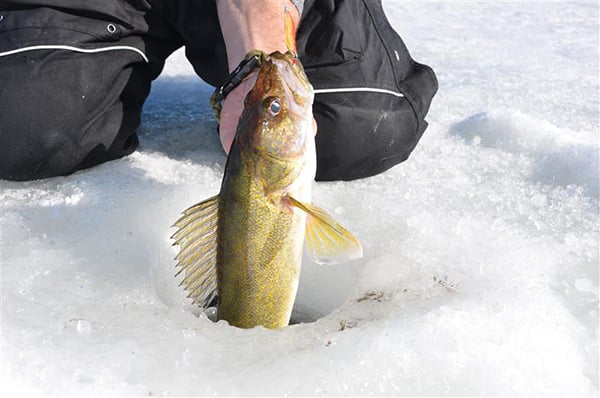
Isle, Minn. — The Minnesota DNR has announced it will extend the current Lake Mille Lacs walleye regulation through the hard-water season this year. The regulation will allow anglers to keep three walleyes over 17 inches long, with one over 20 inches allowed, along with a yellow perch limit of 10.
“Not a lot has changed from the previous year when it comes to walleye populations, as far as adult numbers, so that gave us the confidence that we could continue to have a fairly liberal harvest,” said Brian Nerbonne, the DNR’s central region fisheries manager.
The number of walleyes the agency estimates are in Mille Lacs builds the confidence that a three-fish limit isn’t an unnecessary burden on the fishery – especially when the bite won’t be the easiest again this year. A good population of small yellow perch remains a primary food source for adult walleyes, which has become evident in the lake.
“We saw that in the condition of some of those largest fish, especially, that they were really plump from having all that abundant food throughout the year,” Nerbonne said.
With forage still high, and unknown ice conditions to accurately gauge angler pressure, the agency will meet with the tribal officials in January to discuss walleye poundage quotas for the upcoming year.
“We’ll see what the walleye harvest is for the winter. That could vary the quota a bit as well as the amount of angler hours we’re able to see for the winter. … We’re expecting a moderate level of harvest that should leave plenty of pounds available for the open-water season,” Nerbonne said.
MORE COVERAGE FROM MINNESOTA OUTDOOR NEWS:
Remote border crossing from U.S. to Canada still in limbo
Minnesota man dies in North Dakota waterfowl hunting incident
Minnesota’s 2025 firearms deer harvest higher than a year ago
Yellow perch
There will be a different regulation for Mille Lacs yellow perch this winter compared with the rest of the state. The lake’s anglers will be allowed to harvest 10 yellow perch – instead of 20 as it was at the start of the year last year.
“Because of the pretty good bite of perch and the number of people that came out to fish for them, the state went over its share of the harvest before two months … last winter,” Nerbonne said.
According to Mille Lacs creel survey period from Dec. 14 to Jan. 18 a year ago, state anglers harvested 12,048 pounds of yellow perch. From Jan. 19 to Feb. 23, anglers harvested 31,675 pounds of perch, which was almost the state’s entire allotment of perch for the year at 36,500 pounds.
In opening with a 10-fish limit, the hope is that the agency won’t have to lower the limit during the season as it did last year. Last year, it started with 20 yellow perch, then dropped to five.
“We’re going to try to start with a lower limit to begin with and hopefully keep that for a longer period of time this year,” Nerbonne said.
At the January meeting where the DNR will meet with 1837 tribes to decide what the 2026 total poundage for walleyes, yellow perch poundage could be considered, too.
Nerbonne said that the agency historically hasn’t tracked yellow perch populations the same way it has tracked walleye populations, which allows accurate year-to-year harvest approximations.
“We just don’t have the level of information that we do for walleye. With walleye, we’ve got every three to five years, we do a full population estimate of the lake. … For yellow perch, they’re just way too numerous to do a population estimate,” he said.
But for perch, there is no comparable system to estimate the entire population. Right now, the agency is using an index developed by Canada to gauge yellow perch abundance. But that isn’t even a fully fleshed out calculation.
“It’s certainly not specific to Mille Lacs. It was developed in Canada, from a bunch of lakes up there, and so it may or may not be as applicable to a system like Mille Lacs. So, we’re still learning,” Nerbonne said.
So going into next year and making a decision on the number of pounds that can be harvested of yellow perch remains an equation for the DNR to find a solution.
The northern pike limit will also change this winter. The possession limit will increase from three fish to five fish, with anything over 30 inches being tossed back immediately. This will go into effect Dec. 1, 2025 and run through March 31, 2026.