




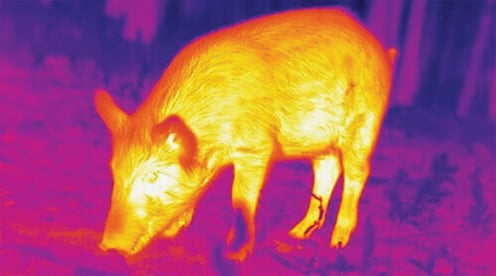
Night hunting has undergone some significant changes in the early decades of the 21st century thanks, in large part, to the advancements in thermal and night vision optics.
We’ve gone from hunters slogging through cornfields and woodlots following behind hounds aiming to bag a treed raccoon using a powerful light and a .22 rifle or handgun, to targeting feral hogs and coyotes with centerfire rifles at distance.
Thermal optics give the user the ability to see the thermal radiation that people, and animals, emit as they release energy in the form of heat. Unlike normal light, infrared rays cannot pass through glass or water. They will simply reflect upon hitting glass or water.
Night vision optics detect visible or ambient light at night and amplifies it for a clearer picture of what lies in the dark. If there is too little ambient light to be amplified, infrared spotlights can be used to supplement the area just like a flashlight would.
Thermal optics give hunters much better detection, while night vision provides much better identification. Some people prefer to use a thermal monocular for detection and a night vision sight for identification and taking shots.
Key components
A thermal optic consists of a front lens that collects and directs a specific wavelength of infrared light to the detection chip known as the sensor, which produces unique electrical signals for each different wavelength variation that reaches it.
Those electrical signals are then taken by the processor where each electrical signal is assigned a pixel in the same spot as the framed image being captured by the lens. The sensor and processor work together in providing a quality image.
All the electrical signals are retained in the memory chip for later use when recording. All of these components combine to provide a visual representation of the heat radiation variations that exist in the objects around us on the display screen within a thermal scope.
Thermal options
Thermal scopes are designed to be mounted directly to a firearm and look similar to traditional scopes. Thermal scopes typically have features such as magnification for longer-range shots, recording capabilities, focusing lenses to get clearer images at different distances and mounting solutions for different rifle types.
Thermal binoculars are used for scouting, detection, ranging and more. Thermal binoculars can be mounted on a tripod for added stability. Many users prefer binoculars for the reduced eye strain and comfortable feel like traditional binoculars, along with other benefits such as a wider field of view. A larger housing for dual tube binoculars sometimes means there will be more room for additional features such as laser range finding and GPS modules.
Thermal monoculars are similar to binoculars, but with one tube instead of two. They’re much lighter and more portable. The length and size of thermal monoculars vary widely to accommodate different applications and uses.
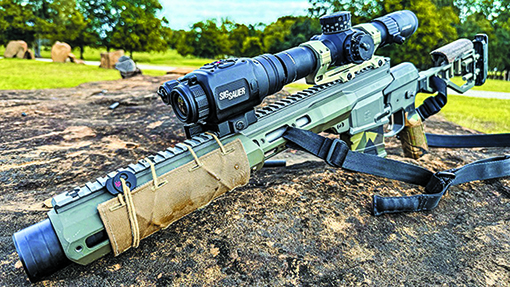
Clip-on thermal scopes are designed to attach to the front of your traditional optic, essentially converting your daytime scope to a thermal scope. With the correct adapters, clip-on thermal systems can be mounted directly to the objective lens of a scope or mounted to a picatinny rail in front of your optic.
They also can be removed quickly and used as a standard handheld thermal monocular. Many hunters like to use thermal clip-on systems if they’re in situations where they either don’t want to replace their main scope, or possibly switch back and forth between a normal optic and thermal imaging.

Factors to consider
Detection range is normally defined as the furthest possible distance at which any thermal scope can detect variations in temperature. It is important to remember that detecting a target or an object is different from the device’s identification range.
Identification range is the furthest distance at which the user is still able to identify or determine what exactly is being looked at after the device picks up a temperature variation. From too great of a distance, it will most likely be difficult to tell if a detected target is the farmer’s dog or a coyote or fox.
A higher resolution and refresh rate provides a much smoother image, especially when tracking moving or running targets like coyotes or hogs.
Base magnification is the level of magnification that a thermal scope provides without using any digital or optical zoom.
As for battery life, thermal scopes and optics typically run CR123 or 18650 batteries, providing long battery life while still saving weight.

Popular thermal brands
Several companies have been offering thermal hunting optics for a number of years, and more brands are entering the market. Prices for quality thermal optics range for $1,000 and up, with several in the $2,000 to $3,000 range.
Here’s a sampling of thermal optic scopes: ATN Thor LT 320 5-10x offers excellent performance and reliability at an affordable price. Trijicon Reap-IR delivers military-grade performance in a civilian package.
Pulsar Thermion 2 XQ50 offers excellent detection capabilities and precise ranging. AGM Global Vision Varmint strikes a balance between performance and portability.


The Armasight Contractor 320 Series features the Lite 3-12×25, 6-24×50 and the 2-8×25, with prices starting in the $2,500 range. The price for a Sightmark Wraith Mini 2-16×35 is just over $1,000.
Winchester Supreme THSD 384 Thermal Scope is shaped like a normal scope instead of looking boxy. It currently has an MSRP of $2,300. The Sig Sauer Echo CV25 thermal optic, can be used as a clip-on and stand-alone optic.
When choosing an optic for night hunting, remember thermal allows for much faster follow-up shots, while night vision allows you to maintain clear aim points and make more precise shots. Hopefully this overview will help you in determining what would best meet your needs and fit your budget.

Fall is the perfect time to catch Lake Erie’s giant walleyes; here’s what to focus on
Anglers who are prepared to face some colder weather can catch lunker walleyes. For the past decade, walleye fishing derbies
Upper Peninsula landowner provides evidence feral pigs have established there
A population of feral pigs that escaped from a game farm have become established in southern Marquette County, based on
Big waterfront project in Lorain, Ohio, to benefit anglers
When the Hot Waters Boat Launch reopened in the City of Lorain on May 22, it was just one milestone
