




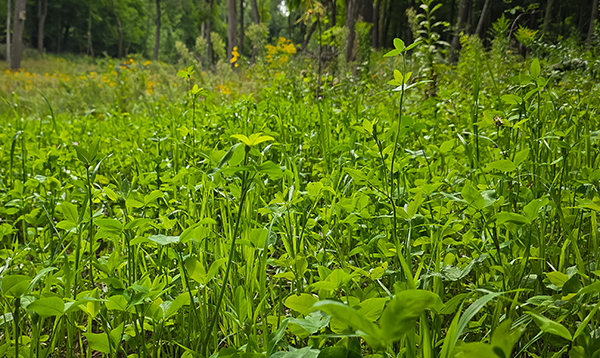
If you’ve been around the food-plotting world for a while, you know the past several years have provided more than their fair share of challenges to successful food plot establishment in Minnesota.
Whether it’s been severe drought or torrential rain, it’s been a roller coaster trying to provide whitetail nutrition and hunting opportunities.
True to form, 2025 has been no exception, with heavy rains across much of Minnesota. But the good news is that it’s not too late to get some forage on the ground and salvage your growing season. Whether you’re dealing with heavy soil that’s finally drying out, or you just haven’t had the time to get your food plots in (no judgment here), here’s your road map for last-minute food plot success in 2025.
Finding bare ground
 Whether you’re working an existing food plot or trying a new spot, finding bare ground of some type for seeds to land is critical to success. Some type of tillage is the obvious answer here, although I’m a little wary of it on higher ground.
Even in a wet year, precipitation can get highly variable in a hurry late in the growing season, and it’s a bit of a gamble to break ground and lose that existing soil moisture.
Without breaking ground, I’ve tried two different methods to ensure seed to soil contact in a fallow plot, and both can work fine depending on your situation. If weed density is sparse to moderate, I like to broadcast seed directly over the top and follow with the brush mower to knock all the weeds down.
This accomplishes two things. First, I’m at least setting back the weed competition to give the food plot seed a chance, and this time of year, regrowth will generally be more limited than earlier in the summer. Second, this does a great job of covering up the seed I just scattered, which serves a similar role to covering with soil while also trapping moisture at the ground level, aiding in germination and growth.
MORE WHITETAIL COVERAGE FROM OUTDOOR NEWS:
Video: Scouting for whitetails after storm alters years of intel
Hunting in comfort: Is a box blind the best option for your top deer spot?
Want to hunt big game from a ground blind? Pay attention to the finer details
The second method I’ve utilized when weeds – particularly annual grasses – are heavy is to broadcast seed over the top and follow this with a healthy dose of glyphosate. With glyphosate being a contact herbicide, there is no risk to the seeds you planted, because they have no growing parts to come in contact with herbicide. If your application is successful, the result will be similar to mowing following seeding, as the dying weeds will lie down over the seed.
Depending on your specifics, it’s important to note that if you have herbicide-resistant weeds (of which there are more every year), you may need to adjust and do some combination of herbicide and mowing to set things back. Ultimately, if you’re dealing with nasty ones such as giant ragweed and water hemp, tillage may be the best option before casting seed.
It’s also important to note that this likely won’t look like a “perfect” food plot. Remember, you’re not following the steps of production ag, and there are some weeds that will come back.
Your seed germination likely won’t be 100% consistent across the plot. But the point here is to grow something that will attract deer throughout the fall, and if most of your plot ends up growing what you plant, consider that mission accomplished.
Seed selection
More than any other time of year, your species selection is crucial.
As we get into late August and September, the luxury of growing typical commodity crops is out the window. I would even argue that, unless you’re in far southern Minnesota, trying to grow brassicas this late is a near guarantee for disappointment.
Don’t get me wrong; they’ll grow. They just aren’t going to be 2 feet tall and have giant, softball-sized bulbs underground. More likely, they’ll grow several inches tall, and that’s all they’ll have time for before frost arrives.
When time is short, there’s only a small handful of species that I’m trusting to pull me to a solid spot come November. For a sure-fire, all-but-guaranteed option, you can’t beat the cereal grains. If I’m planting this late, I’m putting down both oats and either winter wheat or cereal rye, both at 75 to 100 pounds per acre.
This is a higher rate than would be recommended in a more traditional setting, but we’re trying to maximize our coverage, and we can safely assume germination will be below labeled rates considering we’re scattering them on the ground in an unprepared seedbed.
Regardless, oats and winter wheat/rye are the closest things I’ve ever found to a guaranteed green food plot come fall. Even in the worst drought years, they’ve limped me along to have something to offer whitetails.
Another item I’m throwing in is an annual clover or two. I’ve tried most of them in the past, and I keep coming back to red, crimson, and frosty berseem clover. These have all proved to be total workhorses for me, and the best part is, they grow fast.
I would strongly caution against planting perennial clovers this late, as we need maximum top growth in a finite amount of time, and annual clovers are going to be the best bet.
Whether you choose one variety or use all three, I’m going to broadcast the clovers at a total rate of 15 to 20 pounds per acre. Again, this is slightly higher than traditional settings, but we’re banking on lower germination. This rate seems to work well for a last-gasp plot attempt.
Timing it out
This is where I tell you to wait until the rain comes. I get it: Considering how late it is, shouldn’t you get seed on the ground as soon as you can? In my experience, no.
If you put seed on the ground with no realistic chance of precipitation in the next 10 days, odds are that a substantial portion will be scooped up by turkeys and songbirds.
Timing your seeding until there’s at least a 60% chance of rain soon after has been critical to my food plot success, regardless of time of year.
Yes, time is of the essence at this point in the growing season. But nothing will germinate without the rain, and odds are some of the weeds you mowed off will start regrowing by taking advantage of existing soil moisture and getting a head start on your food plot seed.
The one caveat I’ll add is that if your food plot is several hours away and you get only one chance, do what you need to do. It’s better to have seed on the ground and hedge your bets than to know you won’t be having a food plot this fall.
If you can, though, play the rain. I have had consistently better results since I began focusing all my planting effort around immediate rains, no matter the time of year.
Final thoughts
The clock is ticking, but it’s not too late to get forage on the ground. There’s still time to pull something together for your deer season.
Cereal grains and annual clovers are genuine workhorses, they grow fast and furious, and the best part: Whitetails can’t resist them.
$10,000 bond set for Wisconsin deputy in shooting that injured turkey hunters
Bond was set at $10,000 for the Racine County Sheriff’s Department deputy who faces four felony charges after his 3-year-old

Wisconsin Mixed Bag: DNR’s Madison service center to close
The Wisconsin Department of Natural Resources (DNR) announced that with the sale of the GEF2 building on Webster Street in
Wisconsin’s Buena Vista Grasslands and its prairie chickens entice handlers, pointing dogs
As far as John Mathys is concerned, there’s nowhere he rather be than with his dogs and horses in a
