




Home » Nature Page & Night Sky » Ohio State University students report on fisheries research at Stone Lab
Ohio State University students report on fisheries research at Stone Lab
Gibraltar Island, Ohio — The Ohio State University’s F. T. Stone Laboratory on Gibraltar Island in Put-in-Bay offers scholarships for highly qualified students enrolled in classes each summer through its Research Experience for Undergraduate (REU) program.
Stone Lab’s research coordinator, Justin Chaffin, said that for this highly competitive opportunity, 150 to more than 200 students apply each year for four REU projects conducted in the Lake Erie island area that are mentored by university faculty.
The student researchers use the standard scientific method of posing a question about an observation, checking to see what is already known about the topic, developing a hypothesis, running an experiment to test the hypothesis, analyzing the data from the experiment and drawing conclusions, and sharing the results with others.
On July 24, the four students gave their oral reports via power point presentations in the classroom building’s conference room that were aired live via Zoom and recorded.
The topics included environmental conditions affecting Lake Erie algal species; habitat versus insect prey availability for Lake Erie island bats; microplastics in Lake Erie fish; and population status of the threatened channel darter at Lake Erie Islands.
MORE COVERAGE FROM OHIO OUTDOOR NEWS:
Ohio Insider: Time to make the walleye the official state fish
Bobcats once again thriving in Ohio
New aquatic visitor center opens at Ohio’s Put-In-Bay in Lake Erie
Algae
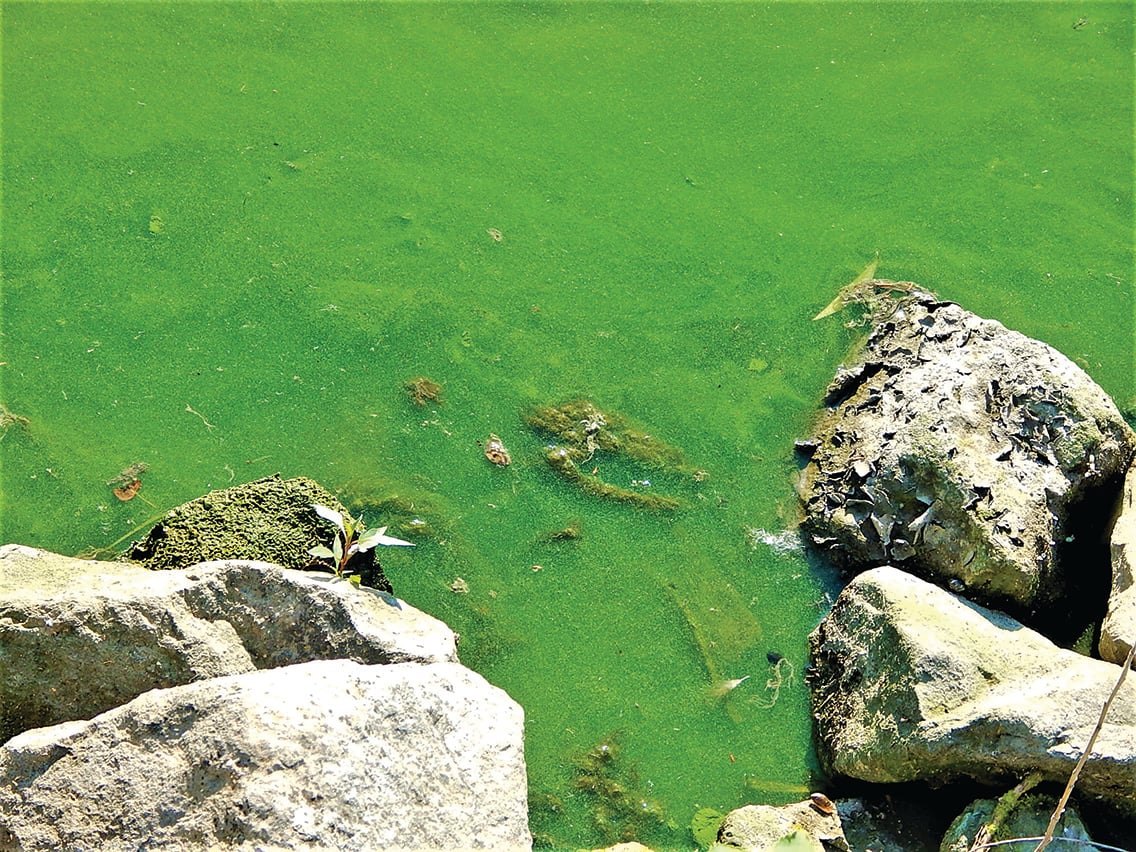
Gracyn Armstrong, of Muskingum University, worked with Chaffin to see what factors impact Lake Erie’s various phytoplankton (algae) populations and growth rates.
The title of her presentation was, “Competition Among Algae and Environmental Effects on Growth Rates of Algal Species.”
Armstrong showed differences in the preferences of Lake Erie’s phytoplankton, including green, diatoms (brown-green algae with silica shells), cyanobacteria (aka blue-green algae), and cryptophytes (unicellular algae with flagella, a whiplike tail).
Raw water was collected by the University of Toledo in Maumee Bay and from the middle of the Western Basin by Stone Lab.
Variables tested included water temperature, nutrient levels, pH, light levels, and agitation tolerances from samples that were bottled and then incubated in meso cosm tanks and in the lake.
Armstrong found that all of the algal varieties do best with more nutrients but growth rates slow after densities rise.
Cyanobacteria, which can create toxins (harmful algal blooms) and green algae do best in warmer water than diatoms tolerate. Cyanobacteria benefits more in warmer water than green algae but both can tolerate high or low light levels.
Cyanobacteria prefer clearer water and higher pH levels, but when over 9.2 diatoms cannot produce their silica shells.
Diatoms exhibit higher growth rates during cooler temperatures with lower pH when accompanied with lower light intensities.
Diatoms and green algae tolerate higher wave energy levels than cyanobacteria, which do best in calm conditions.
Bats
Next up was Elliot Ross, an Ohio State University entomology student who looked at the relative importance of bat habitat versus insect densities in her presentation, “All you can eat: Insect dynamics and bat activity on South Bass Island.”
Her advisor was Amy Alford, who serves as the research coordinator at the Lake Erie Islands Nature and Wildlife Center on South Bass Island.
Ross used three types of insect collection devices, including Light, Pheromone, and Impact traps to survey South Bass insect species and densities and was able to identify 58 families of invertebrates.
She compared the use of three habitat types by foraging bats at night on South Bass Island including Coastal Clear, Coastal Forested, and Interior Forested areas. Each bat can eat 50% to 100% of its body weight in insects each night.
Using an acoustic monitor, Ross was able to detect the unique feeding sounds made by 10 species of bats, including some (marked with an asterisk) that are currently considered species of concern.
They included big brown, hoary, silverhaired, eastern red, *tri-colored, evening, seminole, *little brown, *Indiana, and *grey bats.
Ross determined that the coastal open habitat type was the favorite places where the island’s bats did their foraging and where the most insects were active, especially mayflies during their emergences.
The big bat species avoided the interior forest habitats where the smaller bat species are better able to maneuver within the denser canopies. Habitat has a much more profound effect on bats than food availability.
Ross documented a reduction in bat activities during rain and hot weather and concluded that insect densities only had a weak correlation with foraging effort.
Microplastics in gobies
The third presentation was titled, “Assessing microplastic retention and hematological effects in Round Goby (Neogobius melanostomus) for a project assigned to Hanna Busby, a marine science major at Boston University while working with Zach Steffensmeier, of Ohio State University’s School of Natural Resources.
Busby began her talk with a brief overview of the scope of microplastics found in all seafood products and the presence of it in Lake Erie, where an estimated 4.41 metric tons exists and comprises 80% of all beach litter.
When fish ingest plastic, it can cause blockages and give a false sense of fullness, which prevents feeding and growth.
Chemicals absorbed on the plastic particles can also be transferred to fish. Tire particles are estimated to be in 22% of all fish, with 10% of wild gobies having detectable levels of microplastics on a daily basis.
Busby constructed plastic particles, using various blends of tire fragments, clothing fibers, fishing line, and hard plastic to check their retention time in round gobies. This abundant and hardy fish is easily obtained, tolerant of confinement to an aquarium, and willingly feeds in captivity, thus a good study subject.
Busby measured blood performance, including hemoglobin, total protein, hematocrit, red blood cells, and white blood cells in the days following feeding gobies a microplastic pellet hidden in a piece of nightcrawler.
After analyzing the blood 48 hours later, Busby detected some individual blood performance response in the pellet blend with highest concentrations of tire fragments.
These fish appeared to be treating the high tire fragment blend similar to how it would respond to a pathogen, such as increasing numbers of red blood cells, decreasing levels of total proteins and then an increase in white blood cells, but not enough to affect overall health.
Her conclusion is that because the pellets are not being retained in the fish longer than 48 hours, it is too brief to cause permanent health consequences in the adult fish she was using as test subjects.
Since adult fish are the hardiest life stage, microplastic may have a much higher impact on smaller specimens, especially when larval fish and juveniles feed upon them. Also, gobies are known to be more hardy and pollution-tolerant than other more sensitive fish species.
The final project of the evening was shared by Anna Sedlock, a student at the University of Montana majoring in aquatic wildlife.
Brian Alford, Stone Laboratory’s assistant director, was her project advisor for her work entitled, “Influence of Round Goby on Native Darters in Lake Erie, with an Emphasis on Threatened Channel Darter.”
Round gobies were introduced into the Great Lakes in 1990 by transoceanic ships and their impacts on native fish were observed soon thereafter. Some of those affected include members of the perch family, including logperch and channel darters.
To check for their presence, groups of students seined using standardized methods at 15 sites on Lake Erie islands where museum records showed they had previously been collected.
In a total of 35 trips, 10,905 fish were caught and identified. Round gobies dominated the catch with 7,967, or 73% being this invasive exotic species. Refreshingly, there were 308 darters captured, including 240 logperch, 55 channel darters, and 13 Johnny darters.
Channel darters were caught at three of the 15 sites: Kelleys Island’s Marina Beach, and on South Bass at the state park and Miller Boat Line’s Lime Kiln Dock beaches.
With respect to whether gobies affect logperch behaviors, observations in aquariums saw few interactions between the two species, with no signs of bullying or intimidation.
Logperch numbers have been declining for around 30 years, longer than gobies have been present in Lake Erie, so the cause is more likely a result of environmental changes unrelated to gobies.
They may include more algae-covered rocks due to deeper sunlight penetration from zebra mussel’s water column filtration and higher nutrient concentrations that are causing more frequent occurrences of low dissolved oxygen levels.
Stone Laboratory is celebrating the 100th anniversary of the donation of Gibraltar Island for the location of its facilities.
SUBSCRIBER CONTENT
Read this article now.
Create a free Outdoor News account.
Create a free account below to get instant access to this article, thousands of Outdoor News stories, and our digital editions. Your 1-month trial starts the moment you sign up.
No credit card required
No credit card required
Subscriber? Login Here.
Share on Social
Hand-Picked For You
Findlay Reservoirs support walleyes and saugeyes in northwest Ohio
Ohio’s Outdoor Calendar
Ohio Cuffs & Collars: Stolen black walnut tree from Wallace O’Dowd Wildlife Area
H2Ohio wetland to benefit St. Marys
USFWS announces new duck season framework process
Making sense of this year’s waterfowl report for Ohio hunters
Related Articles
Ralph Loos: Michigan’s reliable hunting traditions got an update (upgrade?) this season
More than any other collection of like-minded individuals, hunters tend to get stuck in their ways — and I say

Findlay Reservoirs support walleyes and saugeyes in northwest Ohio
An angler could do much worse than the pair of reservoirs at Findlay in northwest Ohio.
The latest offering
Ohio’s Outdoor Calendar
A look at upcoming outdoor-related events from across Ohio published in the Sept. 22, 2026 edition of Outdoor News.
