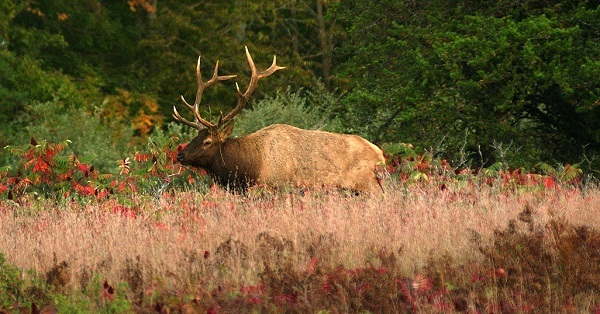
Researchers from the Michigan Department of Natural Resources will pilot the use of trail cameras to estimate the state’s elk population as part of a larger research project aimed at determining the most accurate and cost-effective way to manage the elk herd.
The DNR’s Wildlife Division recently set up about 200 cameras in and around the core elk range, which encompasses some 1,100 square miles across northern Lower Michigan. Most of the cameras are on state-managed land, although DNR researchers worked with landowners to set up cameras on private land as well.
Camera data will be compared against the DNR’s current method of estimating the elk population – aerial surveys – to determine which method is more precise and cost-effective.
Survey goals, challenges
Having an accurate elk population estimate helps the state determine how many elk hunting licenses to issue every year. The DNR uses the annual elk harvest as the main tool to maintain a sustainable elk population while providing highly prized recreational opportunities for hunters.
“We will compare the results from these different survey methods and balance the precision of the estimates they provide with the resources they require,” said Angela Kujawa, a DNR wildlife biologist.
MORE COVERAGE FROM MICHIGAN OUTDOOR NEWS:
Researchers discover 62-year-old ‘Mary Catherine’ — the oldest known lake trout in the Great Lakes
Mike Schoonveld: The ‘Secret Weapon Rig’ is not so secret, but it really catches fish
Bob Watson’s attention to detail, perseverance aids success of Pheasants Forever in Michigan
For more than two decades, the DNR has conducted aerial surveys every other year to estimate the size of the elk herd. The last aerial survey, in 2024, estimated the elk population at 1,146, with a confidence interval range of plus/minus 262, meaning the population is between 884 and 1,408 animals.
Tyler Petroelje, the DNR’s northern Michigan wildlife research specialist, noted that the aerial survey requires sufficient snow cover to aid in detection of elk; such cover has recently been unreliable during the January survey period.
The aerial survey’s uncertainty rate of about 25% would adequately inform typical wildlife population management needs but is somewhat imprecise to evaluate effectiveness at reaching Michigan’s narrow population goal of 500 to 900 elk, Petroelje added.
Next survey, new technique
The next aerial survey will be conducted in 2026. The surveys generally take eight days with two planes flying each day and two DNR observers aboard each plane.
To pilot the new estimation technique, researchers will collect data from the cameras each summer for three years (2025-2027). The battery-powered trail cameras are affixed to trees about 40 inches off the ground and use infrared and motion detection to take photos, which are stored on an SD card.
The DNR will partner with the Michigan Cooperative Fish and Wildlife Research Unit at Michigan State University to analyze the photos using AI technology and human review:
- The photos will be run through an open-source program called MegaDetector that is highly accurate at detecting animals, though it does not classify by species. Photos of humans are deleted.
- The animal photos will then be uploaded to a cloud-based platform called Wildlife Insights that will identify photos of elk. All animal photos uploaded to the platform are checked by a human as an extra layer of review.
- Seasonal staffers on the MSU Cooperative team will then verify that the technology accurately identified elk photos.
In addition, DNR researchers will begin analyzing teeth taken from harvested elk this fall and winter to help estimate the population. That low-cost method, called statistical population reconstruction, or SPR, is a supplemental technique and would not take the place of the independent survey (aerial or camera).
If the SPR method is determined to be accurate, it could be used annually and might allow researchers to conduct the chosen independent survey less often – such as every three to five years, instead of every other year.
Ultimately, the research findings from the surveys support the state’s elk management plan, which is used to manage a sustainable elk population in balance with habitat.
“That management plan really guides the information we need to manage our elk herd,” Petroelje said. “And so we have a responsibility to follow the management plan to estimate elk abundance with the best tools that are available.”