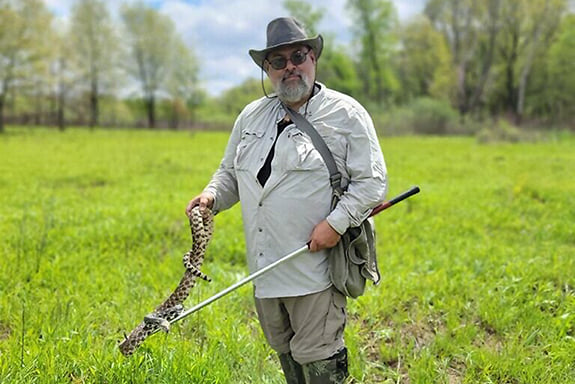
Springfield —Michael Dreslik, a dedicated Illinois Natural History Survey research scientist of nearly three decades, will be the survey’s next director and Illinois State Biologist at the Prairie Research Institute.
Dreslik has served as interim INHS director since January. Prior to that, he led the Urban Biotic Assessment Program and the Amphibian and Reptile Conservation Program. He has served as director of the Population and Community Ecology Lab, PaCE Lab, since 2017.
His research generates critical understanding necessary for guiding conservation decisions. With a focus on amphibians and reptiles, particularly chelonians and pit vipers, he is studying some of the most imperiled vertebrate groups in Illinois and around the world.
He has led major studies on ornate box turtles, eastern massasauga rattlesnakes, spotted turtles, and Blanding’s turtles that were directly tied to species recovery efforts, mitigating the impact of infrastructure development, and agency planning in Illinois and across the U.S.
MORE COVERAGE FROM ILLINOIS OUTDOOR NEWS:
Ralph Loos: Will disappearing gray foxes be next success story in Illinois? Trapping, hunting seasons officially close
Mallards could receive big boost from HEN Act introduced in Congress
World trapshooting championships in Illinois hit 20-year mark
At the PaCE Lab, Dreslik’s team provides the scientific data needed by decision makers at state agencies like DNR, and federal agencies such as the U.S. Fish and Wildlife Service.
“From a personal perspective, the mission of INHS is a source of professional clarity. It matches my values as a field ecologist and as a public servant. I have never viewed science as an end in itself,” he said. “I am interested in results that reduce extinction risk, inform climate adaptation, and preserve functional ecosystems.”
Dreslik’s career at INHS began in 1997 while pursuing his doctorate in natural resource ecology and conservation at the University of Illinois Urbana-Champaign. His career has been built on field-based research, science for the public good, and the INHS mission.
“INHS has endured for more than 165 years because it has produced knowledge that matters,” Dreslik said. “It has documented change, informed decisions, and trained generations of scientists and stewards. Such a legacy is not simply inherited. It must be sustained and renewed through leadership, persistent inquiry, and responsibility.”