




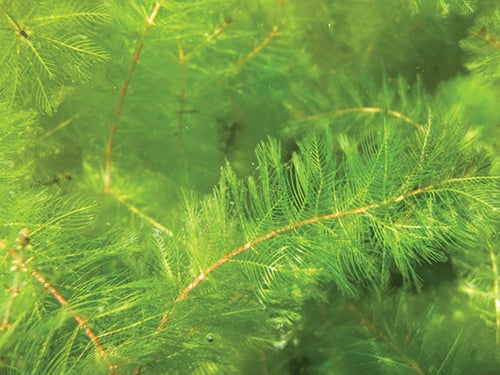
Minnetonka, Minn. — As the Lake Minnetonka lake association and resident-managed lake improvement districts consider annual aquatic invasive vegetation treatment – and streamlining the process – in the west-metro lake’s Harrison Bay, debate has ignited among other lake recreators and residents.
“They’re kind of nuking these bays, and Harrison Bay is a prime example. … They’ve been doing that for three or four years now and there is literally no weeds in that bay, there is very little fish in that bay now,” said Brett Pioske, Lake Minnetonka fishing guide and co-owner of REL Fishing.
Pioske is not alone in avoiding those areas where chemicals are sprayed in an effort to tame aquatic invasive vegetation. More than 1,300 people have signed a petition to curb this type of aquatic plant management on Minnetonka.
While the DNR maintains that the chemical treatments have no adverse effects on fish populations, the petitioners caution that the chemicals tailored to treat curlyleaf pondweed and Eurasian watermilfoil may affect native plant growth, too.
And with the anecdotal observations of native aquatic plants disappearing, fish populations are less likely to reside in bays with little to no foliage, according to the petitioners.
“For our ice-fishing business, North Arm has always been great to us, Maxwell has been good to us. Harrison used to be really good for us, but knowing they are chemically treating these bays, we don’t go in Harrison anymore,” Pioske said.
MORE COVERAGE FROM MINNESOTA OUTDOOR NEWS:
What does the new federal spending law mean for conservation?
Steve McComas: Examining the curious case of disappearing green sunfish from a Minnesota lake
James Lindner: Mapping the modern weedline for summer bass
He added that guides scout in Harrison for crappies, which used to swarm in the bay, but there just aren’t many showing up on their radars.
The petition argues that chemical treatments should be halted now and into the future in an effort to protect fisheries, aquatic habitat, and ecological stability. It maintains that certain residents in certain spots on the lake having the authority to apply and receive permits to chemically treat public water isn’t fair to other recreators on the Twin Cities’ largest metro-area water body.
“This is a public body of water, a massive public body of water, and we’re having these (lake improvement districts) basically making these decisions that could vastly effect an entire ecosystem on the lake,” Pioske said.

Lake improvement districts
Kathy Metzker, the DNR’s land use hydrologist, said that lake improvement districts are created by residents to solve one specific problem on a lake within state rules and guidelines.
“A lake improvement district has no special legal authority or powers, so they can’t do things that would otherwise be illegal,” Metzker said.
She added that the improvement districts are grassroots efforts that are started and spearheaded by residents who live on the lakes or bays the districts manage. One of the reasons that this avenue is sought by some residents is because a lake improvement district can levy the work that it wants to do. The levy is specific to the people on the body of water the district was created to manage.
Lake improvement districts aren’t the only entities that can treat AIS. Referring back to Lake Minnetonka, the Lake Minnetonka Association will treat 10 Minnetonka bays for curlyleaf pondweed and Eurasian watermilfoil from April to September of 2025, and has conducted similar treatments for years.
While the DNR primarily assists in the LID application process and receives annual reports on the work conducted, the local government unit – such as a city council – primarily works with the improvement districts.
“The LGU plays a role in the ongoing administration and running of the LID from an organizational standpoint. … The DNR as an organization may have ongoing involvement with a lake improvement district, if they are doing something like aquatic species management,” Metzker said.
Using Minnetonka as an example, residents on Harrison Bay created an association in 2021 to begin fundraising to mitigate the amount of curlyleaf pondweed in the bay. Under DNR supervision and with licensed contractors, the association funded four years of curlyleaf pondweed chemical treatments and one year of Eurasian watermilfoil chemical treatment. But funding became difficult to sustain.
So, Harrison Bay residents are currently working with Mound City Council to form a lake improvement district with the goal of repairing the bay’s water quality – an attempt to remove it from the Minnesota Pollution Control Agency’s impaired waters list.
At city council meetings since late April, various residents and community members have spoken against the formation of this improvement district. More recently, at the June 24 council meeting when the topic was brought up, council member Kathy McEnaney pushed back on its formation. She cited concerns about another form of taxation on those residents, and the formation of a LID leading to another bay full of chemicals.
There will be another public comment session open for community members at the first council meeting in August, which will likely be the second Tuesday of the month.
Currently, there are about 55 active lake improvement districts operating within the state. Metzker said the DNR has never found an improvement district in violation of the agency’s AIS or aquatic plant management.
AIS treatment
When an aquatic plant management permit hits Mike Verhoeven’s desk, the DNR treats all applications the same, whether they are submitted by a soil and water conservation district, lake association, or LID.
Once a permit is received, the DNR, a SWCD, or other entity sends an AIS specialist to determine the prevalence and effects of the invasive aquatic plants on lake ecology and native aquatic plants.
“The various things related to overall lake health are sort of our primary considerations in those permit decisions,” said Verhoeven, the DNR’s AIS management consultant.
The herbicides raising the eyebrows of Lake Minnetonka recreators are allowed by the DNR because they are approved by the U.S. Environmental Protection Agency and the Minnesota Department of Agriculture to target problem species.
“The concerns that are being highlighted are very much central to the impetus for an AIS management program. We have state statutes and rules that set out this aquatic invasive species management permitting program,” Verhoeven said.
He said the type of plant sought to be destroyed will dictate the type of herbicide that is used to prevent larger unintended plant kills.
“A treatment aimed at controlling Eurasian watermilfoil (a dicot) and avoiding damage to native monocot species would require the use of a dicot-specific herbicide,” Verhoeven said.
He added that the AIS consultants and specialists will continually track the prevalence of invasive versus native aquatic species in a body of water permitted for AIS treatment.
While these herbicides are common practice, with options for mechanical removal of invasive vegetation, the Minnetonka petitioners are calling on the DNR, lake associations, and elected officials to pause chemical treatments on the lake. During that pause, the entities should assess less-harsh alternatives to treat aquatic invasive species, or how these kinds of efforts should be carried out on public bodies of water.
“You don’t go into the Superior National Forest and start cutting down trees with Dutch elm disease,” Pioske said.

Illinois DNR survey captures first blue cat in Carlyle Lake
The southern Illinois reservoir continues to produce a strong crappie fishery. DNR’s 2025 survey produced 26 crappies per hour, with
Illinois’ Outdoor Calendar
A look at upcoming outdoor-related events from across Illinois published in the Oct. 2, 2026 edition of Outdoor News.

Illinois Cuffs & Collars: Illegal minibike at William Powers State Park
Illinois cuffs and collars are field reports from Conservation Police Officers. These reports are from the Oct. 2, 2026 edition

1 thought on “Minnesota’s Lake Minnetonka AIS treatment gets mucky”
Soon the whole lake will be effected if this isn’t stopped. Terrible to destroy a bay like that