





Leech Lake, Minn. — A widely anticipated study will begin as soon as next month in an effort to determine if there is increased muskie mortality on Minnesota’s Leech Lake due to savvier angling pressure.
As a call to action, in coordination with the Minnesota DNR, Leech Lake Band of Ojibwe, and MN-FISH, researchers at Bemidji State University will lead the charge in tagging and tracking muskies for three years.
Bemidji State University Professor Dr. Andrew Hafs is still in the early stages of applying for permits to fit muskies with tracking devices and subsequently monitor them during the tenure of the study.
Ideally, researchers will tag at least 30 muskies: 10 when the DNR is doing its May egg take, 10 that are in deep, open water in the summer, and 10 that are located shallow or near-shore.
“I’m suspicious that fish captured in the depths will have a higher mortality rate, but I don’t know yet. It’s entirely possible that they don’t,” Hafs said.
RELATED COVERAGE FROM OUTDOOR NEWS:
Discussion on forward-facing sonar, walleye limit among hot topics at MN-FISH summit
Commentary: Let’s examine potential solutions of the forward-facing sonar issue and muskies
Jeremy Smith: Time to take a pinpointed approach to managing forward-facing sonar
Despite the suspected higher mortality in muskies that are in the open-water at greater depths in the early summer, Hafs said he isn’t going into the study with any certainty on where or if mortality is on the rise.
Once the muskies are fitted with tags, Hafs and BSU graduate students will routinely go onto the lake with telemetry equipment to download data from tagged muskies.
The study goes beyond understanding whether muskie mortality rates are higher in certain areas compared with others on Leech Lake. According to Hafs, not much research has been conducted on inland waters’ large muskies.
“I think we’re just going to get a lot of really awesome data about overall mortality rates, movement data, and what habitats are actually being used in Leech Lake,” Hafs said.
Beyond trying to grasp how angling pressure may or may not be causing higher mortality of large muskies, the study is intended to uncover habits and movement data of muskies that aren’t fully known.
“My general take is that this is going to be one of the biggest muskie studies on an inland lake … ever,” Hafs said.
Another aspect that he wants to ensure is part of the study is that there are tags on the fish that signify it is being studied, and if it is caught by an angler or found dead, the person should call the researchers or DNR and let them know its whereabouts.
Hafs said there could be opportunities to expand the scope of the study beyond tagging 30 muskies if more funds are raised to support the work. MN-FISH will continue to accept donations to further the effort.
Hafs has served on the DNR’s Leech Lake Fisheries Input Group for around a decade. His experience with that has made him even more eager to monitor Leech Lake muskies to determine if, or how, muskies are surviving with new technology like forward-facing sonar in the angling industry.
“They’re an awesome fish. Getting data on muskies is so hard, so I’m just super excited (to learn) about everything we can,” Hafs said.
Anglers asking for more information
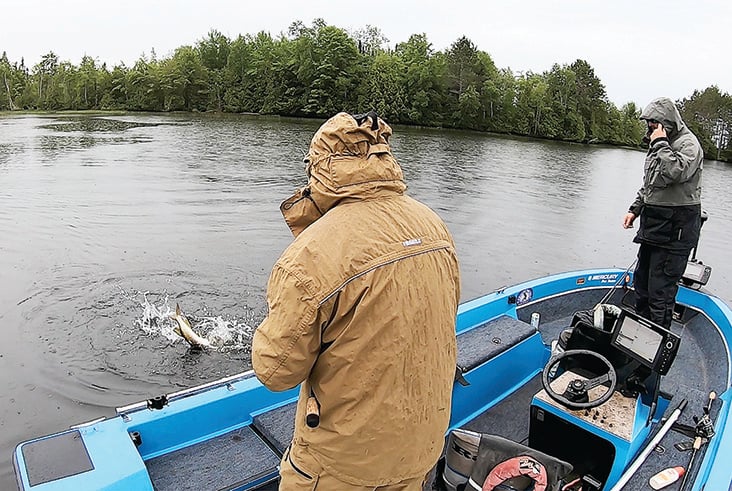
The push for the study came from muskie groups and advocates, including Lindner Media’s Jeremy Smith, given the growing use of forward-facing sonar.
The technology’s ability to assist anglers in locating muskies in open-water areas on Leech has become a larger issue and has drawn calls for protection of the so-called fish of 10,000 casts.
“A lot of people who have fished for muskies for a long time are now seeing what the technology (is capable of) and the way information is exchanged. The catch rates are astounding, and obviously there are some dead fish floating out there,” Smith said.
Even though Smith has been ringing alarm bells regarding Leech’s muskies for about a year, he said he knows that other lakes may be experiencing similar effects of the advanced technology anglers are using.
However, Leech seemed like the obvious venue for the study.
“Leech, we feel, is unique in that it is the mother of all of our muskie fisheries, being the brood stock lake where eggs and fish come from. … So that to me seems to (take) precedence to start to research there,” Smith said.
In a MN-FISH press release last week, the group states that “the three-year study will be a significant step forward in muskie conservation and address growing concerns among some anglers about sustaining muskie populations in the face of advancing fishing technologies and angler skill.
“Leech Lake was selected by the DNR for the study because of its vital role as the primary source of stocked muskie fisheries across the state. Each year during the first week of May, adult muskies – captured by the DNR on Leech Lake – serve as the origin for eggs and brood stock used in Minnesota’s Mississippi-strain muskie stocking programs,” the group said. “The study is designed to help the DNR effectively manage muskie fishing in Leech Lake as well as muskie waters throughout the state.”
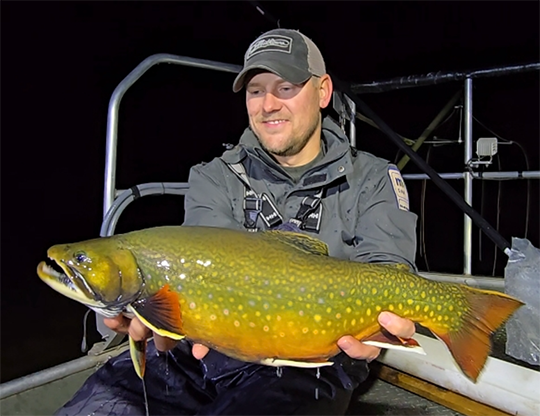
Minnesota DNR seeks to protect Grand Marais’ spawning coaster brookies with possible shutdown of fall fishing
Grand Marais, Minn. — The Minnesota DNR is considering shutting down fall fishing in the harbor of this Lake Superior

Stockings boost angling rebirth at Lake Le-Aqua-Na in northwest Illinois
Recent DNR surveys and stocking efforts offer a snapshot of ongoing efforts to boost Lake Le-Aqua-Na a handful of years
Best method to count Illinois deer herd? AI taking a crack at it
Is AI the answer to sizing up the Illinois deer herd? If nothing else, the technology may at least help
