





The shed-dog craze seems to have slowed down some in recent years. For a while, it was a hot topic in the dog and deer world, and for good reason.
At least for dog lovers, any activity where you can include your four-legged sidekick will be made better by its presence. In the case of shed-hunting dogs, their presence also can add to the bone total.
There really isn’t much downside to training a dog to find shed antlers. It’s purely an additive skill that won’t cannibalize any of its obedience or diminish its bird-hunting talents. But it’s also not as simple as it sounds, often because we don’t quite understand what finding antlers means to our dogs.
1) Rewarding retrievers
Trainers have differing views on what to reward dogs with at different stages of their lives. Most agree that puppies should be treat-trained, but eventually weaned off the calories for some other type of reward.
With retrievers, this move can be nearly seamless because, as their name implies, they want to retrieve.
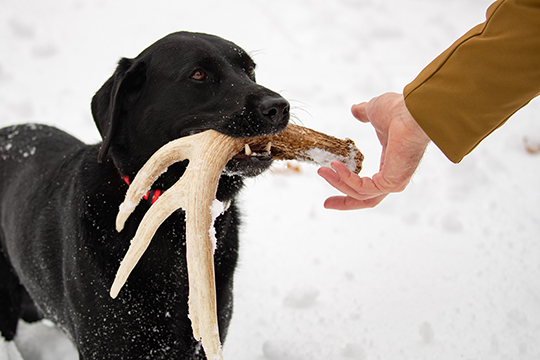
Yet, even well-bred, duck or pheasant retrieving Labradors sometimes don’t seem to care as much for antlers as they do birds (obviously), or even training bumpers. The reality is that most dogs are interested in antlers, but not the same way they’re interested in lots of other objects.
If you’re going to try to train your dog to find antlers, understand that it can be trained to do it, but you might just have to increase the reward ante for a while. Your dog needs to make a positive connection to something that often just isn’t super exciting to them at first.
2) Sight vs. smell
Dogs use their sense of smell the way we use our eyes – to take in the world around them and parse out relevant details by the second.
When a good dog takes to the CRP or the grouse woods, it’s using its nose to scour the landscape for the right scent. This works because live birds give off plenty of scent. Antlers don’t.
While fresh antlers do have some scent, it’s really not even close when compared with birds. This means that your dog is going to want to use its nose to find something that is much easier to find with its eyes.
Training shed dogs involves a heavy emphasis on connecting the sight of an antler to a positive reward. You want your dog to actively scan the brush and investigate anything that might look like an antler.
This is hard for some dogs to understand, because it isn’t as natural as following a scent trail. But through proper training, it is absolutely doable, and it is necessary.
MORE HUNTING FEATURES FROM OUTDOOR NEWS:
Time for a new turkey gun? Here’s what to consider
Take your digital mapping to the next level
Here are basic fire-starting tools to carry in the field
3) Mountains of antlers
This might be the hardest thing for most would-be shed-dog owners to understand. You can train the best dog in the world to be an antler-finding machine, but it won’t matter if you’re not around plenty of antlers.
Think of the best bloodline you could find in a German shorthair, for example. That dog might have the makings of a legendary pointer, but if it rarely gets to hunt birds, or you hunt somewhere where the bird density is really low, the dog’s skills just won’t make up for it.
The same goes for antlers.
Most of us don’t have access to the kind of deer wintering ground that holds dozens of bucks from January to April. If we do, the odds are pretty good we don’t need a whole lot of help finding antlers.
The truth is, a well-trained shed-hunting dog will add to your winter total. But it generally won’t out-hunt you over a long enough timeframe. If you generally find half a dozen antlers in a season, a good dog might bring that total up to nine or 10.
That’s not bad, but it’s not going to be a life-changing amount of bone. It’s still better than shed hunting without your dog, and the antlers the pup does find will make the miles walked a heck of a lot more enjoyable.

Illinois Mixed Bag: Trapping Permit Drawing Set for Shelbyville
DNR has scheduled a public drawing for handing out trapping permits at the Shelbyville State Fish and Wildlife Area.

Illinois Letters to the Editor: Deer hunting has changed for all of us
Reader-submitted letters to the editor published in the Oct. 2, 2026 edition of Illinois Outdoor News.
Ralph Loos: Illinois Outdoor Hall of Fame class has common interest: being useful
You could make a pretty long list of reasons why people get involved in outdoor conservation. Some love hunting. Some
