





Many fields and woodlots may have been somewhat quieter during this fall’s hunting seasons. The silence wasn’t necessarily due to a lack of shooting opportunities, but possibly because more hunters are now adding suppressors to their big-game rifles in record numbers.
It’s rare to pick up an outdoor magazine and not see a successful hunter posing with a trophy buck or bull and the suppressor-equipped rifle he used to shoot the animal.
A suppressor, more commonly called a silencer, is essentially a tube containing baffles and a barrel-sized tube with holes. The gases that propel the bullet are diverted through these holes, and into the baffled area. The baffles slow the gasses to the point where their exit does not make as much of a noise.
Most rifle makers are turning out suppressor-ready models with threaded muzzles, including bolt guns, autoloaders, and even lever-action rifles. The most common thread pattern is 5/8×24, but different suppressors do have different threads.
MORE HUNTING FEATURES FROM OUTDOOR NEWS:
Want to hunt Western big game? Know these tips for navigating tag systems
Here’s how to plan a turkey hunt on western tribal lands in the U.S.
These mini tools will have your mini food plots pulling in deer
Suppressors are legal to own in 42 U.S. states, and legal for hunting in 41. Currently, more than 3 million suppressors are in use in the United States.
Before you purchase a suppressor, you’ll have to address legal concerns, consider your rifle’s characteristics, and what you’ll require from a suppressor.

There are many good reasons to suppress a firearm. The most obvious is noise reduction, in the field and on the range. A suppressor will mute the sound of a rifle shot by 20 to 35 decibels, while also reducing the recoil and muzzle blast of a stout centerfire cartridge.
Adding a suppressor may also improve accuracy, sometimes shrinking groups by up to half an inch.
Here are some things to consider when buying a suppressor is your next step, because doing so is a bit more complicated than buying a gun, and it comes with added costs.
Suppressors rated for centerfire hunting cartridges range from around $600 up to $1,700. That doesn’t include the $200 tax stamp for every suppressor you buy, and the red tape that came along with the National Firearms Act of 1934 that also involves fingerprint cards, photos, and the completion of various forms.
Caliber and pressure
You have to know the caliber of the gun, or guns, you want to suppress before choosing a suppressor. If you have a .45-70 or .450 Bushmaster, you’ll need a suppressor big enough to accommodate the size of the .45 caliber bullet, like the Banish 46 from Silencer Central.
In most cases, you can go down in caliber size. You can, for example, fire a 9mm bullet through a .45 caliber can, or even a .22 LR, but you can’t fire a larger-caliber bullet through a smaller suppressor.
After you’ve determined the caliber basics, check the pressure rating, because not all suppressors are rated for magnum rounds. Silencers with lower pressure ratings are for more specialized, and limited, applications. These suppressors are also often lighter and shorter.
Suppressor size
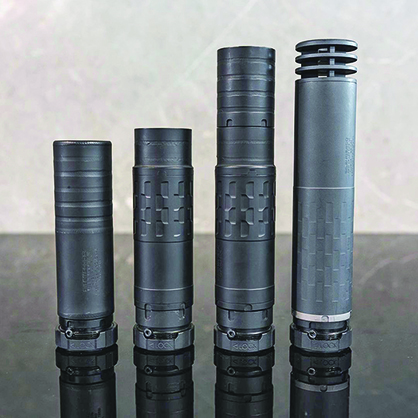
Although many suppressors have fixed lengths, some feature long and short configurations.
In its long configuration, the suppressor will provide best-in-class noise reduction. Reconfiguring the can to a shorter length will save a couple of inches, and also reduce weight without giving up too much noise-reducing capability.
Most rifles use 22- to 26-inch barrels. Some suppressor-ready hunting rifles will likely have shorter barrels, ranging from 18 to 22 inches. For example, a Browning standard X-Bolt, in a magnum chambering, would likely have a 24- or 26-inch barrel.
However, the X-Bolt Speed SR (suppressor ready) could come with a 20- or 22-inch barrel. The shorter, suppressed barrel will make the rifle more maneuverable when stalking through thick brush or when hunting from a small blind.
Some velocity loss can be expected when reducing barrel length. However, a suppressor tends to mitigate the loss compared to a barrel of the same length without a suppressor.
Why weight is important
Adding a suppressor to a rifle, pistol, or even a shotgun will change the way it balances. Consider how much weight you are adding to the platform. If it makes the rifle too heavy or unwieldy, it may not be worth the trouble.
Suppressors must be light and strong. They must resist corrosion and extreme fluctuations of heat, too. Steel and aluminum are tried-and-true, work exceptionally well, and – from a raw material perspective – are readily available. Steel is strong and aluminum is light.
Some early suppressors measured 9 inches and weighed about 2 pounds. That was fine for a predator rifle, but few hunters are willing to pack that extra weight around the mountains or on a long hike into the backcountry. Fortunately, there are now many options for lightweight suppressors that any hunter will find appealing.
Titanium is strong and light and offers exceptional performance properties. Titanium is a go-to for weight conservation, making this a top choice for silencers designed to be carried in the field for long periods of time.
Many suppressor-ready hunting rifles also have shaved ounces, helping to keep the total weight more manageable. The new Ruger American Gen. II rifle even has an optional weight kit you can add inside the rifle’s butt to offset the weight of a suppressor.

Purchasing as a trust
You have two primary choices for buying a suppressor: as an individual or as a legal trust. The main considerations relate to how you intend to use the silencer and what happens to it, legally, upon your ultimate demise.
As an individual, you can buy and use a suppressor, travel with it (where doing so is legal) – everything you’d expect as an owner. As the registered owner, though, you have limitations on who else can possess the silencer.
You can’t loan your suppressor to a friend or relative unless you’re there to accompany it. When you die, your estate will have a headache to deal with even if you have a named beneficiary.
Registering as a trust allows you to add others to the trust. These other people may possess and use the can at your discretion. And you can name, in your trust documents, who the silencer (and trust) will pass to when that time eventually comes.
Several companies will help you navigate the process of buying a suppressor, but Silencer Central creates a free suppressor trust for you if you buy through them, so your spouse and children can also possess the suppressor. They walk you through every step and double-check your paperwork before it is submitted to the ATF. And when your application is approved, they ship the suppressor directly to your home, which might still take several weeks or months.
Top suppressor companies include: Silencer Central’s Banish Line, Dead Air, SilencerCo, Gemtech, Yankee Hill Machine (YHM), Elite Iron, Thunder Beast Arms Corporation (TBAC), and Bowers Group, LLC. More information on these companies is available online. Nosler and Savage also offer a line of suppressors.
Whether you’re young, old, a new hunter, or an experienced woodsman, you will likely shoot better with a suppressor. Once you become accustomed to doing so, you’ll probably never want to shoot or hunt without one.

New York Mixed Bag: DEC Info Locator Virtual Mapping Interface Gets An Upgrade
The New York State Department of Environmental Conservation’s online mapping interface, known as the DEC Info Locator, recently got an

Wisconsin letter to the editor: Mr. Durkin, Please Cut the B.S.
Reader-submitted letters to the from Wisconsin Outdoor News.
Got a hankering to build a wooden canoe? Here’s how to do it
“The way of a canoe is the way of the wilderness and of a freedom almost forgotten. It is an
