





Editor’s Note: The Wood Duck Society and the staff at Outdoor News agree that mounting wood duck houses on trees creates an unnecessary predation hazard for the birds. Following the pole-mounting procedure should reduce wood duck predation by raccoons (and other predators) and produce more young wood ducks.
The most common drawback of using wood to build duck houses is that when poorly constructed, they will last only a year or two before they literally weather apart at the seams.
That is why Outdoor News recommends using cedar (rough side out), overlapping and sloping the roof, insetting the bottom, blunting or pre-drilling and setting all nails (Sheetrock screws also work well), as well as using thin “grip” or “anchor” type cedar shake nails 2 1⁄2 inches long (except to attach cleat spacer to rear wall, where 1 1⁄2-inch nails are used).
Cleaning and accessibility
Since annual cleaning and inspection are an important part of wood duck house projects, easy access is a must. Hinges add expense, and houses with roofs that open up for cleaning are not very strong. Plus, the nest material is a long, sometimes dangerous, reach from the top of the box to the bottom. The simple side wall access door pivoting on two nails permits convenient, safe side access and a much sturdier box.
An added benefit of the side access door is how it simplifies post installation. Note: Placement of the cleaning/access door on the right side wall as you face the front of the house makes installation handy for a right-handed person.
Efficiency
Traditional wooden duck house designs have wasted some wood and created a real “monster” when it comes to carrying and mounting the heavy beasts. Female woodies, goldeneyes and hooded mergansers prefer this snug, 8-by-8-inch interior box dimension, and it can make the boxes much lighter and easier to carry and install.
Duck safety
A 3-by-4-inch duck entrance hole and an 18-inch distance from the bottom of the duck entrance hole to the bottom of the house (17-inch inside distance) are important dimensions to frustrate raccoons and help the hen or the nest survive an attack. Never add a perch to the front of the house. Ducks don’t need it, and raccoons use it for a better grip during an attack.
Installation
Select a relatively open area to pole mount duck boxes. Face the boxes toward an open “flight lane” where woodies are likely to fly by and see the entrance from a distance. Placing the boxes near or over water accomplishes this, as well as being close to where woodies are more likely to spend a lot of time. Don’t rule out posts not close to water. Early morning observation during the nesting season often will reveal pairs of woodies searching favorite areas for nest sites some distance from the closest water. Since raccoons are notorious shoreline predators, these more distant nest locations may be less bothered by raccoons.
Also, don’t be concerned about placing your nest box close to your home or other human activity. Woodies and other cavity nesting ducks are very tolerant of human comings and goings.
Install your house via the relatively low pole-mount method described also in this issue.
Drawing details
1. Use a square to align rear “hinge nail” with front “hinge nail.”
2. Use a wood rasp to round out “finger groove.”
3. Drain holes are not recommend in this house design.
Safety tips
1. Everyone in the woodworking area should wear safety glasses.
2. Adults should closely supervise the use of all tools. Power saws should involve “hands on” adult supervision – if not actual completion by an adult.
Lumber
1. Use grade 3 cedar, rough one side.
2. Sides/front/back/floor 1 inch by 10 inches (actual 3⁄4 by 9 1⁄4).
3. Roof —1 inch by 12 inch (actual 3⁄4-by 11 1⁄4 inches).
4. Rough surface goes out on completed house. One “side” will be smooth unless you make an even number of houses and alternate the direction of your cross cut.
Final considerations
1. Have you attached your 1⁄4-inch mesh exit ladder? (A staple gun works great!)
2. Add 4 inches of cedar shavings as nest base material.
MATERIAL SOURCES
Poles: Eight-foot treated landscape timbers (flat on two sides) from any lumber yard. Discarded steel sign posts sometimes available free to conservation groups from highway departments.
Sheet metal cone guard: Use tin snips, or furnish a heating contractor with a pattern.
Angled support brackets: Purchase 1-inch steel right angle brackets and bend to 40 degrees.
For additional information, visit www.woodducksociety.com
The Junior Pro Team is for youth 18 and under visit www.jrproteam.com
Vistit www.outdoornews.com/Wood-Duck-Challenge/

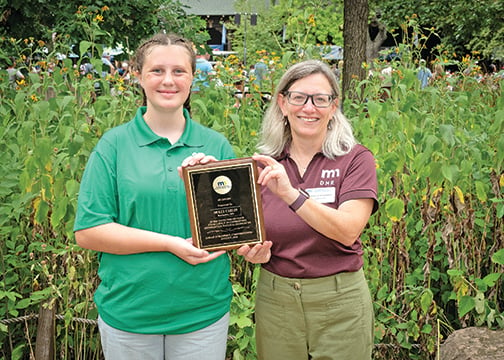
Minnesota DNR recognizes two youth for their conservation efforts
Minnesota DNR Commissioner Sarah Strommen and state Rep. Rick Hansen honored two youths for their outstanding conservation efforts Friday, Sept.

Minnesota Mixed Bag: DNR seeks pine cone collectors ahead of anticipated bumper crop
The DNR is asking the public to collect red pine cones and has increased its payment to $95 per bushel

Minnesota Letters to the Editor: Loons not surviving? Got eagles and trumpeter swans?
Reader-submitted letters to the editor published in the Sept. 11, 2026 edition of Minnesota Outdoor News.
