Key points in the story:
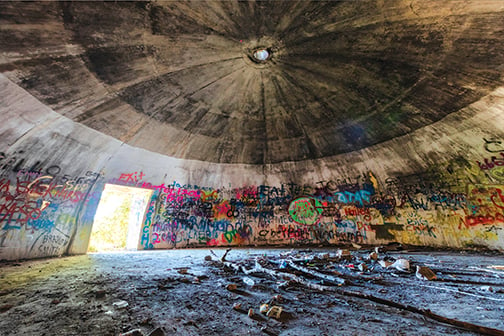
- State Game Land 252 has become a hotspot for illegal activity. The 3,014-acre property in Lycoming and Union counties contains more than 100 abandoned World War II TNT bunkers that have attracted drug and alcohol parties, vandalism, fires, graffiti and litter. A game warden was assaulted there in 2024 while attempting to remove trespassers.
- The Pennsylvania Game Commission has spent significant resources trying to control the problem. Wardens have devoted hundreds of man-hours each year to patrols.
- The Game Commission plans to preserve some bunkers while demolishing most of the others. The agency intends to preserve 16 bunkers because of their historical significance and eventually implode and bury the remains of the rest to restore wildlife habitat.
Williamsport, Pa. — Pennsylvania’s state game lands are usually thought of as places to hunt, trap, or even fish. However, one game land in Lycoming and Union counties is visited often by people hoping to see the old TNT (explosive) bunkers that were built during World War II.
But that property also is known by the Pennsylvania Game Commission for the amount of illegal activity that occurs there.
For years, the commission has been dealing with illegal activity on 3,000-acre State Game Land 252, south of Williamsport. The nefarious activities have centered around the more than 100 abandoned World War II bunkers that exist on game land. They have been used for drug and alcohol parties, and some are filled with graffiti and litter.
Game land 252 is made up of two separate tracts totaling 3,014 acres. It is located in Bradley Township, Lycoming County, and Gregg and Washington townships in Union County. Most of the 17 parking areas are along Route 44 or Alvara Road.
Less than half of the parcel is forested, with the remainder managed herbaceous openings, wetlands (with 19 impoundments) and shrubby areas.
Pheasants are stocked there and rabbit hunting is also popular. Deer, bears, squirrels, woodcock, doves, geese and ducks also are hunted there. Trapping opportunities exist for beavers, mink, muskrats, raccoons, coyotes and red foxes.
According to Lt. Shawna Burkett, information and education supervisor for the Northcentral Region, the commission spends an excessive amount of time and energy patrolling the area and repairing damage to the bunker doors.
“We have spent hundreds of man-hours patrolling there each year,” she said. “There have been fires, vandalism, obscene graffiti, littering and people have been hurt there. In 2024 a game warden was assaulted when attempting to eject trespassers from one of the igloo-shaped bunkers.”
MORE COVERAGE FROM PENNSYLVANIA OUTDOOR NEWS:
Notes off a soiled cuff: Pennsylvania hunter ed instructors aging out
Could Centre County’s Penn’s Cave be a Pennsylvania state park? Decision up in the air
How will fall colors fare in Pennsylvania? Early drought may impact the southeast
History
According to information found at PABucketList.com, in 1942, the U.S. government used eminent domain to seize the small farming town of Alvira and surrounding farms in southern Lycoming County and western Union County.
More 200 people were displaced. The land became the Pennsylvania Ordnance Works, a top secret facility that was used to manufacture and store TNT during World War II. It operated for less than a year.
The TNT was stored in 149 dome-shaped concrete bunkers, many of which are now on State Game Land 252. The Game Commission map of the game land shows the location of the bunkers. They were spaced by the builders so that an explosion at one would be directed upward and not affect the others.
The reinforced concrete bunkers are over 40 feet wide and 24 feet high. They were covered with soil and planted with trees and shrubs to avoid detection from the air.
The Game Commission has tried everything it can to curb the illegal activity, Burkett noted.
“This spring we got fill from PennDOT and used it to block some of the bunker doors,” she said. “However, this has been done before and people dig out the fill and reopen the doors. We have welded shut doors and people have even brought grinders in to cut through the welds.”
Because of their historical value, the commission’s long-range plan is to save 16 of the bunkers. The others are to be destroyed to return the area to productive wildlife habitat.
According to Burkett, the commission has been working with the Pennsylvania State Historical Preservation Office, and officials there are on board with the plan.
“This plan is a work in progress involving engineering studies,” Burkett noted. “The plan is to implode the bunkers and bury the chunks of concrete. The agency has allotted $200,000 to begin demolition in 2027. It will be a costly, drawn-out process, with only a few bunkers destroyed each year.”