




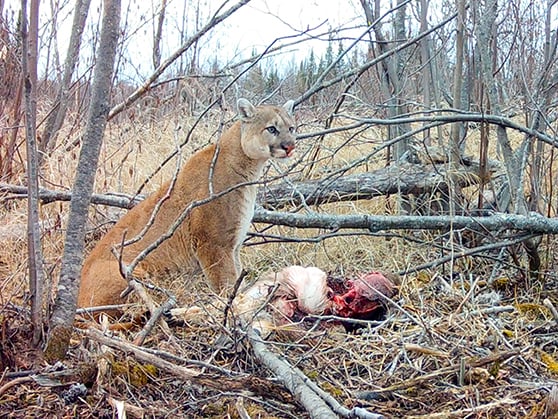
Orr, Minn. — Video evidence of wild cougar breeding activity in northern Minnesota generated big headlines across the region in April. Now, researchers with the Voyageurs Wolf Project have collected DNA from those animals, thus providing an opportunity to determine their genetic origins.
When the story broke three months ago, the DNR said it marked the first time in a century that wild cougar, or mountain lion, breeding activity had been recorded in the state.
Tom Gable, project lead of the Voyageurs Wolf Project, and his team collected samples from two different kill sites: one from a male and the other from a female and her kits. The male’s sample was collected May 5, and the female and kits were collected May 7.
The sites were located just south of Voyageurs National Park.
Around the female’s kill site, Gable said they recovered nine different scats. From those nine samples, genetic material was successfully extracted from five.
The male’s genetic sample came from elsewhere. Researchers searched the area of his kill for scat but found none. Gable said the male killed a deer on a ridge, then dragged the kill about 120 meters down to the edge of a wetland and cached it.
After following the trail where the cougar had been, Gable said they located a hair sample.
“It was a little snag on a little sapling – a little tuft of hair just dangling there and we collected that very meticulously because it was just a tiny little bit,” Gable said. “We put it in an envelope and sent it to the lab. To our great surprise, it worked.”
The scat samples required a little more work.
Gable brought the samples home, and to preserve the genetic integrity, he had to dehydrate them. Once dehydrated, he bagged the samples and sent them off.
All samples went to the National Genomics Center for Wildlife and Fish Conservation in Missoula, Mont., which is run by the U.S. Forest Service. The genetic information is uploaded to a database of genetic samples from across the nation.
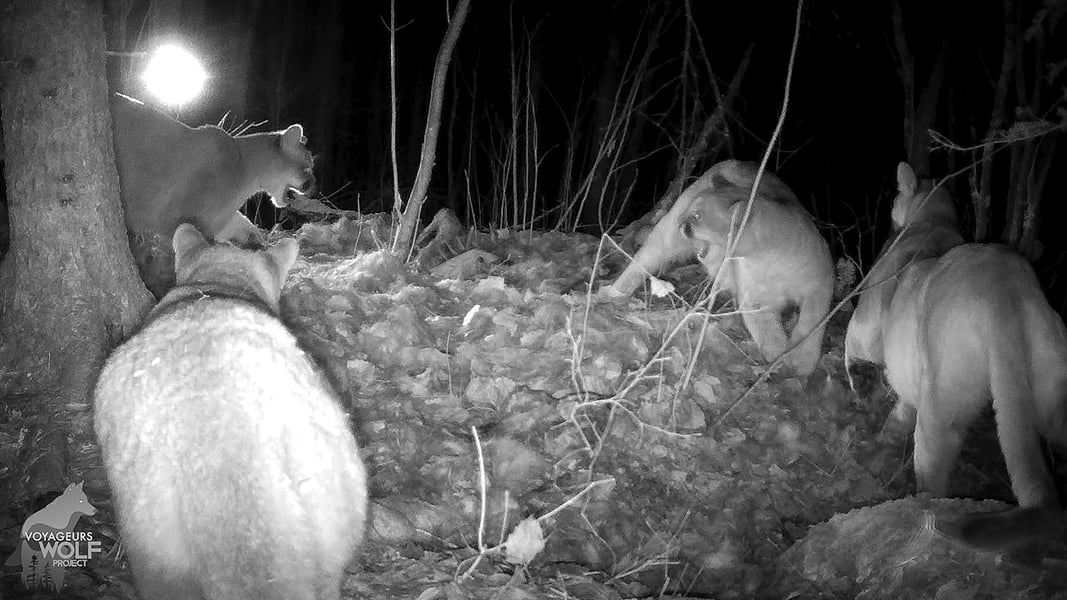
After several weeks, the analysis was completed and returned to Gable the week of July 13. From the results, Gable said genetic material from two of the three kittens was successfully extracted. The analysis showed two of the three kittens were male. From the sample collected from the adult male, Gable said it strongly suggested he sired the kits.
The analysis also provided Gable and researchers with locations where the adults may have originated. It revealed the male was closely related to cougars in the Black Hills region in the western half of South Dakota. The female’s genetics revealed she was closely related to cougars from Nebraska.
“That provides some insight,” Gable said. “Meaning they traveled somewhere between 550 to 700 miles to end up meeting here and having kittens.”
MORE COVERAGE FROM MINNESOTA OUTDOOR NEWS:
Outdoor Insights: Meet Griffith Pugh, a 20-year-old leader on Minnesota’s conservation scene
Minnesota DNR seeks input on three-duck limit proposal
Isle Royale closes two campsites amid wolf activity
As adults, cougars are solitary creatures, and Gable wasn’t surprised to see a male traveling that far. To him, it was more surprising the female covered that ground.
Few females will travel that far to have kittens. Gable said the potential for having a population of cougars in the state is dependent on having enough females dispersed throughout the Great Lakes region.
Gable and researchers plan to continue to monitor and collect genetic samples when able. The Voyageurs Wolf Project has placed 400 cameras spread throughout the area for wolf monitoring. An additional 70 cameras have been deployed this spring and summer in areas where they know cougars are present. Part of the 70 came from the DNR, with Gable sharing information with the agency.
The objective now is to track persistence and see if the cougars are self-sustaining. He said a new population trying to establish itself typically hangs by its claw tips.
“Let’s say that female died and the last kitten was a male. There are no other females that we know of that could start producing kittens,” Gable said. “It does hang on a knife’s edge in some sense of where this is going to go, and we’re interested to try to understand that to the best of our abilities and see if this is a flash in the pan or if this is the beginning of something a bit larger.”
Gable said the work wouldn’t have been possible without funds from the Environment and Natural Resources Trust Fund to collar deer and have the opportunity to observe the cougars. Similarly, he said the research is made possible by many private donations to the Voyageurs Wolf Project.
Learn more at www.voyageurswolfproject.org.
Outdoor Insights: Time to raise Minnesota fishing license fees for nonresidents? And more election season thoughts
Quick comments on a few stories that have appeared in the news recently.
A buddy’s post on social media
Pro Fishing Tip of the Week: Catching fall giants on Mississippi River waters in Minnesota
We guide exclusively on the Mississippi River and the tributaries. The Mississippi is my favorite water body, and choosing between
Minnesota’s deer harvest trending well ahead of 2025
Wildlife managers from the Minnesota DNR expected hunters would shoot more deer this year, and early harvest numbers this fall
