




Taking a deep breath, I eyed the swirling river my grandfather introduced me to nearly 60 years ago. Shiners that I had trapped as he once taught me splashed in a bucket on shore. A kingfisher scolded my intrusion and then darted through the tunnel of trees overhanging the flow.
And just like that, I was a kid again. The current pressed against my legs and everything was familiar and right, from the smells of the water and pines and hemlocks, to the crayfish scuttling away. Catching fish was my focus but there was so much more that mattered.
This trip to the river of my youth was even more special. Over time I have accumulated an embarrassing amount of fishing gear, but until this spring that collection did not include a Mitchell 300, the favorite of my grandfather and the model he used to teach me to fish. One of the venerable spinning reels now hung beneath my old rod, and the first cast was like shaking the hand of an old friend.
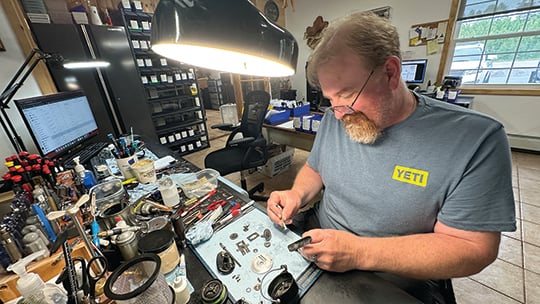
I was reunited with the Mitchell 300 by Mat Hegy, who repairs reels from his shop north of Eagle River, Wis. He and his wife, Marti, and their business, Mat’s Reel Repair, were exhibiting at a sports show last spring.
I spotted a handful of Mitchells and other old reels in their booth. Soon, one of the Mitchells was mine. It turns out my desire to use old fishing equipment is not unique. In fact, refurbishing and selling vintage fishing gear has become a big part of Mat’s and Marti’s business.
“The tackle collecting hobby is popular. We see a lot of guys who collect antique stuff and are looking for parts and repair,” he said. “I don’t know how much we actually sell each year, but we have a pretty good following. We have customers who come up for vacation and stop at our shop to see the reels we have available.”
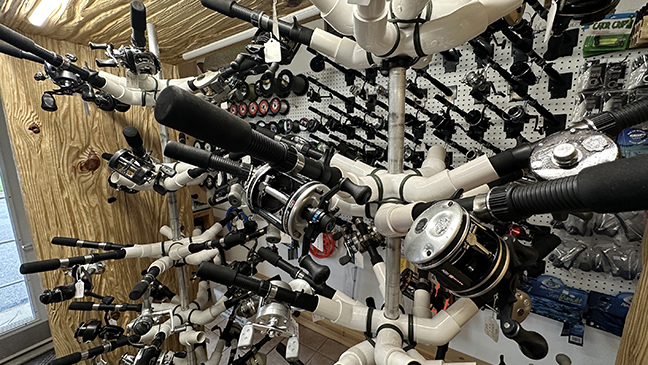
When walking into the shop, you’re greeted by a huge display of antique baitcast and spinning reels. Older, silvery-white Shimano Stradics are especially popular. Mitchell spinning reels are common, whether it’s the 300 size, the ultra-light 308 or the high speed 410.
Shakespeare automatic fly reels and early Abu Garcia baitcasting models are well-represented. And anybody who has ever cast for muskies has to smile and wonder what it would be like to fight the fish of your dreams with a Pflueger Supreme baitcaster.
Hegy called the Mitchell 300 the most popular spinning reel of all time.
“It went unchanged from 1964 to 1984. It was said they sold 110 million of them, which I thought was an astronomical number until you go to a sport show and everybody says, ‘Hey, I have a couple of those in my garage.’ They probably did sell that many,” he said.
FISHING FEATURES FROM OUTDOOR NEWS:
Easy does it down the summer weedline for a great mixed bag of fish
Ron Schara: Fishing trips with legends of sport and cinema
Jeff Frischkorn: Reel Recovery organization offers help after cancer diagnosis
Acquiring reels to refurbish and resell isn’t difficult.
“We possibly have the largest collection of parts in the country,” he said. “We get (reels) from repair centers that have gone out of business. They often have a few totes full of old reels and parts. When we have time we put them together and send them out fishing again.”
How do you set a price for a refurbished reel?
“We look at its condition, the price of parts we had to put into it, and what the market will bear,” Hegy said. “You may get the same reel for less money at a garage sale, but it will not have been cleaned or warrantied. I kind of jokingly say we will guarantee it for 30 fish or 30 days, but we try to be fair. Realistically, we don’t have much trouble with breakdowns with the old reels.”
Vintage tackle has become so popular, Hegy said, that clubs conduct outings in which it’s the only gear that’s allowed for use. Some anglers take things to another level.
“We had guys send us stuff to prepare for an outing on Great Slave Lake for giant northerns,” Hegy said. “They took Pflueger Summits. The ones with no drag, the old knucklebusters. I can’t remember if they paired them with semi-modern rods or old steel rods. But one of the guys got pretty proficient at it. His biggest fish was 48 or 49 inches on antique tackle. He hooked and landed the fish as quickly as with modern tackle. I thought that was pretty impressive.”
Fishing creates strong memories. Hegy feels that drives the vintage market.
“A lot of it is sentimental.
People say their dad or grandpa had that reel. Sometimes the value of the reel isn’t worth what we’re putting into it, but it’s hard to put a price on sentimental value. Old reels, cheap reels, it doesn’t matter. If it was your dad’s or uncle’s reel – you can’t replace that.”
Still, repairing reels remains Hegy’s business. He fixes more than 5,000 reels each year.
“We get stuff from a Zebco 202 to $3,000 ocean reels from all over the country,” he said. “But if someone wants to buy vintage tackle, they have to contact us. Mitchell 300s and 308s are listed online, but everything else is constantly rotating.”

Pennsylvania’s hunting license sales down so far this year
Hunting license sales are down nearly 4.5% at the end of August, although Pennsylvania Game Commission officials believe there is

Origin of road-killed armadillo in southwest Ohio a mystery
An armadillo found as roadkill in southwest Ohio has researchers scratching their collective heads wondering from where the non-native mammal

Bowhunt gets started in Ohio with additional opportunity in CWD surveillance area
Hunters in Ohio’s chronic wasting disease (CWD) surveillance area have additional dates this season to pursue white-tailed deer. The Ohio
