




Key points from this story:
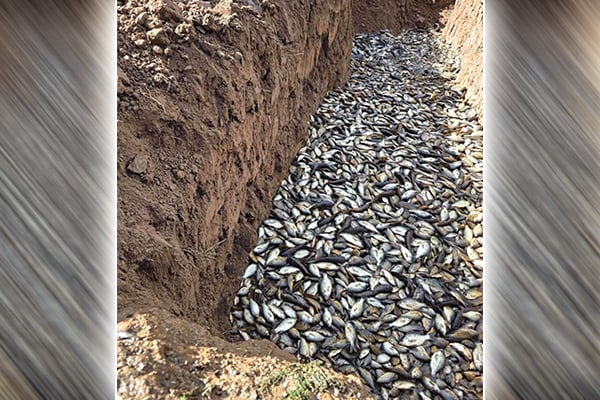
- Fish salvage operation sparks public anger: The Pennsylvania Fish & Boat Commission relocated an estimated 30,000 pounds of fish from 75-acre Fords Lake to the Susquehanna River on Oct. 14-15 ahead of a $3.1 million dam rehabilitation project. However, hundreds or potentially more than 1,000 remaining fish, including largemouth bass, crappie and other panfish, were found in a pit where they were to be buried.
- Anglers and lawmakers demand answers: The discovery prompted widespread criticism on social media, with anglers questioning why more fish could not be saved. Some state politicians condemned the practice as wasteful and cruel. The commission said it’s an unfortunate, yet common, method during projects where lakes need to be drained for dam repairs.
Wilkes-Barre, Pa. — A fish salvage operation that concluded with a significant number of fish being buried in a pit at a Lackawanna County lake has generated a public outcry against the Pennsylvania Fish & Boat Commission.
Fords Lake in Dalton is a state-owned impoundment managed by the commission. The 75-acre lake had been scheduled for a $3.1 million dam rehabilitation project for next spring. As part of the work, the commission began drawing down the water level in the lake earlier this month.
Through the year the Fish & Boat Commission lifted all fishing regulations on the lake, allowing anglers to catch and keep anything regardless of size and species. The move was made to reduce the fishery prior to draining the lake.
For the fish that remained, the commission planned to capture as many as possible and release them in the Susquehanna River.
On Oct. 14 and 15, the agency hauled 10 truckloads of fish – an estimated 30,000 pounds in all – to the river, according to communications director Mike Parker.
However, Parker acknowledged that fish salvage operations never collect 100% of the fish, and those that remain are typically ones that wouldn’t be able to survive being transported.
MORE COVERAGE FROM PENNSYLVANIA OUTDOOR NEWS:
Pennsylvania elk guides charged with trespassing after killing of possible record bull
Commentary: Pennsylvania’s suburban deer need to be managed for people’s benefit
80 years of training dogs at Pennsylvania’s Rolfe Beagle Club
And that’s what several anglers and others discovered in a pit dug near the lake. Estimates claim hundreds or more than 1,000 fish – many still alive – were deposited into the pit where they were to be buried.
Parker confirmed the finding, but said it’s an unfortunate, yet common, method during projects where lakes need to be drained for dam repairs.
“The last resort is to place the remaining fish that aren’t salvageable into a large hole and compost them,” Parker said. “That’s done after all other options are exhausted, and unfortunately some fish perish.”
Known as a “dead hole,” the practice is standard with many large scale fish operations, such as the one at Fords Lake. Parker said more fish were relocated than left behind at Fords Lake, and considering the large fishery, the salvage operation was considered a success.
However, anglers and others who spotted the hole with fish at the bottom posted images to social media, eliciting a critical response.
Hanover Township resident George Bowers, who is a member of several bass fishing organizations in the area, has fished Fords Lake in the past. He said the images of the fish in an open pit was a “total shame” and questioned if more could’ve been done.
“Sport fishermen practice catch-and-release and do everything we can to keep fish alive during a tournament, and then you see this where thousands of fish are left in a hole flopping around in the mud – it’s a shame,” Bowers said.
Among the species present in the pit were largemouth bass, crappie and other panfish.
Bowers said the incident at Fords Lake sends a mixed signal as anglers strive to obey Fish & Boat Commission laws on keeping fish, and then the agency buries fish in a pit.
“I understand the need to drain the lake and replace the dam, but those fish could’ve been transported somewhere else,” he said.
Some comments on social media suggested enlisting local fishing clubs to capture the fish and release them elsewhere. Parker said that isn’t a feasible option because the muddy lakebed presents a safety issue.
He added that stocking fish in other bodies of water can introduce pathogens and invasive species that can harm the existing fishery and habitat.
The Susquehanna River was deemed an acceptable repository for the 10 truckloads of fish collected from Fords Lake because the size of the river and the presence of species already found there presented little risk.
In addition to criticism from the public, the incident also generated a sharp response from several state legislators.

State Rep. Jim Haddock and Sen. Marty Flynn, both serving parts of Lackawanna and Luzerne counties, issued a joint statement saying they were “sickened and appalled” by the number of fish lost at Fords Lake.
They also demanded answers from the commission about how many fish were lost and the decisions leading up to the outcome. The two legislators also stated they intend to bring their concerns to the agency’s board of commissioners.
State Rep. Dave Maloney, R-Berks County, who is the minority chair of the House Game and Fisheries Committee, called the incident “one of the most outrageous and hideous acts of cruelty and waste I have come across.”
If a member of the public did something similar, he said, they would be met with fines and potential jail time.
Parker said the agency is aware of the negativity generated by the incident at Fords Lake. He said the agency has conducted dozens of dam rehabilitation projects over the last decade, and the loss of fish is a part of the process.
“We agree we can do a better job when conducting these types of operations in the future,” Parker said.. “Unfortunately, not every fish is going to make it out of the lake, and that’s part of the price we have to pay for these projects.”
As for the future, work on the dam will begin next spring and will take one and a half years to complete. While the lakebed is exposed, the Fish & Boat agency will install fish habitat structures to improve the fishery.
The lake will be refilled, Parker said, and the commission will restock it with a variety of forage and game fish similar to what was present before. It will take roughly five years to re-establish the fishery, he said, and anglers will be limited to catch-and-release fishing during that period.
“You will have a period where you lose the lake, but after a number of years it will be back much better than before,” he said.

Ohio Division of Wildlife manager Comer retires after 32 years
West Mansfield, Ohio — On Oct. 31, the banquet room at the West Mansfield Sportsman’s Club filled to capacity as
Fooling the wise: Try these tricks to bag wily waterfowl during late season
Even in north-country states like Minnesota that get first crack at fresh birds coming down from Canada, sharp-eyed ducks quickly

Episode 617 – Minnesota deer opener. Post-election notes. Grunt tube tricks with Tony Peterson. DU’s ‘Into The Vault’ fundraiser. FFS research
Lots of whitetail chatter as the Nov. 7 firearms deer opener kicks off. Tony Peterson spends a segment recapping his
