




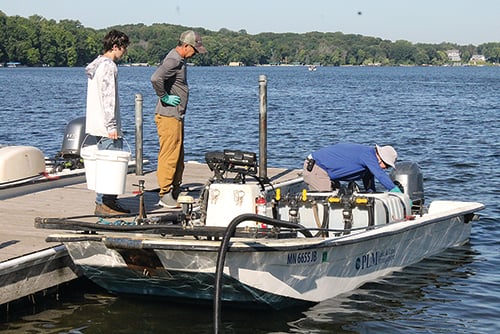
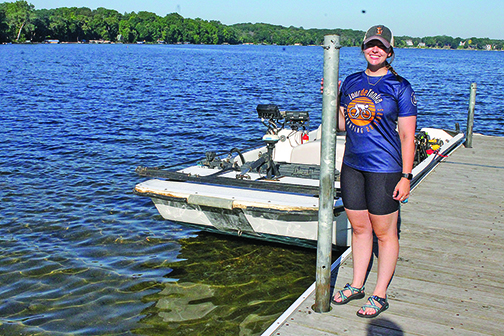
Eden Prairie, Minn. — As Olivia Nyffeler stepped onto a boat along the shores of Minnesota’s roughly 300-acre Lake Riley, she clapped and raised her hands in celebration.
“All right,” she yelled, barely able to contain her enthusiasm. “Here we go!”
Nyffeler, a University of Minnesota Ph.D. student working with the Minnesota Aquatic Invasive Species Research Center (MAISRC), was heading out on the southwest Twin Cities metro lake to witness the first-ever, whole-lake application of copper sulfate in the battle against invasive zebra mussels.
“This is exciting,” Nyffeler said.
“This has been a very long time in coming. There have been multiple Ph.D. students working on this problem even before me, and I’m just the student that gets to push this over the finish line. I’m very grateful for all the other students before me who were dealing with zebra mussels.”
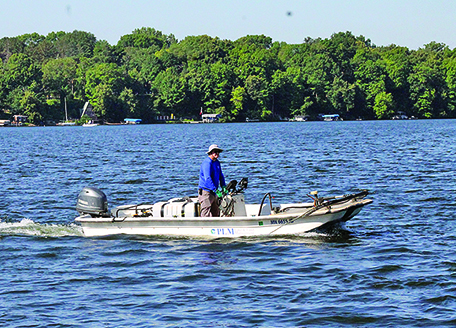
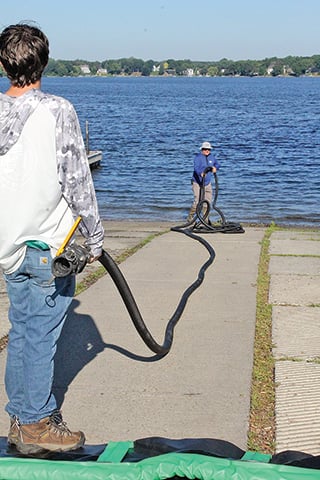
Monday, July 13, marked the beginning of the next phase of MAISRC’s groundbreaking Low-Dose Copper Application Project. Over a three-week period, contractor PLM Lake & Land Management Corporation will be spreading hundreds of gallons of EarthTec QZ – an EPA-approved copper sulfate solution – throughout the entire 296-acre lake. PLM uses computers and GPS to guide its boats through the water to evenly distribute the chemical.
“We’re applying an incredibly low dose … only 10 to 11% of the maximum dose allowed,” Nyffeler said. “We’re trying to target only the zebra mussels and not have any harmful effects to anything else in the lake … the fish community, plant community and snails.”
The dose is so low that it does not impact recreational uses of the lake, like swimming or skiing. “It’s very safe,” she assured.
The copper sulfate being distributed in Lake Riley is specifically targeting zebra mussel veligers (the larval stage) and juvenile zebra mussels.
MORE COVERAGE FROM MINNESOTA OUTDOOR NEWS:
Outdoor Insights: Minnesota loses a huge fishing advocate in Tom Neustrom
National meeting of Ikes brings conservation gathering to Minnesota this week
Commentary: Results of Oregon lawsuit could reshape public lands
Once the copper treatment is completed, the U of M will collaborate with the USGS Upper Mississippi Environmental Science Center, Riley-Purgatory-Bluff Creek Watershed District and the Lake Riley Improvement Association to monitor the lake’s water quality and zebra mussel populations to see if the experimental effort works.
“We plan to monitor all aspects of the lake’s ecosystem for at least two to three years post-treatment,” Nyffeler said.
Promising results
For years, copper sulfate has been used to control algae growth and invasive vegetation in lakes, but only recently has it been used on zebra mussels.
“It’s not a new technology,” Nyffeler said. “But we started doing lab experiments to see what it takes to kill zebra mussels in a jar.”
Those experiments led to larger scale testing within St. Alban’s Bay on Lake Minnetonka from 2019 through 2021.
“We saw some success with that,” she reported. “The next step was to scale this to something larger than a bay. Can we do this in a real lake that is closed and measure the effects?”
Researchers identified Lake Riley as a strong candidate for the copper sulfate project. The lake, along the border of Chanhassen and Eden Prairie, was first infected with zebra mussels around 2018 and populations exploded in just a few short years. It now has a strong, reproducing zebra mussel population.
Nyffeler said Lake Riley Improvement Association is in full support of the copper sulfate project, and lake associations around the state are anxious to see how the research goes. But it’ll be years before any future treatment option is approved for wider use, she warned.
“Historically, homeowners have been told that if zebra mussels are in your lake, that’s just too bad. There’s not much we could do,” she said. “But now we’re kind of starting to offer a path toward a potential solution of at least suppressing the population, so homeowners can see the health of their lake improve. I don’t think we’ll ever be able to fully get rid of zebra mussels in a lake, but maybe we will be able to tamp down that population.”
An expanding problem
The non-native mussels were first introduced in the United States in the 1980s when ocean-going ships infected the Great Lakes with zebra mussels. They have since spread to lakes throughout the U.S. and Canada.
According to the Minnesota DNR, about 5% of the state’s lakes – a total of 378 lakes as of June 2025 – are infested with “zeebs.” Several rivers in the state also have them.
“Zebra mussels are ecosystem engineers,” Nyffeler said. “They essentially change the lake just by being in it.”
Pennsylvania’s Pine Creek Rail Trail celebrated as state’s Trail of Year
Locals and visitors gathered in this town at the northern terminus of the Pine Creek Rail Trail the weekend of
When a selfless stranger saved my opening day deer hunt
The headlight bobbing up ahead was not a welcome sight. It was opening morning of firearms deer season, and more

Steve Sarley: A ‘beginner’ offers his own shotgunning advice
Last time out, I wrote about how I started in the shooting sports. I said I would write about how
