




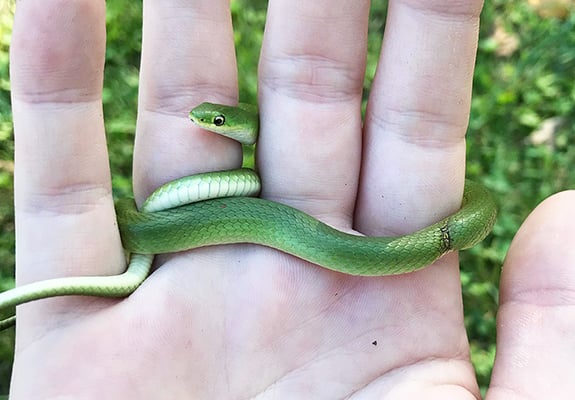
Editor’s note: The Will County Forest Preserve recently released its latest installment of a Wild Science Q&A interview series. In it, we meet Becky Blankenship, wildlife ecologist for the Forest Preserve District of Will County.
Joliet, Ill. — Becky Blankenship had been searching throughout the Will County Forest Preserve District for smooth greensnake nests – with no luck. She found plenty of other snakes under the coverboards she uses to attract the snakes for research purposes. There were eastern foxsnakes, DeKay’s brownsnakes and plains gartersnakes under the boards, but still no smooth greensnakes.
There were times she would check 80 coverboards over a two-day period searching for the snakes. And then, finally, on July 29, she found what she had sought since spring. She didn’t find the adult snakes, but she found their nests.
Blankenship witnessed a hatchling peek out of an egg while she was photographing a nest. After the eggs are done hatching, Blankenship collects the eggshells and submits them to the Peggy Notebaert Nature Museum for further research.
MORE COVERAGE FROM ILLINOIS OUTDOOR NEWS:
Ralph Loos: No mystery anymore about where Illinois hunters, sharpshooters are killing deer
A day of sampling fish on the Mississippi River is an eye-opening experience
Illinois bobcat season again to max out at 2,000 permits
Here in her own words as part of a Q and A, are the reasons for her research:
Q: Why are you surveying smooth greensnakes?
Blankenship: Smooth greensnakes are currently designated as a Species of Greatest Conservation Need and have been formally petitioned to be added to the Illinois List of Endangered and Threatened Species. Data collection is a valuable tool used to inform conservation efforts. On a local scale, we need to document where this species occurs in our preserves so we can make informed decisions regarding habitat management.

Q: What is the goal of your research project?
Blankenship: The overall goal of this research is to record smooth greensnake locations and identify their breeding habitat. This allows us to prioritize protecting areas where this species has been observed and better understand their distribution in Will County. Adult smooth greensnakes can be difficult to detect because they can quickly disappear into vegetation. To improve the odds of detecting this species, I deployed coverboards for the snakes to nest under. While walking between boards, I keep my eyes out for adults, but I have only found nests so far during this project.
Q: Can you describe the snakes and their habits and habitats?
Blankenship: Smooth greensnakes are well named since they are smooth scaled, bright green on top, and white on the bottom. They are very slender and can get up to 33 inches long. They eat small invertebrates like crickets, spiders and snails. This species lives in a variety of grassland types such as prairies, sedge meadows, marshes, old fields, etc. Nesting needs to occur somewhere that will stay moist to prevent the eggs from drying out, such as under logs, in duff, under coverboards, or even in ant mounds. This species is also known to nest and overwinter communally.
Q: How many smooth greensnakes have you located, and were they in just one preserve or throughout the district?
Blankenship: We have records of this species at less than 10 preserves throughout the district, with a couple records from the 90s. Since 2020, I have only encountered adults a handful of times at a few sites. So far this season, I have documented four nests.
Q: Why are smooth greensnakes in decline?
Blankenship: As with a majority of declining species, habitat loss is the main driver for population declines. Illinois has lost almost all its natural prairies, making the remaining snake populations very restricted and isolated.
Habitat restoration is necessary for this species’ conservation, but it must be done responsibly to mitigate potentially negative consequences. Even if habitat is restored, this species has fairly restricted home ranges, so they do not easily populate new areas.
Another major threat to this species is the loss of their prey base from the use of insecticides. Increased drought conditions can desiccate or dry out eggs. Nest predators can include beetles, ants and shrews.

Minnesota Game Fair preview: Danny Suggs breaks barriers, one fishing trip at a time
There are few people in the fishing industry who have had as prolific a career as Danny Suggs, a Minneapolis-based

New York’s 2026-27 hunting and trapping licenses now on sale
After a few days of making sure things were running smoothly, the New York State Department of Environmental Conservation officially
Trophy catfish plan advances for Pittsburgh’s Three Rivers
Just a few days after the Pennsylvania Fish & Boat Commission put the finishing touch on its plan to create
