




Outdoor News may earn revenue from products shown on this page by participating in affiliate programs. This comes at no extra cost to you. Click here to learn more.
There’s no question that you can catch a lot of bass during the late summer months by fishing weedlines, docks, and rock piles.
But if you’re more into catching quality bass rather than numbers, consider Tom Noe’s approach.
Noe is a big bass specialist from Watervaliet, Mich., in the southwest corner of the state. He’s a “puncher” who has chased big bass throughout the Upper Midwest, keying on the thickest and nastiest vegetation he can find.
Armed with heavy duty tackle, he will pitch heavy weighted plastics into the thick stuff, let it rush to the bottom then wind in and pitch again.
“This isn’t a pattern you use to go catch 20 or 30 bass,” he said. “You might get 15 bites, but most of them are going to be from quality bass, like 3- to 6-pounders.”
MORE BASS COVERAGE FROM OUTDOOR NEWS:
September means smallmouths on a binge in these Michigan waters
Try using subtle baits boldly for late-summer bass
Here are your best bets for bronzebacks in southern Ohio
Noe says bigger bass like to set up in isolated areas that provide them overhead cover, security and an optimum ambush area.
This is especially true when late season cold fronts and bluebird days pass through an area and the fish seemingly aren’t in a chasing mood.
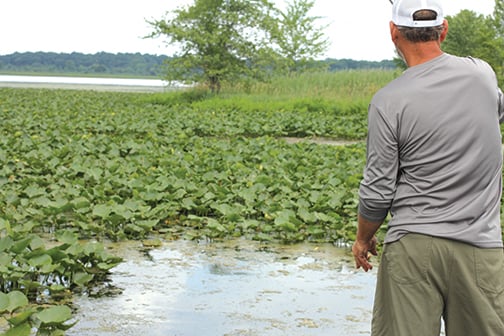
Some of best heavy cover/slop fishing is found around thick grass beds or clumpy lily pads on flats bordering relatively deeper water. Noe likes those weedy flats with lily pad clumps that provide abundant canopies of shade for big bass.
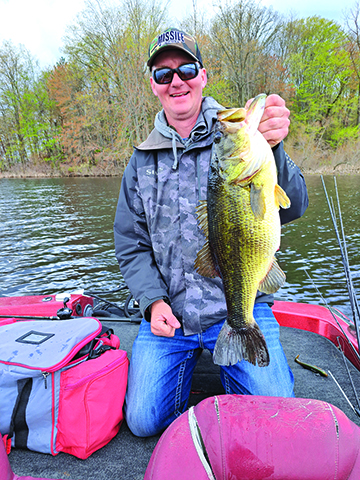
“It helps for that area to have pockets and openings where the forage can flourish, move about and eat insects,” he said. “I’ve found the biggest bass are in those areas where the cover is thickest yet has openings nearby.”
He also likes areas where the algae is thickest and looks like cheese spread over the top of shallow vegetation.
“The uglier and nastier it looks, the better it can be,” he insists.
While much of his punching is done shallow, he said anglers can’t overlook deeper water where deep growing vegetation is harder to see.
“I like those deeper, thick grass mats that are growing within 2 feet of the surface,” he said. “The bigger fish seem to like those deeper areas, especially matted grass that may be separated from the primary weedline. The water may be as deep as 12 feet, but if the vegetation forms some kind of overhead cover, they will use it. Most anglers don’t think to punch a lure in there.”
He’s tried a number of lures, but is convinced that smaller soft plastics with fewer appendages work best for slithering through the plants.
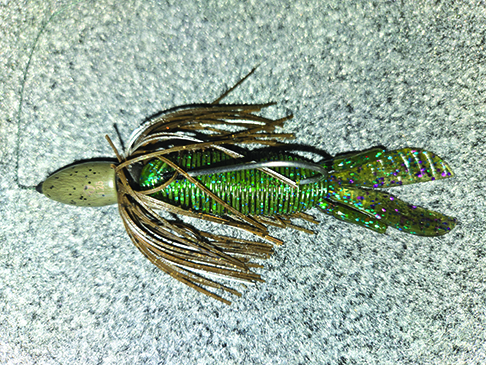
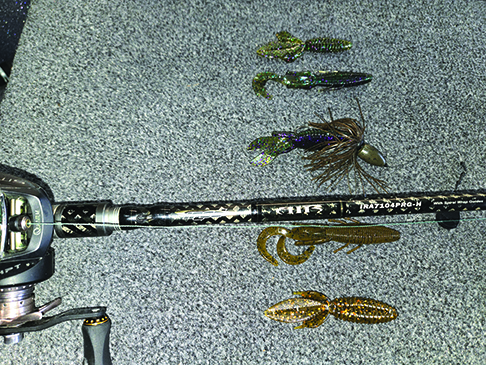
Among those are the Missile Baits Baby D-Bomb and Baby Destroyer, Smallie Beaver, Strike King Rodent, and if there are more openings in the grass, he will use a Zoom Speed Craw.
“You want the bait to slide through the cover easily,” he said. “Baits with a lot of active appendages will catch on grass and slime.
Colors? Well, he keeps it simple, opting for most green pumpkin colors and “nothing translucent or bright. I want to emulate small bluegills, even in lakes that have shad.”
His rig is equally critical. He rigs with a 1-¼-ounce tungsten slip sinker (tungsten is smaller than lead of equal weight) and a Gambler KO Punch skirt.
He pins the slip sinker to the fishing line with a Decoy Heavy Lock bobber stop that keeps the sinker against the soft plastic. The end of the line is threaded through the weight; the punch skirt is added to cover the 3/0 Owner Jungle Hook tied to the line and the soft plastic lure is Texas rigged to make it more weedless.
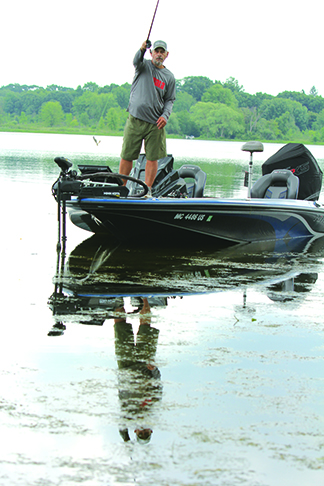
“I want to keep my lure package small so it goes through the cover well,” he said. “I’ve found that works best for me.”
Speed is the key. He wants the bait to pop through the mat easily without a lot of commotion and then zoom to the bottom.
“That often triggers reaction strikes,” he said. “I cover the water quickly; when they’re biting good, they will eat it on the first pitch.”
If he hits six likely looking spots without a bite, he will go back through those areas and yo-yo the presentation, raising the lure to beneath the bottom of the mat and shake it, lower it a few inches and shake it again.
He has experimented with heavier sinkers for a faster fall, but says his landing success drops considerably. Lighter weights take longer; if the vegetation is less thick, he will opt for a ½- to ¾-ounce jig instead.
Because this is close quarters combat with quality bass in thick cover, it requires beefy tackle. His rod is a 7-10 heavy action IRod Air Series with a baitcaster spooled with green, 50-pound PowerPro Braid.
The key to a baitcaster choice is to use one with the drag winched down and one that can handle the stress of wrestling bass out of thick cover.
Not just any bass, but the trophy kind you dream about every time you go fishing.

Michigan Mixed Bag: Night-time walleye surveys scheduled on several of the state’s waters through Mid-October
Nighttime walleye recruitment surveys are being conducted from late September to mid-October, putting DNR survey crews on the water at
Wednesday, Sept. 23 marks Travel Management Rule comment deadline
Managing travel and access is one of conservation’s trickiest topics.
Ask most hunters whether they’d rather drive right to
Michigan DNR clarifies rule changes in effect for trout, salmon, sturgeon
Michigan anglers have some additional fishing regulations to keep in mind this fall after the DNR clarified several changes that
