





About 20 years and four Labrador retrievers ago, I was perched in a dense cattail island awaiting the first flights of ducks. It was opening day, and prospects looked good for me and my energetic, 11-month-old Lab, Mercury.
While we passed the minutes waiting for legal shooting time, dozens of blue-winged teal and a few wood ducks sizzled over our decoys, some alighting within the set. Moments after the clock struck legal shooting, I dropped a pair of gorgeous drake woodies, which Merc deftly retrieved. A bit later, a teal was added to our bag before the action ebbed and the ducks became scarce.
For the next hour, Mercury and I continued to scan the horizon for incoming waterfowl without a single sighting.
Then, a high-flying flock of teal appeared, nearly straight above us. I took careful aim and swung far in front of the lead bird, allowing not only for the bird’s elevation, but its speed of flight, then pulled the trigger.
At the gun’s report, the teal buckled, then recovered enough to set its wings and sail off the lake, over a stand of trees, and out farther, only to suddenly drop from the sky into a soybean field. With that one shot, the hunt went from easy to arduous.
The distance was so great and the obstacles too many to send youngster Merc after the bird by himself. By his excited demeanor, I could tell he marked the bird, but I waded with him to the point where the bird had left the lake, fully intending to walk him through the woodlot and into the beanfield to retrieve the teal.
MORE DOG COVERAGE FROM OUTDOOR NEWS:
How to handle aging dogs when the heat is on
Is your student (pup) not paying attention? There might be a good reason
Don’t make these mistakes when socializing your new puppy
When we reached the heavy cattail shoreline, Merc plowed away from my side, barged through cattails and up a rise, and disappeared into the woods. Mired in the weeds and muck, there was not much I could do but try to reach the field to help him find the bird.
As I was slowly bull-dogging cattails, Merc appeared like a lightning bolt, a drake bluewing softly clamped in his jaws. His expression told me all our months of marking training had now paid dividends, and that I should have remained in the blind. After a couple “good boys,” we headed back to continue our hunt. I did not leave the blind again. I left the duck gathering to confident little Mercury.
That tale illustrates just how well-planned game-dog training can pay off in the field. Besides creating a great story, Mercury carried out two important hunting dog tasks: accurately marking and then bringing back a wounded bird from difficult terrain.
While training dogs in home yards can reap dividends, training in varying cover depths and with a partner is the apex of teaching marking. When you combine both, the training will crank out experienced, confident hunting dogs. In my mind, pinpoint marking is the most important asset a game dog can have, and I train exhaustingly toward that end.
I generally begin with short marks in short cover, gradually lengthening them out to 150 yards. The next step is to repeat that in higher and higher cover and over changing terrain.
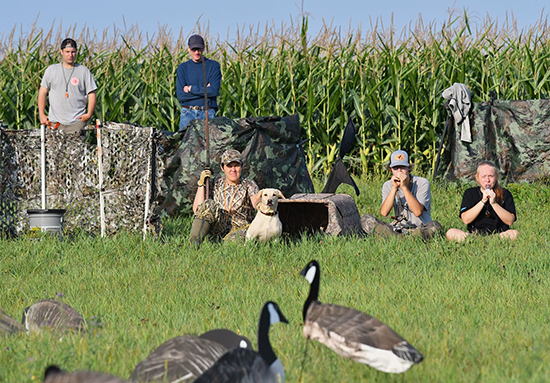
Running a dog through an obstacle such as a shallow ditch or brushy fence line will sometimes create a wall to the dog.
Work on getting your pup to power through those spots by launching your marks near the obstacle, then move back incrementally until the dog nails it.
Most of these sessions should be run into the wind to increase the success rate and the dog’s confidence.
Using a dummy launcher with varying power loads is a great way for solo trainers to get birds out a fair distance. Better yet, have a partner who can use the launcher to jettison birds from a more distant position. This not only lengthens marks, but it also lets you concentrate on handling your dog.
To accurately mimic real bird hunts, your training pal can toss birds from a blind while you fire shotgun blanks. This work should be done both in fields and over water.
Dogs that excel at blind retrieves are a joy to watch, but typically, retrieves can be accomplished more quickly if the dog is set up to mark birds himself. Hunters who do most of their hunting from boats should position both boat and dog to make marking easy and clear.
My dogs perch on the front deck of my rig and are able to peer over the blind in any direction. Other folks position their dogs on an aft hunt deck, which accomplishes the same thing. My dogs and I hunt wood ducks frequently and hide on a heavily wooded shoreline. I tether either Cash or Jet to a tree and use pruning shears to create an “observation lane” for them.
To keep hunts flowing and marks easy, avoid sketchy shots; keep them over the decoys so the birds fall in close proximity, if possible. This is doubly true with young dogs on their first hunts.
One last tip: Do not over-train.
Keep sessions short. Twenty to 30 minutes is plenty, and two or three days per week is enough.
Training a hunting dog solo can result in a great dog, but often it takes loads of time and a lot of specialized gear. Training with range-extending launchers and friends can set the bar even higher and propel a good dog to great. It may never be asked to retrieve a teal hundreds of yards away, but it always makes a waterfowler smile to know the dog can do it if called upon.
Plus, the resulting stories are the stuff great memories are made of.

Minnesota Mixed Bag: New state parks license plate contest accepting entries through Oct. 31
The Minnesota DNR reminds Minnesotans that they may submit designs for the next state parks and trails license plate through

Minnesota Letters to the Editor: The circle of life doesn’t bode well for young waterfowl
Reader-submitted letters to the editor published in the Sept. 25, 2026 edition of Minnesota Outdoor News.
Another View: Time to reimagine firearms safety programs
I grew up in Brainerd, Minn., in the 1980s, counting down the days until I earned my firearms safety certification,
