





Editor’s note: For subscribers searching for some leisurely reading during the long days of summer, Outdoor News is reprinting a seminal piece of American literature. Ernest Hemingway’s “Big Two-Hearted River” marks its centennial in 2025, and this publication will print the lengthy story in four parts over our next several issues.
This story of a young World War I veteran seeking solace in the battered, post-logging era landscape of Michigan’s Upper Peninsula first appeared in 1925 in Hemingway’s collection of short stories entitled, “In Our Time.” Hemingway was living in Paris but crafted the piece from his many trout fishing experiences in the region. The story is one of the earliest to employ Hemingway’s iceberg theory of writing; a modernist approach in which the underlying meaning is hinted at, rather than openly stated. Like much of Hemingway’s writing, it requires readers to read between the lines.
The story features a single protagonist, Hemingway’s recurrent autobiographical character, Nick Adams, and it explores the destructive qualities of war countered by the healing and regenerative powers of nature.
Author and journalist John Maclean published a version of Big Two-Hearted River (which is now in the public domain) two years ago, and he graciously has given Outdoor News permission to reprint the excellent drawings by Chris Wormell that accompanied that volume.
The story originally appeared in two parts, but for the sake of space, we’re reprinting it in four sections, with Part 1 beginning below.
We hope you enjoy this classic 100-year-old story, and perhaps it’ll inspire you to read more from “Papa,” especially his Nick Adams stories, many of which occur out-of-doors in mid-America during the early 20th Century.
Part one of four
The train went on up the track out of sight, around one of the hills of burnt timber. Nick sat down on the bundle of canvas and bedding the baggage man had pitched out of the door of the baggage car. There was no town, nothing but the rails and the burned-over country. The thirteen saloons that had lined the one street of Seney had not left a trace. The foundations of the Mansion House hotel stuck up above the ground. The stone was chipped and split by the fire. It was all that was left of the town of Seney. Even the surface had been burned off the ground.
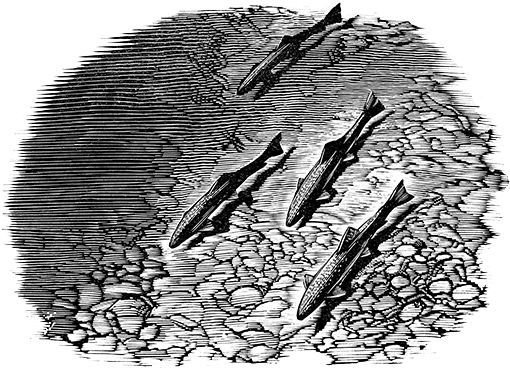
Nick looked at the burned-out stretch of hillside, where he had expected to find the scattered houses of the town and then walked down the railroad track to the bridge over the river. The river was there. It swirled against the log spiles of the bridge. Nick looked down into the clear, brown water, colored from the pebbly bottom, and watched the trout keeping themselves steady in the current with wavering fins. As he watched them they changed their positions by quick angles, only to hold steady in the fast water again. Nick watched them a long time.
He watched them holding themselves with their noses into the current, many trout in deep, fast moving water, slightly distorted as he watched far down through the glassy convex surface of the pool, its surface pushing and swelling smooth against the resistance of the log-driven spiles of the bridge. At the bottom of the pool were the big trout. Nick did not see them at first. Then he saw them at the bottom of the pool, big trout looking to hold themselves on the gravel bottom in a varying mist of gravel and sand, raised in spurts by the current.
Nick looked down into the pool from the bridge. It was a hot day. A kingfisher flew up the stream. It was a long time since Nick had looked into a stream and seen trout. They were very satisfactory. As the shadow of the kingfisher moved up the stream, a big trout shot upstream in a long angle, only his shadow marking the angle, then lost his shadow as he came through the surface of the water, caught the sun, and then, as he went back into the stream under the surface, his shadow seemed to float down the stream with the current unresisting, to his post under the bridge where he tightened facing up into the current.
Nick’s heart tightened as the trout moved. He felt all the old feeling.
He turned and looked down the stream. It stretched away, pebbly-bottomed with shallows and big boulders and a deep pool as it curved away around the foot of a bluff.
Nick walked back up the ties to where his pack lay in the cinders beside the railway track. He was happy. He adjusted the pack harness around the bundle, pulling straps tight, slung the pack on his back, got his arms through the shoulder straps and took some of the pull off his shoulders by leaning his forehead against the wide band of the tump-line. Still, it was too heavy. It was much too heavy.
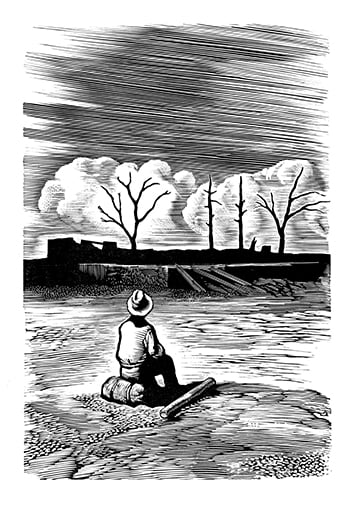 He had his leather rod-case in his hand and leaning forward to keep the weight of the pack high on his shoulders he walked along the road that paralleled the railway track, leaving the burned town behind in the heat, and then turned off around a hill with a high, fire-scarred hill on either side onto a road that went back into the country. He walked along the road feeling, the ache from the pull of the heavy pack. The road climbed steadily. It was hard work walking up-hill. His muscles ached and the day was hot, but Nick felt happy. He felt he had left everything behind, the need for thinking, the need to write, other needs. It was all back of him.
From the time he had gotten down off the train and the baggage man had thrown his pack out of the open car door things had been different. Seney was burned, the country was burned over and changed, but it did not matter. It could not all be burned. He knew that. He hiked along the road, sweating in the sun, climbing to cross the range of hills that separated the railway from the pine plains.
The road ran on, dipping occasionally, but always climbing. Nick went on up. Finally the road, after going parallel to the burnt hillside, reached the top. Nick leaned back against a stump and slipped out of the pack harness. Ahead of him, as far as he could see, was the pine plain. The burned country stopped off at the left with the range of hills. On ahead islands of dark pine trees rose out of the plain. Far off to the left was the line of the river. Nick followed it with his eye and caught glints of the water in the sun.
There was nothing but the pine plain ahead of him, until the far blue hills that marked the Lake Superior height of land. He could hardly see them, faint and far away in the heat-light over the plain. If he looked too steadily they were gone. But if he only half-looked they were there, the far-off hills of the height of land.
Nick sat down against the charred stump and smoked a cigarette. His pack balanced on the top of the stump, harness holding steady, a hollow molded in it from his back. Nick sat smoking, looking out over the country. He did not need to get his map out. He knew where he was from the position of the river.
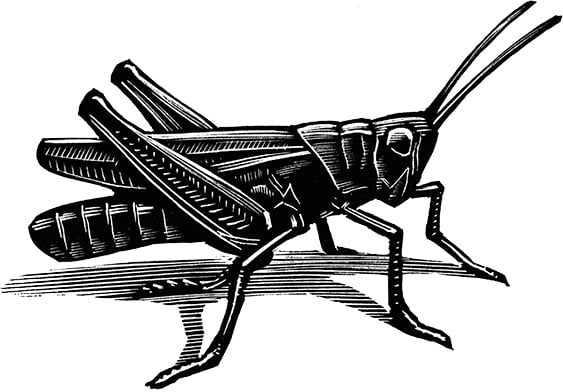 As he smoked, his legs stretched out in front of him, he noticed a grasshopper walk along the ground and up onto his woolen sock. The grasshopper was black. As he had walked along the road, climbing, he had started many grasshoppers from the dust. They were all black.
They were not the big grasshoppers with yellow and black or red and black wings whirring out from their black wing sheathing as they fly up. These were just ordinary hoppers, but all a sooty black in color. Nick had wondered about them as he walked, without really thinking about them. Now, as he watched the black hopper that was nibbling at the wool of his sock with its four-way lip, he realized that they had all turned black from living in the burned-over land. He realized that the fire must have come the year before, but the grasshoppers were all black now. He wondered how long they would stay that way.
Carefully he reached his hand down and took hold of the hopper by the wings. He turned him up, all his legs walking in the air, and looked at his jointed belly. Yes, it was black too, iridescent where the back and head were dusty.
“Go on, hopper,” Nick said, speaking out loud for the first time. “Fly away somewhere.”
He tossed the grasshopper up into the air and watched him sail away to a charcoal stump across the road.
Nick stood up. He leaned his back against the weight of his pack where it rested upright on the stump and got his arms through the shoulder straps. He stood with the pack on his back on the brow of the hill looking out across the country, toward the distant river and then struck down the hillside away from the road. Underfoot the ground was good walking. Two hundred yards down the hillside the fire line stopped. Then it was sweet fern, growing ankle high, to walk through, and clumps of jack pines; a long undulating country with frequent rises and descents, sandy underfoot and the country alive again.
Nick kept his direction by the sun. He knew where he wanted to strike the river and he kept on through the pine plain, mounting small rises to see other rises ahead of him and sometimes from the top of a rise a great solid island of pines off to his right or his left. He broke off some sprigs of the heathery sweet fern, and put them under his pack straps. The chafing crushed it and he smelled it as he walked.
He was tired and very hot, walking across the uneven, shadeless pine plain. At any time he knew he could strike the river by turning off to his left. It could not be more than a mile away. But he kept on toward the north to hit the river as far upstream as he could go in one day’s walking.
For some time as he walked Nick had been in sight of one of the big islands of pine standing out above the rolling high ground he was crossing. He dipped down and then as he came slowly up to the crest of the bridge he turned and made toward the pine trees.
There was no underbrush in the island of pine trees. The trunks of the trees went straight up or slanted toward each other. The trunks were straight and brown without branches. The branches were high above. Some interlocked to make a solid shadow on the brown forest floor. Around the grove of trees was a bare space. It was brown and soft underfoot as Nick walked on it. This was the over-lapping of the pine needle floor, extending out beyond the width of the high branches. The trees had grown tall and the branches moved high, leaving in the sun this bare space they had once covered with shadow. Sharp at the edge of this extension of the forest floor commenced the sweet fern.
 Nick slipped off his pack and lay down in the shade. He lay on his back and looked up into the pine trees. His neck and back and the small of his back rested as he stretched. The earth felt good against his back. He looked up at the sky, through the branches, and then shut his eyes. He opened them and looked up again. There was a wind high up in the branches. He shut his eyes again and went to sleep.
Part 2 continues the story next week.
To own the complete version of Big Two-Hearted River in one handsome volume, check out the 2023 Mariner Classics version, which includes a lengthy forward from author and journalist John N. Maclean. It’s available via online (this is an affiliate link from Outdoor News) and retail book-sellers everywhere.
The evolution of the shotshell spans 400 years of innovation
The shotgun shell is one of the most recognizable forms of ammunition in the world, but its development spans more
Pennsylvania’s hunting license sales down so far this year
Hunting license sales are down nearly 4.5% at the end of August, although Pennsylvania Game Commission officials believe there is
Origin of road-killed armadillo in southwest Ohio a mystery
An armadillo found as roadkill in southwest Ohio has researchers scratching their collective heads wondering from where the non-native mammal
