





What irony! I love just about everything about my neighbor, big, burly Saginaw Bay. But I’m not the person you’re most likely to see on that lobe of Lake Huron.
A few Fridays ago a friend and I paused at mid-day at the end of Linwood Road, just east of the village that proclaims itself Michigan’s Walleye Capital, and guessed the number of vehicles parked at 400 to 500, almost all pick-up trucks and most with a trailer, parked on the road shoulder, in a park, on private land at $5 a pop, and on the ice itself.
 This was well before the weekend rush, and many hours ahead of the last-light, “golden hour” when walleyes sometimes feed with abandon. It looked like an abandoned truck storage facility, one of those auction yards along the highway. The only people visible were a half-dozen on snowmobiles and wheeled vehicles, heading toward the eastern horizon, the rest so far offshore as to have vanished.
It was not hard to imagine them all ankle-deep in walleyes. Social media postings surely feed one’s imagination, with abundant grip-and-grin and bucket-pour-out images. But I’ve heard enough first-hand reports and seen enough fishy evidence to know that hundreds – maybe thousands – of legal-length walleyes are coming off Saginaw Bay and Saginaw River ice each day.
MORE COVERAGE FROM MICHIGAN OUTDOOR NEWS:
Bobcat hunting hounds tree cougar in Michigan’s Mackinac County
Michigan legislation would require COs to use body cameras, search warrants
Don’t blink: Michigan’s annual sturgeon season on Black Lake ends in 17 minutes
That’s how fisheries managers want it. Fishing on the Bay and River has been expanded to year-around, the minimum length shortened to 13 inches and the creel limit raised to eight fish. There’s a real bumper crop, and we’re enlisted as gleaners.
But most days, I pass. Saginaw Bay fishing is not everyone’s cup of tea. Most days, not mine. I’ve had great days at mid-Bay, in open water and on ice, but always aware that the Bay’s mood can switch in an instant, and those unaware can be in instant danger. Several people I’ve known have died on the Bay.
The Bay’s so big, at more than 1,100 square miles total, and its Inner Bay gets ornery when wind lashes its average 15-foot depth into frothy fury or, this time of year, creates cracks in ice or sends ice blocks afloat.
Others, of course – thousands of times as many – have had highlight-reel days out there, never feeling more alive.
Maybe I’m intimidated by an apparent mechanical curse. My Dad was a part-time, military-trained gunsmith with proven mechanical aptitude. I inherited none of that, barely able to keep my hundred-dollar-clunker cars running in college times. Cars, outboard motors and, I presume, snowmobiles and off-road vehicles are not my strong suit.
I remember my first visit to the Bay’s Black Hole, 25 feet deep and a couple of miles northeast of Linwood. I rode on the back of Dale’s bogie-wheeled Ski-doo. Pre-walleye boom, we tried for perch.
I don’t remember how we did; what I remember is Dale lifting the cowl to spray ether into the carburetor. Only way to start it, he said. Can’t use too much – somebody he knew blew the carb right off a block. I gazed at the far-off shoreline, partly obscured by blowing snow, and longed for my favorite little inland lake.
But Bay people are special. Ryan Rezler of Saginaw reminded me of several old-timers when he and a friend fished from sleds tipped on end to become canvas-wrapped wind-breaks. Otherwise, they were in the open.
Rezler, of Pinconning, had bought a matched pair of sled boxes for $30 at an Auburn rummage sale. I loved the hand-off of tradition and technology, and wanted to learn more about the builder and retired angler, and his partner.
I wrote a story in the 1970s when a DNR fisheries manager predicted the Bay would become a standout walleye fishing destination. Few believed him, outside of the local fishing clubs that helped create and operate drainable walleye rearing ponds whose production would jump-start the recovery that by all reports has far eclipsed the original walleye population.
I remember an evening fishing up to nightfall with a couple of the biologists who oversaw the ponds, stunned as for the first time I watched the headlighted parade of returning anglers.
Now the Bay’s full of fish, and anglers, across the calendar but never as stunningly as when winter finally delivers a frozen lake-top.
Plenty of us sneak out onto early near-shore ice and focus on perch, pike, and panfish. We’re back on late ice, walking from shore over water survivably shallow if things go sour. In between, we shake our heads at the sheer numbers of anglers heading out multiple miles for walleyes.
There is interplay sometimes between the two groups. A friend, after hours spent watching finger-sized perch in a near-shore fishing hole, engaged a returning walleye angler in conversation.
At goodbye, the walleye fisher gave Bill one of the three fish he’d caught in mid-day, and my friend, an 80-something-year-old who’d fished the Bay as a youth for perch with his dad, brought home his first (and admittedly mooched) walleye, a 20-incher he fixed for dinner that night.
While there is, of course, no such thing as safe ice, one can minimize its hazards, both in avoiding trouble and being prepared to deal with it.
It helps that Marty Sveliga, the Airborne Angler, flies regularly on donation-provided fuel and posts Facebook reports and photos of the Bay’s ice.
It helps, too, that several companies now offer recovery services for those whose vehicles break through or fall into cracks.
And yes, I love the Bay, and living near it, and all it does to support life in east-central Michigan. I just don’t often ask its open ice to support me!

Iowa’s upland wildlife researcher Todd Bogenschutz receives career award
National group recognizes his uplands work
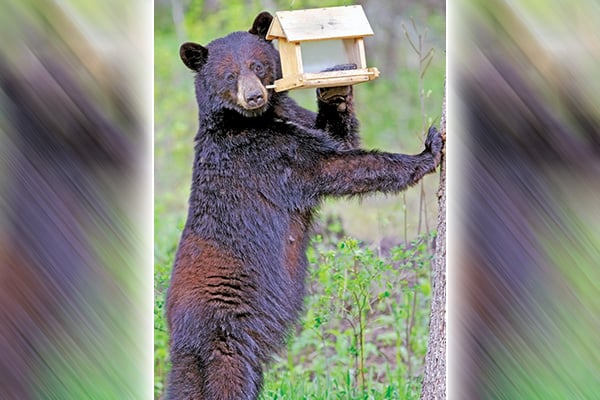
Minnesota man defending his dog from black bear attack sustains minor injuries
A bear attack occurred the morning of Oct. 5 in Solway Township, Minn., after a man confronted it for attacking

Minnesota Mixed Bag: Zebra mussels confirmed in Traverse, two other state lakes
The Minnesota DNR has confirmed the presence of zebra mussels in Traverse Lake, near Browns Valley in Traverse County.
