




What hunters should know about the top modern ammo innovations
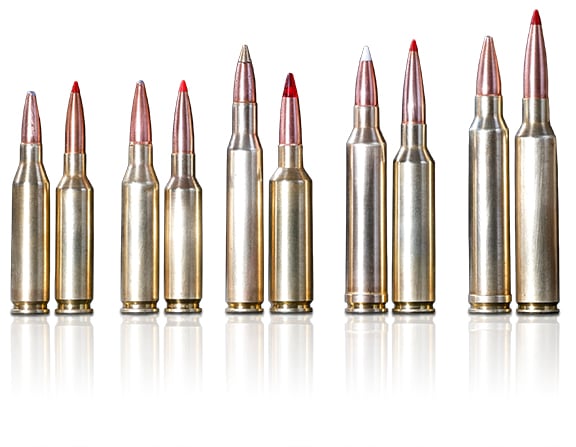
Long necks. Long bullets. And fast twist barrels to stabilize them. That’s what’s new in hunting ammunition.
If you’re a hunter with more than a few seasons in your rear-view mirror, you may be sadly shaking your head at all these newfangled cartridges that keep popping up. Creedmoor this and PRC that and Blackout with RPMs …
What’s going on?
Aerodynamic efficiency. Ever since the laser rangefinder made pinpointing the distance to your target, hunters have been arming up with cartridges and bullets that reach accurately reach farther and farther. The key is no so much muzzle velocity as hanging on to that muzzle velocity, and aerodynamically shaped bullets are the key.
Back in the glory days of the 20th century cartridge manufacturers were in a velocity race. The .250-3000 Savage broke the 3,000 fps barrier in 1915. The .270 Winchester became the flat shooting speed darling in 1925. Roy Weatherby turned up case for oldies still being goodies horsepower with his series of magnums in the 1940s. Remington and Winchester joined in the 1950s and hit home runs with the 7mm Rem Mag and .300 Win Mag in the early 1960s. Remington capped off the 20th century race with its 7mm RUM in 2000.
But speed at the starting gate does not always translate to speed at the finish line. Air drag slows bullets dramatically, and the shorter, wider, and blunter the bullet, the faster it slows. Trouble was, shaping them longer and sleeker made them too long for the common twist rates rifle makers had carved into their magnum barrels for decades.
The solution came from Hornady in 2007 in the guise of the 6.5 Creedmoor, a relatively small, unassuming little target round that launched a 143-grain bullet about 2,750 fps, no better than the 6.5×55 Swede of 1892. How was that progress?
WHITETAIL COVERAGE FROM OUTDOOR NEWS:
New York’s youth deer hunters, mentors enjoy solid weekend
Solve for where the bucks are pre-rut, and tag out before the chaos kicks in
Ryan Rothstein: Knock, knock, knocking… on the door of whitetail prime time
The barrel’s 1- to 8-inch twist rate was the progress. This was quick enough to stabilize a long bullet engineered to sneak through the air and retain more energy than shorter, less aerodynamic bullets of yesteryear. The silly little Creedmoor began winning long range shooting competitions out to 1,000 yards. This gave rise to today’s cluster of fast twist, medium velocity cartridges such as 6mm Creedmoor, 25 Creedmoor, 22 Creedmoor, 6.8 Western, 6.5 PRC, 7mm PRC, 300 PRC, 26 Nosler, 28 Nosler and more.
What each of these have in common are relatively long cartridge necks holding long, sleek, heavy for caliber bullets designed to fly far and minimize wind deflection. This is the critical performance standard for placing bullets on target far downrange. Gravity is a constant, so bullet drop can be easily compensated. But wind is maddeningly variable. Call it wrong by as little as 3 mph and a good hit at 600 yards can turn into a wounding shot. Which is both a good reason to stalk closer and use a modern, fast twist rifle flinging bullets with a high Ballistic Coefficient, the numerical measure of its aerodynamic efficiency.
In addition to this, bullet makers have been tweaking terminal performance to keep up. Instead of the same-old same-old jacketed lead core bullets of the past, today’s projectiles can have jackets and cores molecularly bonded, locked within partitioned sections, wrapped within tapering jackets with extra heavy bases, formed with two hardness levels of lead, or lathe turned out of solid copper. They can have needle sharp tips, hollow tips, wide hollow noses, polymer tipped noses, even bronze tips.
Each bullet is engineered to expand within minimum and maximum impact velocities, too. Hunters want harder bullets not only for bigger game on which penetration is important, but that will stand up to the incredible impact velocities inside of 100 yards. But they also want bullets that will expand reliably at slower impact velocities well beyond 400 yards.
The upshot is that hunters need to study and select not only their rifles and cartridges with care, but the ammo they shoot. And at what. The good old bullets of yore still work at the impact velocities of yore, but anyone planning to stretch their range needs to choose carefully.
Personally, this author recommends stalking as the ultimate long range shooting solution. Inside of 300 yards there is minimal bullet drop, deflection, or under-expansion. But this author also understands that rifles and cartridges of last century work just as well now as then. There is no need to buy the latest and greatest, but there is the desire, especially from young hunters and rifle nuts who love to experiment. ‘Nothing wrong with that. Long range shooting is the rage and many will undertake it.
Those who do should apply themselves to careful study of ballistics, wind deflection, rifle accuracy, cartridge capabilities, and bullet performance. Not to mention field shooting skills. It’s one thing to clang a plate at 750 yards from a bench on a calm day after four or five sighter shots. It’s quite another to drill a deer center chest from a field position on a slope in the cold with your heart racing.
One recent cartridge/ammo advance hints at big changes in rifle performance coming soon. In fact, in the case of the 6.5 Creedmoor and 7mm Backcountry, it’s already here.
Federal Premium, instead of building a larger volume or faster twist cartridge, is adding muzzle velocity to standard designs. Last year they broke the ice with their new, slightly re-shaped .280 Remington case, calling it the 7mm Backcountry. While having roughly the same powder volume as the .280 Rem., it requires its own rifle and chamber, but produces about 300 fps more muzzle velocity.
This year Federal expanded its stellar idea by releasing a 6.5mm Creedmoor version, this one the exact dimensions of the original Creedmoor. This means 6.5 Creedmoor owners can gain 6.5 PRC velocities or better just by firing Federal’s PEAK steel case ammo in their existing 6.5 Creedmoor rifles.
That, then, is the big innovation. Instead of a traditional brass cartridge case, Federal’s patented PEAK Alloy cases are made of a special, extra strong, reloadable steel that can withstand chamber pressures as high as 80,000 psi. The highest pressure brass cartridges are no higher than 65,000 psi.
Because the steel cases are, one presumes, containing the increased pressures, standard modern rifle actions and barrels can handle it. This has hunters speculating wildly about PEAK ammo being offered soon in 308 Winchester, perhaps 25 Creedmoor, 7 PRC and dozens of other extant cartridges. So stay tuned and hold on to your pistol grip. A new standard in velocity may be emerging.
The key takeaway is this: our most modern cartridges are all focused on aerodynamic efficiency rather than pure muzzle velocity. This results in better precision shot placement at longer distances plus higher retained energy in bullets far downrange. But if you’re taking your game inside of 400 yards, the oldies are still goodies. Hunt honest and shoot straight.
SUBSCRIBER CONTENT
Read this article now.
Create a free Outdoor News account.
Create a free account below to get instant access to this article, thousands of Outdoor News stories, and our digital editions. Your 1-month trial starts the moment you sign up.
No credit card required
No credit card required
No credit card required
Subscriber? Login Here.
Share on Social
Hand-Picked For You
Wisconsin’s statewide fishing report on Nov. 6, 2026
New York’s statewide fishing and hunting report on Nov. 6, 2026
Indiana Fishing Report – October 30, 2026
New York Fishing Report – October 30, 2026
Wisconsin Fishing Report – November 2, 2026
Lake of the Woods Fishing Report – November 3, 2026
Related Articles

Southern Zone opener marks new earn-a-second-buck era in New York
Albany — Although deer hunting seasons have been open in various forms in parts of New York for weeks, things

MN Daily Update: Don’t wait to get your ice-fishing gear ready
It’s time to get that ice-fishing gear out of the corner of your garage that you haven’t touched since last

Minnesota’s homegrown brook trout strain shows first signs of success in metro streams
DNR crews found young brook trout in two east-metro streams this summer, proof that the new MN Driftless strain, bred
