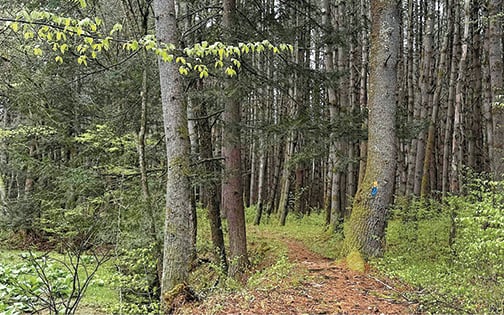
Harrisburg — The Pennsylvania Department of Conservation and Natural Resources in late July celebrated the addition of two forest tracts in Potter and Schuylkill counties into the national Old-Growth Forest Network: Ole Bull State Park in Potter County and the Tuscarora State Park in Schuylkill County.
“Pennsylvania is the national leader in designated old-growth forests because of the commonwealth’s legacy of conservation, environmental stewardship, and continued focus on protecting these special places,” said DCNR Deputy Secretary John Norbeck.
“These designations are critical in helping the public understand the immense value of our forests, especially our older forests, and the value they add to ensuring we have clean air and water. Thank you to the Old-Growth Forest Network for continuing its mission of highlighting these remarkable natural areas.”
Ole Bull State Park is the 45th Pennsylvania forest to be inducted into the Old-Growth Forest Network and the first in Potter County. The park consists of 132 acres along the Kettle Creek Valley.
This area is called the Black Forest because of its once dense tree cover, mountainous terrain and wilderness habitat.
About 40% of Ole Bull is forested, containing species such as eastern hemlock, white oak, sycamore, white pine and spruce. Many areas in the forest were planted as part of the Civilian Conservation Corps efforts and includes red pine, tamarack, white pine and spruce in these areas.
MORE COVERAGE FROM PENNSYLVANIA OUTDOOR NEWS:
New group forms to put an end to stocking over wild fish in Pennsylvania
Pennsylvania’s CWD pilot program may give hunters an option
Pennsylvania agencies coming to grips with open fields decision
Ole Bull State Park is named for Ole Bornemann Bull, the famous Norwegian violinist who toured the United States in the 1850s. Bull purchased a large tract of land in Potter County and attempted to develop a series of Norwegian settlements.
Tuscarora State Park is the 46th Pennsylvania forest to be inducted into the Old-Growth Forest Network and the first in Schuylkill County.
The 1,618-acre park is home to the park office and visitor center for Tuscarora and Locust Lake state parks. When viewed from the lake or the day-use area, Locust Mountain seems to drop right into the southern side of Tuscarora Lake.
The scenic picnic area hosts many day trips and family reunions, and the lake is a popular fishing spot.
Tuscarora State Park became a state park in 1971. Until the mid-1800s, the area was covered by a forest containing a variety of mature oak and chestnut. This dense forest was removed by the early settlers who cleared the land for agriculture and lumber. Today, over 80% of the park area is forested. Second and third growth hardwoods grow in the park today.
“The induction of Ole Bull and Tuscarora State Parks into the Old-Growth Forest Network demonstrates the importance of protecting areas of scenic, historic, and ecological significance, whether or not these areas are in a traditional forest setting,” said State Parks director John Hallas.
“These designations are the first for Potter and Schuylkill counties, and we appreciate the work of the Old-Growth Forest Network as it continues to support connecting the public to these special places in Pennsylvania’s 125 state parks.”
Founded in 2012 by Joan Maloof, Old-Growth Forest Network currently includes 346 forests across 40 states. The network also educates the public about the ecological benefits of old-growth forests and speaks out regarding immediate threats to specific ancient forests.
“The importance of the preservation of these rare forests cannot be overemphasized,” said Brian Kane, Mid-Atlantic regional manager with the Old-Growth Forest Network.
“Forests such as those at Ole Bull and Tuscarora State Parks perform critical environmental services that benefit communities, such as carbon storage, unique wildlife habitat, and stormwater retention.”
Old-Growth Forest Network is grateful for the foresight and stewardship of Pennsylvania’s DCNR, Kane added, so that residents and visitors will marvel at Ole Bull’s old trees far into the future as they grow more mature and majestic.”
All forests are essential to a healthy ecosystem, but old-growth forests are particularly valuable for their unique structure, Kane noted. They retain more carbon and nitrogen than younger forests, improving water and air quality.