




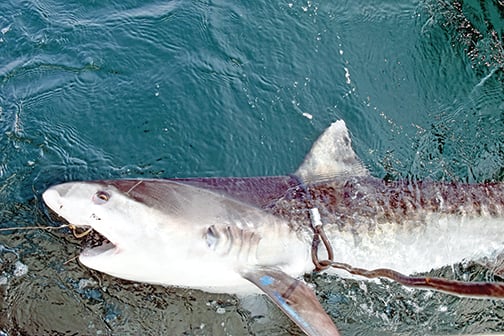
Editor’s note: This is the second in a two-part series on sharks off New York’s coast. Part 1 was featured in the March 6 issue of NYON.
Most people would be surprised, and perhaps a little dismayed, to learn how many sharks swim close to the shores of Long Island.
Four hundred-pound thresher sharks cruise in 40 feet of water. Schools of spinner sharks tear through pods of menhaden within easy sight of the beach. And just off the famed summer homes of The Hamptons lies the only known white shark nursery on the East Coast of the United States.
Long Island’s waters are also a seasonal home to sandbar sharks, duskies, blues, tigers, shortfin makos, sand tigers, hammerheads and porbeagles. Some sharks weigh less than 50 pounds; some might weigh more than 1,000. Together, they represent a readily accessible resource for recreational fishermen.
Shark fishing gear
Some anglers balk at the idea of fishing for sharks, thinking that it’s dangerous, and requires expensive equipment.
While handling a shark alongside the boat requires some caution, and having the right gear always helps, the novice shark fisherman can get started with a minimal investment using gear that they probably already have on hand.
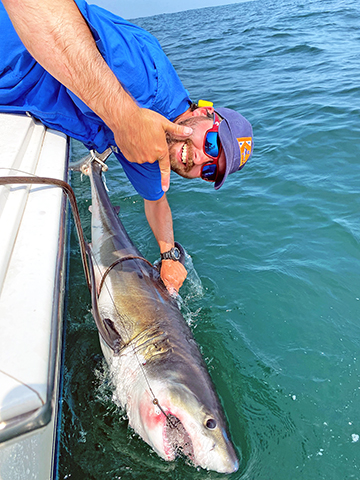
The first need is four conventional rods and reels. The rods should be optimized for no less than 30-pound line, the reels large enough to hold at least 400 yards of 30-pound monofilament, and sporting harness lugs, if at all possible.
The same conventional outfits that an angler uses for livelining menhaden for striped bass and bluefish will handle a surprising share of the sharks encountered, but will be quickly overpowered by anything over 150 or 200 pounds. If an angler chooses to invest in dedicated shark outfits, the best choices are 5½-foot “stand-up” rods rated for 30- to 80-pound, or 50- to 130-pound line and matching, lever-drag reels loaded with 50-pound monofilament.
Terminal gear includes shark floats, quality ball-bearing snap-swivels, No. 14 single-strand stainless leader wire, and non-stainless steel, non-offset circle hooks in the No. 16/0 to No. 20/0 range (I prefer the Eagle Claw No. L2045 in No. 18/0), the latter being required by law.
Other necessary equipment includes a chum pail (best made by taking a lidded, 5-gallon pail, drilling a couple of holes for a ¼-inch rope near the rim, and a dozen or so 2-inch holes in the pail’s sides), heavy gloves for handling the leader, a fighting belt, and a pair of fishing pliers to cut the wire. A stand-up harness helps the angler endure long fights, while a pair of bolt cutters makes it easy to cut through the hook and release the shark at the fight’s end. Anglers who intend to keep a shark for food will also need a flying gaff with a 6-inch hook and a couple of tail ropes (4-foot lengths of 5⁄8-inch line with loops spliced into both ends).
FISHING FEATURES FROM OUTDOOR NEWS:
Two sisters, two Minnesota records, one shared passion for steelhead
A summer walleye pattern most anglers cruise right past
When and why do bass attack topwater lures? Here’s what the science says
On the water
The owner of the boat must also go to the National Marine Fisheries Service’s online permit shop and obtain an Angling Category Highly Migratory Species Permit, with Shark Endorsement, well before the date of the first trip, to get the legal requirements out of the way.
On the morning of the trip, the boat will typically stop at a fuel dock/bait station, pick up three cans of chum and a flat of mackerel for bait. One can of chum and the mackerel should be allowed to thaw on the ride out to the fishing grounds, which is typically a wreck or some sort of irregular bottom structure. I particularly like fishing over “fingers,” long, parallel ridges in the bottom that hold squid and baitfish and often deflect deep, nutrient-laden currents toward the surface, attracting more life.
Although sharks can be found much closer to shore, I’ll typically set up over fingers in 120 to 240 feet of water, planning my drift so the boat will spend as much time as possible over the structure. As soon as I shut down the boat’s engines, I’ll dump the thawed chum into the chum pail, put the pail over the windward side of the boat, and tie it off to a cleat.
Rigging the baits is simple. The hook is attached to one end of a 15-foot wire leader, using a haywire twist; and a loop fashioned to the other end of the leader that is clipped into a snap-swivel at the end of the line. The point of the hook is pushed through a whole mackerel’s nose from the underside, and the bait dropped into the water.
The first line to be put out requires a float, which is slipped over the line before the snap-swivel is attached. That float is fixed 30 to 40 feet above the leader, and the line let out until the float is 125 to 150 feet from the boat. The second line is rigged similarly, but with the float 60 to 75 feet above the leader, and let out until the float is halfway between the first float and the boat.
The third bait is fished 120 feet off the rod tip, without a float, while the fourth bait is dropped just out of sight, directly below the chum can. The reels are then taken out of gear, with the clickers engaged, and the wait for a shark begins.
Fish on
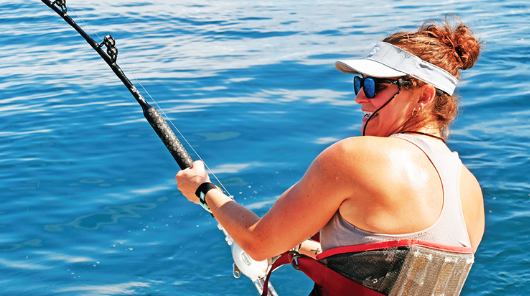
The shark may announce its presence by slowly pulling line off the reel, a few feet at a time, or it may grab the bait on the run and speed away. Either way, the angler should pick up the rod, throw the reel into gear, and wait for the circle hook to set itself.
If the fish has some weight, someone should slip the fighting belt around the angler’s waist, to keep the rod butt from scraping off some skin. If the fish seems big enough to fight for an hour or more, a stand-up harness will take some of the strain off their upper body, and let them bring their back and legs into the struggle.
When the fish is finally close to the boat, someone must put on the gloves, take hold of the leader, and pull the shark in the last dozen feet. Sometimes, if the fish is big, it might pull the leader out of the wireman’s hands, but the one thing that the wireman should never do is wrap the wire around one or both hands to get a better grip. People have been badly hurt, and lost fingers, doing this.
If the shark will be released – and there are “prohibited species,” including sandbars, sand tigers, duskies, whites, and makos that must be released – the wireman merely holds on while someone snips through the hook with the bolt cutters, and sets the shark free.
If the fish is to be kept for food, the wireman holds it in place while another crew member fastens the flying gaff line to a sturdy cleat and sinks the hook immediately behind the shark’s dorsal fin. That gaff placement will leave the shark in a tail-up position, making it easy to loop the tailrope around the tail and cleat it off to the boat.
At the end of the day, when the shark is brought into the boat, a second rope can be attached to the shark’s head, to keep it from thrashing around in the cockpit. If the shark is too heavy to bring into the boat, it must be tied alongside, using multiple lines to guard against one chafing through, before beginning the very long, slow trip to the dock.
There’s a lot more to shark fishing, of course, that will be learned through experience, but the basics described here are enough to successfully introduce an angler to the world of recreational shark fishing, a world that I entered nearly a half-century ago, and never chose to leave.
A quick chat with Jim and Will Pattiz, brothers behind morethanjustparks.com
Outdoor News has monitored the website Morethanjustparks.com with increasing frequency for its one-stop shopping content on America’s most important public
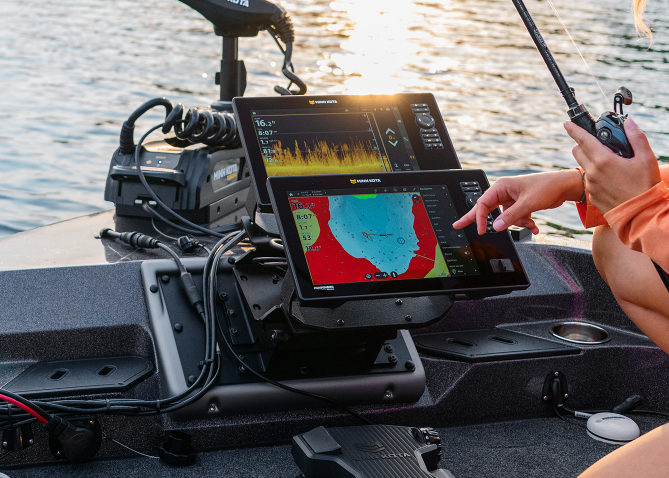
Minn Kota introduces one seamless fishing system powered with Humminbird Imaging
On Oct. 6, Minn Kota introduced the most significant expansion in its history with a new, seamless fishing system, powered

French tip: muskies in summer, slabs during winter on this southeast Minnesota water
Muskie anglers have a limited number of options in the southern part of the state; French Lake near Faribault is
