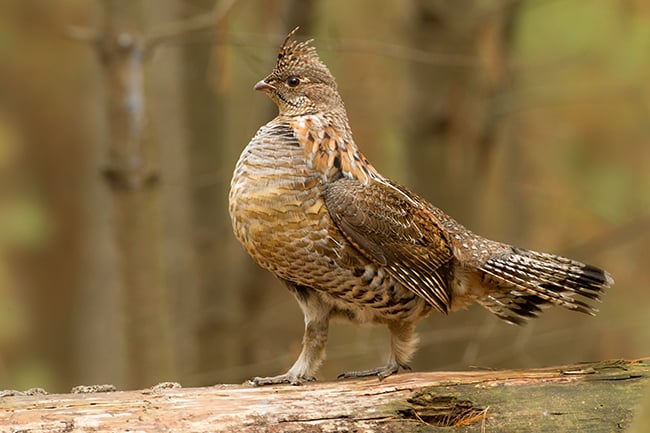
St. Paul — The Minnesota DNR’s latest ruffed grouse counts found the state’s spring 2026 population again dropped from the species’ peak in 2024. Ruffed grouse drums per stop were 1.7 statewide, which is down slightly from last year.
“That is completely expected because we peaked a couple years ago, and grouse cycle on an approximately 10-year cycle, with the cycle averaging between 8 and 11 years. And we’re on the declining phase of that. It’s not entirely unexpected, and that was the trend statewide,” said Charlotte Roy, grouse research scientist for the DNR.
The DNR conducts the survey by monitoring spring grouse drumming activity. Drumming is a low sound male grouse produce as they beat their wings rapidly and in increased frequency to signal the location of their territory. Drumming displays also attract females ready to begin breeding. The DNR and its partners, including federal agencies, have conducted ruffed grouse surveys for 75 years to monitor the state’s breeding population.
The DNR said the grouse decline was observed in the Northeast, Central Hardwoods, and Southeast survey regions, which comprise the majority of survey routes (124 of 129 routes surveyed this year). However, in the Northwest, survey effort has been down the past two years due to federal staffing reductions; five of eight routes were surveyed, which the grouse report says may not be representative of the region.
Given that some surveys weren’t conducted in the northwest, Roy is less confident in those numbers.
“I think that it’s difficult to infer the whole region based on five routes. And so I’m not confident in those numbers,” Roy said. “But I have talked to the wildlife manager at Red Lake Wildlife Management Area, who is in that region, and he says he’s seeing good numbers of birds. I’m hopeful that things are very favorable this season.”
Some of the lost routes were covered by the U.S. Fish and Wildlife Service. It has become a challenge for that federal agency to work the routes thanks to staffing shortages and recent cuts. Roy said the DNR works collaboratively with many different partners, and when one is affected by funding shortfalls, it affects their collective data.
Populations are surveyed by counting the number of male ruffed grouse drums on established routes throughout the state’s forested regions. Though the survey is complete, Roy cautioned looking at population numbers as an indicator for what to look for in the fall.
“The ruffed grouse survey has been used in the past as kind of a indicator of what to expect in the fall, and it really shouldn’t be used that way because our drumming survey is conducted in the spring, in April and early May,” Roy said. “And a lot happens between the time that the birds are getting ready to nest and then the actual nesting success and the chick survival through the summer.”
Readers can see the entire 2026 ruffed grouse survey report at the DNR’s grouse management webpage: www.mndnr.gov/wildlife/grouse.html.
Sharpies similar in the northwest, lower in
east-central region
Minnesota’s northwest sharp-tailed grouse population is similar to last year, but the east-central population is lower, according to spring population counts conducted by the DNR and cooperating organizations. The average number of sharp-tailed grouse per lek (dancing ground) in the northwest was 12.4 this year, compared to 12.0 last year. The average number of sharp-tailed grouse per lek in the east-central region was 8.1 compared to 11.9 last year.
“The east-central region, the numbers are down. And they’ve been kind of struggling in the east central part of the state for a while now,” Roy said. “One of the challenges we face in the east-central region is that these birds really require large areas, and it’s hard to manage across lots of different land ownerships because people have different goals for their property, and sharp-tailed grouse may not be one of those goals.”
The sharp-tailed grouse population level remains low in east-central Minnesota, and the DNR has kept the hunting season closed in that east zone since 2021. Low population levels in the area are thought to be driven largely by changing habitat conditions. The birds require 1 to 3 square miles of grassland and brushland, and establishing and maintaining suitable habitats of this size often requires cooperation between multiple landowners.
The Minnesota Sharp-tailed Grouse Society, Pheasants Forever and others have collaborated with the Minnesota DNR on targeted habitat management – specifically on prescribed burns, mowing and tree shearing projects – for sharp-tailed grouse and remain committed to enhancing open-land habitats to the extent possible.
These types of surveys are essential for continuing to manage species and address issues sooner rather than later.
“These surveys are really useful for us to be able to understand how the birds are doing and be able to notice problems early so that we can try to turn any problems around,” Roy said. “And without that monitoring data, we aren’t able to notice these changes happening and respond to them early while we can still do something about them.”