




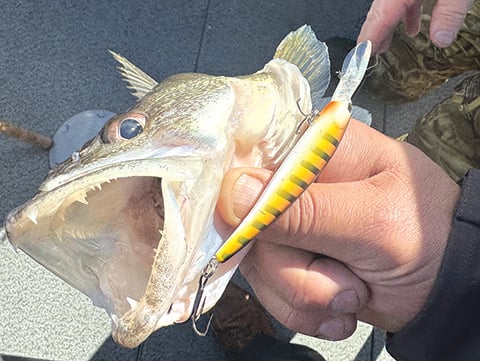
Few places where walleyes are caught regularly are as susceptible to rapidly changing water clarity as the western basin of Lake Erie. A stretch of calm weather can leave the water relatively clear, but strong winds can turn it muddy in a matter of hours.
That muddy water can develop in two different ways. First, strong winds create heavy waves that pound the shallow shorelines, stirring bottom sediments until the water changes from appealingly clear to muddy brown.
 Often that’s just a localized problem.
Longer periods of sustained wind can create an even bigger problem – a phenomenon called a seiche. In Lake Erie’s western basin, prolonged westerly winds push the lake’s water eastward.
If the winds persist a day or more the water levels on the Michigan end of the lake can drop by four, five, or even six feet as the water piles up on the eastern end of the lake, sometimes rising as much as 10 feet above normal.
Then, when the wind dies or changes direction all that displaced water rushes back westward. That returning surge churns sediments from depths of 40 feet or more – and few areas of western Lake Erie are deeper than that. The result is extremely muddy water and, usually, difficult walleye fishing.
Tough fishing makes sense when you consider how walleyes feed. Most predator fish with eyes as large as walleyes are primarily sight feeders. Walleyes do use smell, hearing, and their lateral line to locate prey, but under normal conditions, vision is their primary feeding tool.
I was reminded of that reality on a recent trip to Lake Erie. Strong winds had muddied the water along Michigan’s shoreline.
Cleaner water may have existed near the mouth of the Detroit River, but instead of making a long run, I relied on lessons learned through experience about coping with muddy water walleyes.
Sound off
In dirty water, fish often hear a lure before they ever see it.
All lures create sound and vibration that walleyes can detect through both their internal hearing system and lateral line. Deep-diving crankbaits and lures with wide wobbling actions naturally produce more vibration than slim-profile baits with subtle movement. Internal rattles inside the lures make them even easier for fish to locate.
The goal is to attract fish from a distance with noise and vibration, then give them something visible enough to strike once they get close.
Bigger and brighter
When muddy water drastically limits visibility, I switch to larger and brighter lures than I’d normally use.
This is no time for silver or gold metallic finishes that depend on reflected light for their flash. Instead, I favor fluorescent colors and high-contrast patterns. Almost every lure manufacturer offers some version of the classic fire-tiger pattern – bright green, chartreuse, orange, and black.
Fire-tiger is always a reliable starting point, but any lure featuring dominant “hot” colors can be productive.
Glow-in-the-dark finishes can be even more effective. Fluorescent colors only appear bright when enough light penetrates the water. In heavily stained conditions, lures running 15 or 20 feet down may effectively be fishing in darkness even on sunny days. Glow finishes continue to stand out when ordinary colors disappear.
And when visibility shrinks, size matters. Bigger lures are simply easier for fish to find.
Think shallow
Muddy water also changes where walleyes position themselves in the water column.
Walleyes often move shallower because light penetration is better near the surface.
The water is still discolored, but at least it’s brighter and forage fish and your lures are easier to see. Instead of running all your lures in the typical 15- to 25-foot range common in western Lake Erie, experiment with crankbaits that dive only five to 10 feet deep.
Don’t ignore scent
Walleyes aren’t scent feeders in the same way catfish are, but they absolutely use smell to help locate food – especially in dirty water.
Adding scent to a lure creates a trail fish can follow once vibration and visibility bring them close. Commercial gels like Gulp Gel have worked well for me, although plenty of anglers have confidence in homemade mixtures or other scent products. Garlic and anise have long track records, and I know anglers who swear by rhubarb-based scents.
Natural bait can also help.
Nightcrawlers on worm harnesses are a longtime favorite, but even adding a small piece of crawler to a lure’s belly or tail hook can leave enough scent to help walleyes zero in on the bait.
Muddy water may make walleye fishing tougher, but it doesn’t make it impossible. The anglers who continue catching fish when the water turns brown are usually the ones who adapt – using more vibration, brighter colors, larger profiles, shallower presentations and scent to help walleyes find what they think is their next meal.
Pennsylvania’s hunting license sales down so far this year
Hunting license sales are down nearly 4.5% at the end of August, although Pennsylvania Game Commission officials believe there is
Origin of road-killed armadillo in southwest Ohio a mystery
An armadillo found as roadkill in southwest Ohio has researchers scratching their collective heads wondering from where the non-native mammal
Bowhunt gets started in Ohio with additional opportunity in CWD surveillance area
Hunters in Ohio’s chronic wasting disease (CWD) surveillance area have additional dates this season to pursue white-tailed deer. The Ohio
