




Outdoor News may earn revenue from products shown on this page by participating in affiliate programs. This comes at no extra cost to you. Click here to learn more.
June in the underwater world of the Minnesota walleye screams “transition time!”
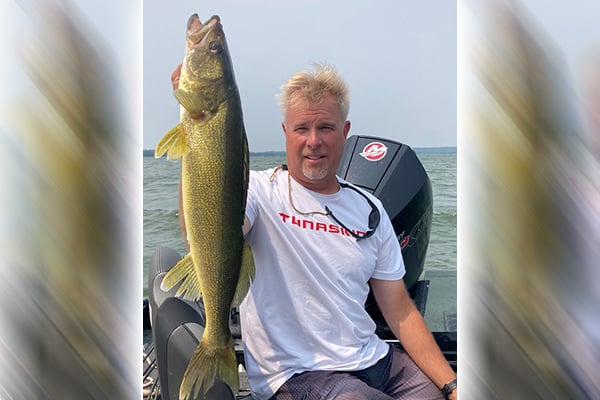
It’s when the yearly fishing cycle sees schools of walleyes across Minnesota adapt from their spring (April and May) locations to their summer haunts. And depending on where your next big fishing adventure occurs, there can be multiple patterns or strategies to monitor.
Now don’t get me wrong, not all of the fish exit the shallows that they coveted throughout May and instantly dart for deeper water simultaneously. In fact, in most water bodies, some walleyes never leave the shallows (5 to 10 feet) all summer – and that’s one of the easiest patterns to fish. That’s a later article; for now we are concerned with the basics of June walleye location.
June walleyes are basically eating machines and the more productive depth ranges seem to be between 6 and 20 feet – which is either up on the shallow flats (6 to 12 feet centered around pods of baitfish and newly established weed beds of cabbage and coontail). They’ll be close to previously occupied spawning areas or depths centered around the first break (drop off) and down potentially to the newly growing weed line – think 12 to 20 feet. In either location, a food source (bait fish) and cover is the key to finding walleyes – year-round for that matter!
Walleyes need food 24/7/365.
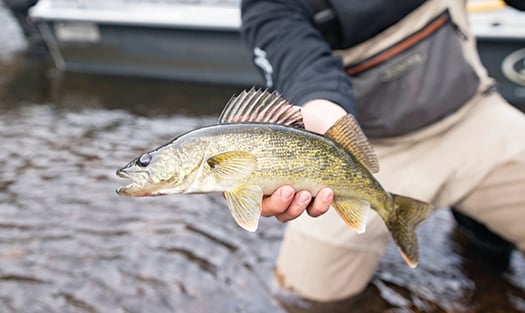
So get out the side-imaging or the forward-facing sonar and use it as a beam to scan the shallow feeding flats around your boat for pods (blobs) of bait fish/minnows and new weed growth as you idle around those flats. Find the food and the walleyes will be close by – within yards of the food source.
Long-line troll stickbaits like Rapalas or Salmos while you are searching/scanning with the boat – preferably by using your trolling motor for stealth. Rippin’ swimbaits like a Rapala Rippn’ Rap, Berkley Rip Fish, or a plastic like the Berkley Power Switch can also help locate “weed fish” quickly. If relying more on plastic swimbaits, stick to a 3- to 4-inch length on a ¼-to 3⁄8-ounce jig. Work it fast and erratic.
When you find (or catch) multiple pods of bait fish or walleyes stop the boat and work the area more thoroughly by pitching a small jig 1⁄16- to 1⁄8-ounce colored silver, gold, green, blue, or glow white lead head tipped with a half crawler/medium leech or a minnow hooked through the lips. Fish it on clear 6- or 8-ounce monofilament line.
Line stretch helps the fish inhale the bait easier than a non-stretch line. Drag the jig along the bottom and slowly work the area you think the school is using.
Hold your position with the trolling motor. This is where your “spotlock” feature on your trolling motor comes in handy. Do not anchor with a rope anchor or a Talon-type anchor until you have caught numerous fish in the same area. Disturbing the bottom can spook the fish.
MORE WALLEYE COVERAGE FROM OUTDOOR NEWS:
How many pounds of fish are kept by Minnesota anglers? New research sheds light
C.B. Bylander: Minnesota shifting to a smarter approach to walleye stocking
Steve Carney: Fine tuning your late-spring minnow choices
Typically in June, small schools of walleyes are roaming and will not hang around long anyway – hence why some movement of your bait via trolling or drifting works well on the flats right now.
Concentrating on these shallow feeding flats certainly will put fish in the boat. But don’t forget about current areas like in-flowing rivers/creeks for some great evening fishing. The walleyes will filter into the shallows as the sun sinks beneath the horizon making for some great shore fishing/wading opportunities where boat anglers often fail to capitalize.
Besides shoreline-related weedy “feeding flats” and simple current areas, June-flavored walleyes use shallow sand/gravel flats, primary breaks/deep weed lines, mid-range flats (13 to 20 feet), and some mid-lake structure options as well like sunken islands close to the first shoreline break. These are only some of the obvious options. To keep it simple, focus on the primary deep weed line on the first break line (drop-off) out from shore.
That first break could be a hundred yards out from shore or a mile. The further out and the more it stretches into deep water (30-feet plus), the better. Use your lake map charts to find these areas and then use your sonar to narrow the search find the depth of the weed line (the depth at which the weeds stop growing and the bottom appears “clean and empty” on your sonar. An average weed line depth in most Minnesota lakes is in between 15 to 20 feet deep. Water clarity and bottom content decides its location.
Throughout June, we can find walleyes, as well almost all gamefish, using this newly formed weedline. Cabbage weeds or a mix of cabbage and coontail weeds seem to be the best for holding a good mix of fish. We can catch big loner walleyes, and schools of eaters throughout the day using a variety of live bait presentations.
Live bait rigs (like Lindy rigs) comprised of a 30- to 40-inch leader, ¼- to 1⁄2-ounce slip sinker, and a No. 2 or 4 hook tipped with an active minnow, medium leech or crawler will catch fish. On the jig side of the world, an 1⁄8-ounce jig tipped with a medium-sized minnow or medium leech will cover most weed line depths.
If you are having problems keeping bottom contact with your bait – try a slower boat speed. For faster trolling speeds, try a ½- to 3⁄4-ounce bottom bouncer and a spinner crawler combination – my personal favorite. Always note the depth and boat speed when a fish is caught.
While there are no hard rules for walleye fishing, there are basic patterns in fish behavior, location, and activity. Learn them and succeed!
Learn more from Captain Josh Hagemeister via www.minnesotaguideservice.com.
Minnesota duck hunters await fresh birds as warm weather lingers
If you spoke with enough waterfowlers and waterfowl managers across Minnesota in the last handful of days, the message you
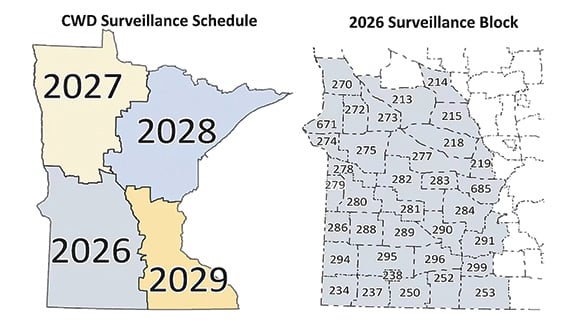
Minnesota DNR reminds firearms deer hunters to prepare for CWD sampling
Sampling is mandatory for southwest Minnesota the opening weekend of firearms deer season Nov. 7-8

Short on walleyes, but long on muskies: Beers Lake in Minnesota’s Otter Tail County
Otter Tail County’s Beers Lake is an excellent walleye fishery – nope. Beers is loaded with good-sized panfish and northern
