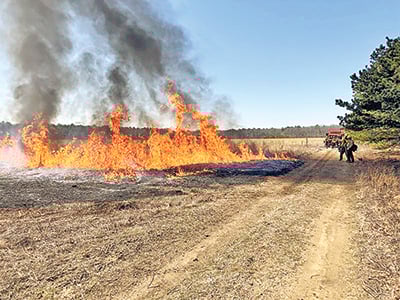
Albany — The New York State Department of Environmental Conservation recently announced the agency will be conducting prescribed burns on certain DEC-managed lands through early May.
Prescribed fire is a tool used to improve habitat for lands and wildlife. It is regulated by law and regulation, requiring technical expertise to conduct these burns safely. Prescribed fires are planned in many regions of the state, specifically, DEC’s Regions 1, 3, 4, 6, 7, and 8.
“Prescribed fires are used to reduce the buildup of wood and timber litter to prevent wildfires that would threaten public safety and structures,” DEC Commissioner Amanda Lefton said. “It is also an important land management tool that helps DEC achieve specific ecological goals, including eliminating habitat for invasive species.”
MORE COVERAGE FROM NEW YORK OUTDOOR NEWS:
Wetland enhancement completed at New York’s Lakeview WMA
Commentary: Rockland County, N.Y., youth hunt opt-out is sad and shameful
Changes in store for New York’s Long Island spring turkey hunters
Before any prescribed fire is conducted, a burn plan is developed that outlines land management objectives, as well as parameters that must be satisfied before any prescribed fire can take place. Careful consideration is given to environmental factors such as current and expected weather conditions and smoke management considerations in close coordination with the National Weather Service. In addition, burn plans are executed by nationally qualified burn bosses.
Prescribed burns accomplish more than simply using fire to manipulate habitat for a land management objective. The burns serve as an opportunity for DEC Forest Rangers to develop partnerships among different DEC divisions. Prescribed fires on DEC-managed lands allow Forest Rangers, working with the DEC Divisions of Lands and Forests, Operations, and Fish and Wildlife, to train more staff to become wildland firefighters, supporting efforts to implement future prescribed burns and wildland fire responses.
In 2025, DEC and partner agencies burned more than 1,600 acres of grassland and woodland habitats. These treatments included prescribed fires on two of DEC’s largest Long Island properties, the Otis Pike Pine Barrens State Forest and the Rocky Point Pine Barrens State Forest, as well as other DEC-managed properties in Regions 3, 4, 6, 7, and 8.
Prescribed burns are regulated by law, and they are exempt from the annual residential brush burn ban in effect from March 16 to May 14. The list of locations scheduled for prescribed burns this spring is as follows:
Region 1
• Otis Pike Pine Barrens State Forest – Suffolk County;
• Ridge Pine Barrens State Forest – Suffolk County;
• Rocky Point Pine Barrens State Forest – Suffolk County;
• David A. Sarnoff Pine Barrens State Forest – Suffolk County;
• Dwarf Pine Plains Pine Barrens State Forest – Suffolk County.
Region 3
• Lafayetteville Multiple Use Area – Dutchess County.
Region 4
• Albany Pine Bush Preserve – Albany County,
Region 6
• Wilson Hill Wildlife Management Area – St. Lawrence County.
Region 7
• Three Rivers Wildlife Management Area – Onondaga County;
• Cicero Swamp Wildlife Management Area – Onondaga County;
• Long Pond State Forest – Chenango County.
Region 8
• Cameron State Forest – Steuben County;
• Canisteo River Basin Unit Management Plan – Steuben County;
• Helmer Creek Wildlife Management Area – Steuben County;
• Rush Oak Openings Unique Area – Monroe County;
• Sonyea State Forest – Livingston County;
• Coon Hollow State Forest – Schuyler County;
• West Cameron Wildlife Management Area – Steuben County;
• West Hill State Forest – Steuben County.