Chicago — Coyotes are expertly adapting to areas where humans live and recreate, leading researchers in Chicago to offer what not many years ago would’ve been surprising advice.
Get used to it.
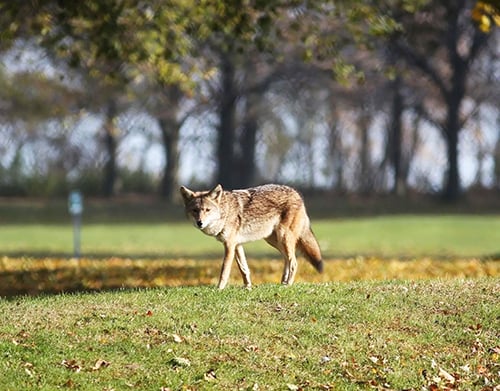
Focused on 54 coyotes – 44 males and 10 females – the Urban Coyote Research Project tracked predators for an average of 221 days in the Chicago Metropolitan Area. What researchers found was that parks and golf courses with plants and small mammals tend to serve as hotspots for interaction between coyotes and humans.
The work follows previous findings that suggests that areas of Chicago that are most densely populated with people are associated with longer coyote lifespans.
MORE COVERAGE FROM ILLINOIS OUTDOOR NEWS:
Patience pays off for Illinois hunters as overdue ducks answer the call
Steve Sarley: Stroke provided perspective for this outdoorsman
Jeremiah Haas: Yes, we do have ‘River Monsters’ in Illinois
In this new study, the research team analyzed times and locations in Chicago when coyotes were on the move at the same time people were working, socializing or otherwise occupied outdoors. The analysis showed that overlap of human and coyote activity would be far more probable in areas with more open space.
“Coyotes are not going anywhere – in fact, they’re increasing in numbers,” said Emily Zepeda, lead author of the study and a postdoctoral scholar at Ohio State University. “The problem to solve is how to coexist with them and, is there a chance we can even appreciate their presence as the apex predator in many urban areas? They can have an impact on urban residents’ appreciation for nature.”
Zepeda works in the lab led by Stan Gehrt, a wildlife ecologist at Ohio State and senior author of the new paper. The aforementioned previous study sought to identify urban factors that help or hinder coyotes’ ability to survive. This new work digs more deeply into the interplay between people and coyotes in Chicago and, possibly, in other North American cities with growing coyote populations.
For years, the project team has been capturing and fitting Chicagoland coyotes with GPS collars that record the animals’ location every 15 minutes for 24-hour periods every two weeks.
Human activity used for statistical modeling was represented by population density data from the U.S. Census Bureau and Illinois Department of Transportation data indicating that the highest traffic volume spanned from 6 a.m. to 8 p.m.
The coyotes’ attraction to areas of high human density is surprising given their general avoidance of humans, Zepeda said. Decades of research has shown that coyotes are very good at avoiding people and tend to favor eating rabbits, mice, and voles over the abundance of household trash they find in neighborhoods.
Some findings from the new study:
• Coyotes’ use of areas of high human population density increased 1.8 times when those areas also contained moderate levels of open space, like parks or golf courses.
• In contrast, coyotes may be less likely to overlap with humans in regions featuring the negatives associated with people, like traffic.
• Even though there is a population-level trend for avoiding humans, the subset of coyotes in this study – those that are active when humans are active – may be responsible for many of the human-coyote interactions that occur in the Chicago area.
“Coyotes are incredibly hard to study because they exhibit so much individual variation – which contributes to their success at establishing populations in new environments like cities,” Zepeda said.
In newer work, she is examining people’s attitudes toward coyotes after interacting with them.
The latest work was supported by Cook County Animal and Rabies Control, the Max McGraw Wildlife Foundation, the Forest Preserve District of Cook County, and a National Science Foundation Graduate Research Fellowship.
Andrew Sih of the University of California-Davis and Christopher Schell of the University of California-Berkeley also were co-authors.