




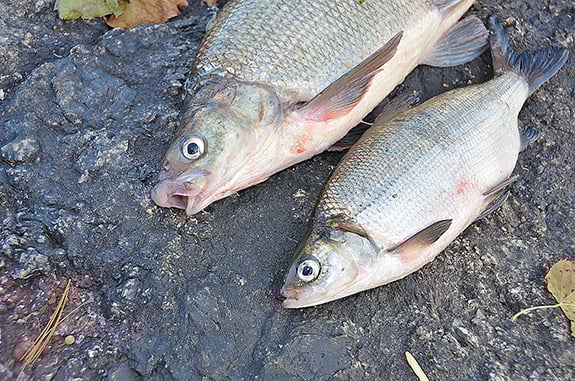
There’s a neighbor at our cabin whose family has fished the lake decades longer than I’ve been alive.
This is Lake Carlos in the Alexandria, Minn., area and growing up, I used to be fascinated by their stories of walleyes patrolling bulrush beds after dark, the big northern pike that would hit on sharp drop-offs in the late fall and the smallmouth bass that congregated on a couple of deep humps (smallies have since become much more common).
But nothing piqued my interest more than seeing their grainy photos of tullibees, those slender, silver- to white-colored fish that live in deep, cold lakes. I’d often wondered about those fish stacked up in the deepest portions of the lake. I’ll never forget the day the neighbor said, “We used to catch them all the time. Just tie on a jig and a minnow and drop it down to where they’re at.”
This involved a great degree of trial and error, because while the fish finder showed them at 90 or 100 feet, I had no way to be sure my jig was at the proper depth. But I stayed committed and eventually developed something of a system for determining how much 6-pound monofilament had left the reel.
It wasn’t long before I started catching them with some regularity. My initial forays occurred during the middle of the summer, but as I learned more about them, I figured out these fascinating fish follow extremely predictable patterns in the late fall and early winter that put them within even easier reach for many folks.
To be clear here, we’re talking about ciscoes (also known as tullibees) and whitefish, which are similar fish that follow very similar seasonal patterns.
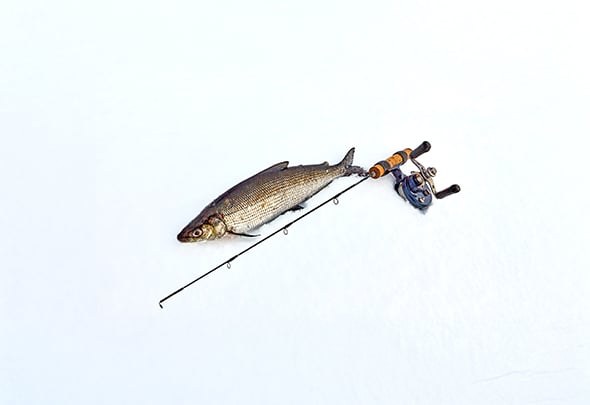
Both are salmonids, members of the trout and salmon family. They’re mildly oily compared to other freshwater sport fish, and they have Y-bones, but they’re fine tablefare, especially whitefish.
As the water temperature drops in the fall and into the winter, ciscoes/whitefish in the northern United States begin making their way from their deep-water haunts where they find cool water during the summer to shallower reefs. Unlike many other freshwater fish, ciscoes/whitefish spawn in late fall and early winter, as opposed to spring and early summer.
By the time the water reaches the mid-40s and high-30s, they can predictably be found around the edges of the hard-bottomed reefs where they’ve probably by now wrapped up their spawn. They may stage in deep water – say 20 to 60 feet – but the key is to locate reefs that feature hard substrate such as gravel, rocks, and rubble.
Like other fish species, this isn’t a completely linear progression – they’ll move back and forth between their deep-water staging areas and their spawning area before they fully commit to the spawn, which typically occurs after dark on extremely calm, cold nights.
MORE FISHING FEATURES FROM OUTDOOR NEWS:
Whitefish and the old ways: Maintaining a North Country tradition in Minnesota
Al Lindner: Anglers located and caught a lot of lunker fish during open water 2025
November is trophy muskie time
Generally speaking, spawning occurs on top of hard-bottomed reefs or along gravel shorelines and includes large clusters of fish. Most of the spawning occurs under the light of the moon. By the time dawn arrives, the fish have returned to their deeper-water hangouts.
While ciscoes and whitefish don’t feed heavily during the spawn, they do gorge themselves on things like aquatic insects and small baitfish before and after spawning.
Folks who want to target ciscoes/whitefish during this late fall and early ice wintertime period have a couple of options: Angling and netting. It’s important, of course, to understand any state-specific regulations.
Minnesota, for example, offers a sport netting season for residents that’s open for several weeks in the late fall/early winter. Wisconsin also has a netting season, in addition to a hook-and-line season. The netting season dates vary by area and sometimes lake, but most opened Oct. 10 this year and carries into the new year, where season-ending dates can vary, as do bag limits.
While netting requires specialized equipment, hook-and-line anglers generally already have everything they need in their tackle box. They can get in on a good cisco/whitefish bite while there’s still open water, but other times the bite roughly coincides with first ice.
Whether they’re in a boat or atop the ice, anyone targeting ciscoes/whitefish this time of year should wear a life jacket and be prepared for conditions that can change quickly.
Targeting whitefish and tullibees through the ice calls for finesse and mobility. Drill multiple holes over deep basins or steep breaks where these schools often roam. Use light line – 2- to 4-pound-test – to help small presentations flutter naturally. Tiny tungsten jigs, spoons, and waxworm-tipped plastics work best; experiment with colors and cadence until you find what triggers bites.
Because these species feed upward, keep your lure above marks on your sonar. Long, subtle lifts followed by a controlled drop often draw fish in. Stay mobile, hop between holes and watch your electronics closely. When the school appears, move quickly – whitefish and tullibees often feed in short, fast-paced windows.
Bottom line, simple presentations like small spoons and jigs are the most effective. Drop them near the fish and they’re usually willing biters. Again, watch the electronics because schools of these fish tend to move quite a bit.
Depending upon the seasonal conditions, most anglers may be targeting early ice panfish or simply biding their time waiting for ice to form. But if you know of a lake with ciscoes/whitefish in it and you’re willing to step out of your comfort zone, targeting them over early hard water can be a great way to bridge the outdoor-activity gap.
Ralph Loos: Illinois Outdoor Hall of Fame class has common interest: being useful
You could make a pretty long list of reasons why people get involved in outdoor conservation. Some love hunting. Some
Mixed bag of success as many Minnesota hunters face a wet waterfowl opener
It felt like a “ducky day” in Minnesota for Saturday’s waterfowl opener.
Many hunters shot through rain and strong
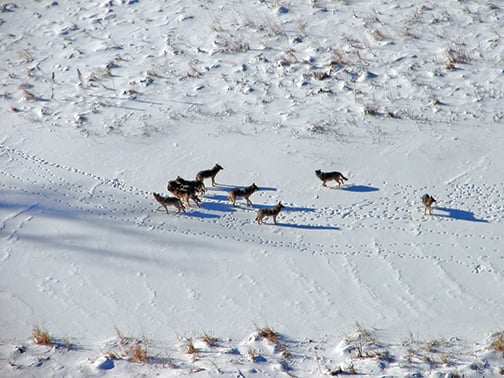
Minnesota’s wolf population remains stable, DNR considers new monitoring
Minnesota’s wolf population remained statistically stable within confidence intervals from 2025 across nearly 26,000 square miles of wolf range, but
