




Chuck and I sat listlessly, perched on 5-gallon buckets while guarding a little pothole off the big water where ducks like to settle in for the night. We had tried fishing – unsuccessfully – earlier that afternoon, and so far, the duck hunting wasn’t any better.
It was the first week of November, but it had been a mild fall. Maybe the ducks were gone already, glancing hastily at their wing watches, if there is such a thing, trying to make it for a rendezvous on a rice bed down in Arkansas. Or maybe they hadn’t come yet. Given the mild weather, really, there had been no reason to push south.
Whether they were here and gone or yet to arrive, one thing was certain: They weren’t here now. At least not in any numbers. And the birds that were around weren’t stupid.
The trouble with the little pothole is it’s not little enough. Ducks like to land in the center, and no point projects toward it, giving us hunters a fair crack at a bird. So it often becomes a matter of just watching birds pitch into the wild rice for the night, hopelessly out of range.

Indeed, we’d already seen a few small flocks do just that, tucked safely away 100 yards out, giving the middle wing feather to our small, nearshore flock of decoys.
Finally, a flock of four mallards – either uneducated or just oblivious – gave us a look. I missed, but Chuck sent a plump northern mallard careening to the ground like a bird on Nintendo’s Duck Hunt. The greenhead was a true trophy: glossy green head, big red legs, and more curls than Shirley Temple. But it was the only bird we would bag that evening.
Later, back in my camper, that greenhead, along with a ruffed grouse I’d brought from home, steamed up the windows as the breaded birds sizzled in a frying pan. The meal was a nice way to top off what had been a rather unsuccessful day of fishing and hunting.
The next morning, I was all for going fishing. The wind had died down overnight, which would make fishing easier, and meaning ducks would be less likely to fly. But it was Chuck’s boat, and he wanted to duck hunt, so that’s what we did.
We set up on a small island back on the main lake where we’ve enjoyed a lot of good diver duck hunts over the years. Given the lack of birds the previous night, I was afraid we might be in for nothing more than a nice sunrise. But with a duck hunter’s optimism, we sat to greet the dawn.
MORE WATERFOWL COVERAGE FROM OUTDOOR NEWS:
Sun, heat greet hunters, but ducks were plentiful in some areas of Minnesota on opener
A judge’s first-hand account from the 2025 federal waterfowl stamp contest
Four ways to turn passing shots into point-blank opportunities on waterfowl
Sunrise came and went.
We saw a few distant flocks, but nothing anywhere near our little setup. The sun rose higher. My thoughts began to stray from duck hunting to fishing.
Suddenly, a flock of five birds materialized in the east, circling behind our little island. But they didn’t give up on us. Instead, they wheeled around and swung closer for another look.
These were not the shrewdest of birds, and they made a communal decision that things looked as they should and they decided to join our fake flock. We watched as the birds swung in unison, cupped up, and dropped in altitude. As they made their final approach, a lump formed in my throat.
Oh my gosh! I thought.
“Cans!” Chuck blurted aloud, finishing my unspoken thought as we rose to fire.
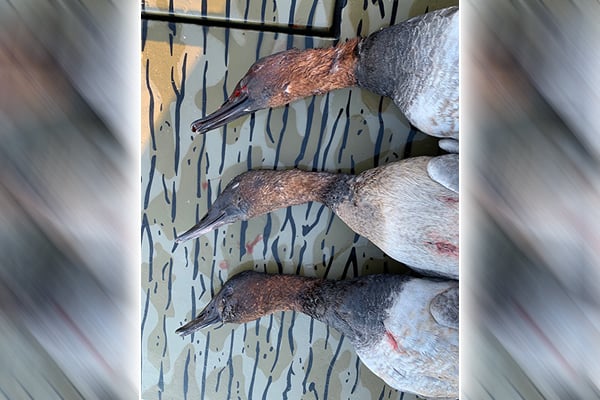
In 35 years of duck hunting, I could count on one hand how many canvasbacks I’ve killed. There had been exactly two, the first of which was on this very lake. And now, five canvasbacks hung over the decoys as we rose to shoot.
When the shooting was over, only two birds departed. I don’t know how many of the birds I actually killed, but Chuck shoots an over-under, so I’m for sure giving myself credit for one!
We were riding high. Three bull cans in the bag, although none of them were fully plumed. After recovering the birds, we just sort of quit hunting. We were so excited about the canvasbacks and not much else had been flying anyway. Besides, we didn’t feel like we could top that experience.
As we motored back to camp, regal cans laid out across the bow of Chuck’s boat, a funny thought occurred to me: On our morning hunt, we’d had only one more bird in range than on the previous evening’s “poor” hunt. But man, what a difference it makes when you get a chance at a real rarity!
Pennsylvania’s hunting license sales down so far this year
Hunting license sales are down nearly 4.5% at the end of August, although Pennsylvania Game Commission officials believe there is
Origin of road-killed armadillo in southwest Ohio a mystery
An armadillo found as roadkill in southwest Ohio has researchers scratching their collective heads wondering from where the non-native mammal
Bowhunt gets started in Ohio with additional opportunity in CWD surveillance area
Hunters in Ohio’s chronic wasting disease (CWD) surveillance area have additional dates this season to pursue white-tailed deer. The Ohio
