




Home » Home Page News » A quick chat with Ben Jones of the Ruffed Grouse Society
A quick chat with Ben Jones of the Ruffed Grouse Society
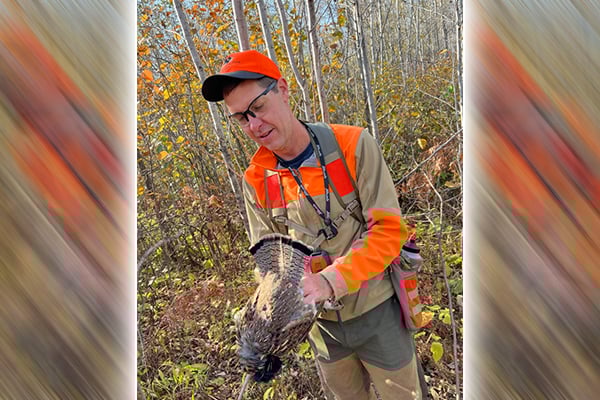
Ben Jones is the president and CEO of the Ruffed Grouse Society & American Woodcock Society. The two groups work together to unite conservationists to improve wildlife habitat and forest health for all forest wildlife.
Jones calls ruffed grouse and American woodcock “bellwethers of forest condition – they can only persist in healthy, diverse forests. These same forests clean the air, filter water, and support local communities.”
Jones has worked closely with many conservation partners during the past 20 years from small woodlot owners to the U.S. Forest Service.
Prior to joining RGS/AWS in June 2018, he was chief of the Pennsylvania Game Commission’s Habitat Division where, among other duties, he oversaw habitat programs on private and public lands. He has served on the board of the Pennsylvania Forestry Association and the Pennsylvania Prescribed Fire Council where he was chair for six years.
Jones earned a Ph.D. in forestry and wildlife science from the University of Tennessee, an M.S. in wildlife ecology from Mississippi State, and a B.S. in wildlife and fisheries with forest science minor from Penn State.
Jones took time from his busy schedule for a Quick Chat with Outdoor News.
Outdoor News: How did you develop your passion for grouse and woodcock that got you into the position you’re in now?
Jones: My passion for the outdoors and hunting in general, and the whole ball of wax, which includes grouse and woodcock, started at my earliest memories. I can’t remember not being drawn to this. My whole family hunted. My great uncle John had pointing dogs and I remember going into his house when I was probably 4 or 5 years old and seeing a mounted woodcock on the wall. I was like, wow, look at that.
I remember walking to school… we had this half-mile lane to catch the bus, and I was walking up this gravel lane and this mama woodcock came out with her chicks behind her in tow. I remember thinking, this is the coolest thing I have ever seen.
Well, it’s seared in my memory. I was maybe 7 years old. I just grew up with a heck of a passion for it. I really never felt like I made this choice of, ‘What am I gonna do for a career?’ I was just like, I’m gonna be a wildlife biologist and that’s all there is to it. That’s what got me into it.
Then I worked around the country on forestry and wildlife issues. I’ve made the focus on habitat management and specifically forestry. I worked for our state wildlife agency in my home state of Pennsylvania for 13 years.
Then I took this position with RGS seven years ago. It’s just a really great fit for my interest and where I’ve taken my professional career.
READ MORE QUICK CHAT FEATURES FROM OUTDOOR NEWS:
A quick chat with Kip Adams of the National Deer Association
A quick chat with Clay Newcomb — avid outdoorsman and storyteller
A quick chat with Pheasants Forever and Quail Forever lobbyist Ariel Wiegard
Outdoor News: What’s the status of RGS and AWS as far as membership and budget? Is the organization holding its own?
Jones: We are. We’re holding our own. We’ve been growing coming out of COVID. This is well documented and… we’ve grown our conservation impact.
You know, it’s always a hustle for a nonprofit. The thing that people need to realize is how important our membership base is, and our donors, and our supporters. That’s the lifeblood of an organization like this.
So it’s work day-in and day-out to make sure we’ve got that part that’s keeping our wheels turning and keeping our operation healthy. In addition to that, we’ve got tons of funded agreements with various state and federal partners helping them deliver on-the-ground habitat management. I was on the public sector side for over a decade and realized how important nonprofit partnerships can be in helping agencies get this work done. So it’s interesting now to flip the script and be on the nonprofit side and we approach our agency.
Our agency partners always need some level of help to get this work done and especially right now, here in 2025. Our role right now is going to be more important than ever with agencies like the U.S. Forest Service or the U.S. Fish and Wildlife Service with national forest and national wildlife refuge management.
So business is good, but we can’t ever rest on our laurels because there’s a ton to do. We’ve got to keep gearing up to get the work done.
Outdoor News: What are a couple of your bigger projects that are going on? Studies, surveys, restoration projects?
Jones: Well, one is that for the first time ever, we’ve got a forest conservation director that’s leading delivery in the coastal plain in Piedmont of the Carolinas and in southeastern Virginia.
We’ve also been supporting research of the Eastern Woodcock Migration Study. We’ve been supporting that research for about eight years now and what we’ve got from the GPS transmitters on these woodcock is, for the first time ever, a real look at where they go and what they do during their migration. It’s really highlighted the importance of the coastal plain in Piedmont of the Carolinas.
That’s wintering grounds and the migration stopover habitat.
So last December we hired a forest conservation director, Sarah Serve, to concentrate on what that research tells us, like where are the hot spots in the really important places to make sure that we’re conserving woodcock during the migration and the overwintering. That’s been a huge project for us.
Also, our ability to bring their plight to the attention of more people, certainly hunters and then the broader public, that these are species that are in trouble. We need to help them.
Outdoor News: Do you see good progress being made along those lines? Are are you getting the word out?
Jones: Making strides for sure and always more work to do. That’s why interviews like we’re doing right now are so important. I can’t do enough of them.
And then as far as our business, we’re making sure that our marketing and communications are strong so we’re getting that word out, too. That’s a constant work in progress, but progress is being made.
Outdoor News: Any messages that you want to send our readers that we haven’t touched on?
Jones: I’d just like to ask everybody to be an active participant in conservation. We’re involved from individual state level projects and things being done on the ground all the way to being active in Washington, DC, and advocating for good policies. A great way for people to get involved and to stay up on what’s going on is to join us. I can’t be on an interview and not ask readers to take a minute and consider joining Ruffed Grouse Society and American Woodcock Society.
Outdoor News: That’s where it all starts, right?
Jones: It it sure is. And it’s not gonna break the bank to join.
SUBSCRIBER CONTENT
Read this article now.
Create a free Outdoor News account.
Create a free account below to get instant access to this article, thousands of Outdoor News stories, and our digital editions. Your 1-month trial starts the moment you sign up.
No credit card required
No credit card required
Subscriber? Login Here.
Share on Social
- Tags: Hunting, Quick Chats, Upland Birds
Hand-Picked For You
Ohio’s Outdoor Calendar
Ohio Cuffs & Collars: Stolen black walnut tree from Wallace O’Dowd Wildlife Area
H2Ohio wetland to benefit St. Marys
USFWS announces new duck season framework process
Making sense of this year’s waterfowl report for Ohio hunters
Nine Ohio DND Division of Wildlife officer cadets training
Related Articles

Findlay Reservoirs support walleyes and saugeyes in northwest Ohio
An angler could do much worse than the pair of reservoirs at Findlay in northwest Ohio.
The latest offering
Ohio’s Outdoor Calendar
A look at upcoming outdoor-related events from across Ohio published in the Sept. 22, 2026 edition of Outdoor News.

Ohio Cuffs & Collars: Stolen black walnut tree from Wallace O’Dowd Wildlife Area
Ohio cuffs and collars are field reports from the Division of Wildlife. These reports are from the Sept. 25, 2026
