Editor’s note: The following story is reprinted with permission from Interlochen Public Radio. It first appeared on their website on Feb. 5.
Antrim County, Mich. — Lake whitefish are on the brink of collapse in lakes Michigan and Huron.
So scientists are hoping they can get the fish to spawn in northern Michigan’s rivers, something they haven’t done in well over 100 years. The latest experiment occurred earlier this month on a wooded river bank in Antrim County. Kris Dey, hatchery manager at the Little Traverse Bay Bands of Odawa Indians, held up a plastic bag full of thousands of little fish eggs.
“You can see all their little beady eyes. You can see the little tails. You should be able, if you look closely, you should be able to see their heartbeat,” Dey said.
These whitefish are only partially developed, but inside each of these 25,209 eggs, impossibly tiny fish are starting to take shape – all curled up with two black eyes staring out.
MORE COVERAGE FROM MICHIGAN OUTDOOR NEWS:
Outdoor Observations: Will Michigan deer-baiting ban be lifted? History says no
Legislation seeks to overturn deer baiting ban in Michigan
Michigan Natural Resources Commission mulls changes to bear hunt, raising concerns with some
Trying to help
Little Traverse Bay Bands has teamed up with the Sault Ste. Marie Tribe, the Bay Mills Indian Community, the Michigan Department of Natural Resources and The Nature Conservancy. They want to see if stocking whitefish in rivers can help the dwindling species rebound.
Here’s the problem right now: Lake whitefish lay their eggs on rocky, shallow reefs in lakes Michigan and Huron. Those eggs hatch, and the babies stay in the shallow water eating zooplankton. But invasive quagga mussels also eat zooplankton, and they’ve slurped up huge amounts of the food source in lakes Michigan and Huron, so baby whitefish have very little to eat these days.
Scientists like Matt Herbert, with The Nature Conservancy, think that’s where rivers can come in.
“These rivers feed into more nutrient rich habitats; they’ll have a lot of zooplankton,” Herbert said. “At first they’ll hatch, and they’ll just basically be passive. … For the most part, they’re just gonna drift down in the current, and basically, wherever the river delivers them, that’s where they’ll hang out. And then, once they get there, then they’ll start looking for food. Fortunately, these sorts of habitats at the mouth of a river have a lot of food, so they ought to stay put.”
In the case of the Jordan River, that habitat is Lake Charlevoix. The fish should begin to hatch and float downstream to Lake Charlevoix starting in mid-March. The idea is that, years from now, the surviving fish will return to this same river to spawn as adults.
But stocking the eggs in the past has been a challenge. Take last year, for example, when the team planted incubators full of eggs at this same spot in the river.
“A lot of incubators,” said Angel Guerrero, also with the Little Traverse Bay Bands, “And all of them were full of fungus and sand, and there were hundreds of fish in each of them, so obviously that did not work.”
Many of the fish survived, said Herbert, but not as many as they’d hoped.
“So I’m a proponent of trying something different,” Guerrero said.
The new approach
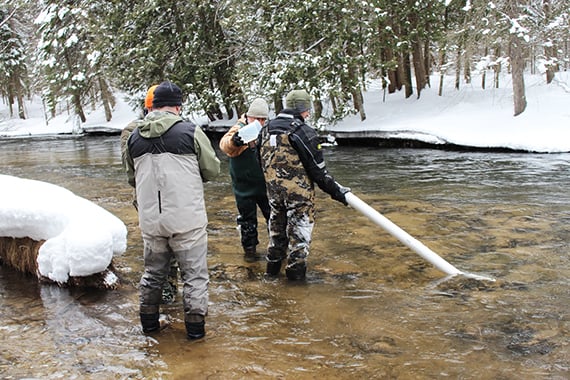
Early this month they started testing a new strategy. Instead of using incubators, the eggs will get spread directly onto the rocky river bottom – like how they would in the wild.
“We’re transferring all the eggs into a beaker so we can carry them out,” Dey said.
Then they tilt a long PVC pipe down into slightly different locations in the river. They pour the eggs down the pipe, and like people at a waterpark, the little whitefish eggs go sliding down to the riverbed and disperse.
The whole process only takes about 15 minutes before all the eggs have been planted and everyone wades out of the river.
“I’m excited to see how this turns out. I think this should do really well,” Dey said.
They’ll be back in mid-March to estimate how many larval fish have hatched and are floating down the river. Underlying all this, though, is a ticking timer for whitefish. The 25,000 eggs they planted this month might seem like a lot, but it’s a fraction of the amount they planted last year.
The reason for that? There just aren’t a lot of whitefish out there to collect eggs from anymore.
“In a place where we normally catch 400 or more fish, we only caught probably 32,” Dey said. “So, quite a decline.”
But Guerrero says that’s what keeps him passionate about the project.
“Honestly, a lot of hatchery work is working yourself out of a job,” he said. “Your hope and goal is that (the fish) can just take care of themselves and you don’t have to take care of them anymore.”
It’ll be years before they’ll truly know if this works – before they can see whether whitefish return to the river to spawn.
But for now they’ll wait, gather more data, see what happens with this year’s new stocking strategy and keep trying.