




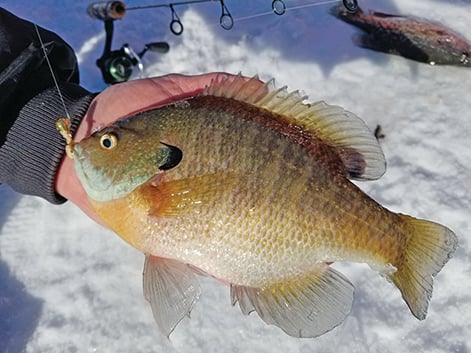
Lately, bluegills in area lakes have been hitting fast and furiously, mostly in shallow water. The lakes I fish contain a variety of sizes of bluegills, but I’ve been targeting only the bigger ones.
My strategy is simple. I used artificial lures, such as small spoons, and no live bait.
Here’s why.
 Using larger spoons keeps small bluegills from biting. And I don’t want to be spending my time constantly dealing with 6-inch bluegills. The smaller bluegills rarely hit an unbaited spoon, but they’ll hit like crazy if you put on a wax worm. The bigger bluegills will slam the plain spoons.
Most of my spoons are l⁄8-ounce. Any spoon smaller than that will attract the occasional smaller bluegill, which I don’t want.
There are times when I’m fishing a school of larger bluegills that adding a wax worm or maggot can make a difference. But I add live bait only if I know I’m on quality fish. Most of the time, I don’t even have any live bait with me when targeting bluegills.
Turkey brine
A few weeks ago, I wrote about cooking my smaller wild turkey and trying a brine for the first time.
Last year’s 14-pound tough tom was barely edible. This time, my 8-pound turkey turned out excellent.
The key was the brine. The brine can be either a wet brine or a dry brine. My wet brine is simple, and the main ingredient, salt, needs to be kosher salt, not table salt.
Brining consists of a 24- to 36-hour soak in a refrigerator, and the results are amazing. Here’s the recipe:
• Water
• Kosher salt
• Lemon
• Orange
• Onion
• Pepper
• Thyme/sage
• Sugar
Fill a tall cooking pot with water and kosher salt, sugar, lemon, onion, pepper, and herbs. Leave enough room for the bird. Heat briefly, then allow the brine to get to room temperature. Submerge the turkey in the pot and leave it in a refrigerator for 24 to 36 hours.
After the brining period, rinse the turkey and place it in a roasting pan and roast for about 15 minutes per pound at 325 degrees.

Illinois DNR survey captures first blue cat in Carlyle Lake
The southern Illinois reservoir continues to produce a strong crappie fishery. DNR’s 2025 survey produced 26 crappies per hour, with
Illinois’ Outdoor Calendar
A look at upcoming outdoor-related events from across Illinois published in the Oct. 2, 2026 edition of Outdoor News.

Illinois Cuffs & Collars: Illegal minibike at William Powers State Park
Illinois cuffs and collars are field reports from Conservation Police Officers. These reports are from the Oct. 2, 2026 edition
