




Outdoor News may earn revenue from products shown on this page by participating in affiliate programs. Click here to learn more.
Eager footsteps grounded in common-sense trepidation guide our way out onto the first few inches of jet-black “glass.”
Every hit of the spud bar resonates through our eardrums. Flashes of light from the headlamp catch the childish little smirk as it quickly passes over your partner’s face. Standing upon a transparent boundary line between the world we live in, and what swims beneath, we feel the rush once again. It’s go time.
Early season ice is usually not much; a few inches at best, but that crystal clear, rock hard, “black ice” is the strongest there is. Regardless of its strength, it is always protocol to use a spud bar and carry safety ice picks on your person at all times when dealing with any questionable ice conditions. Safety is always at the forefront of any ice fishing adventure.
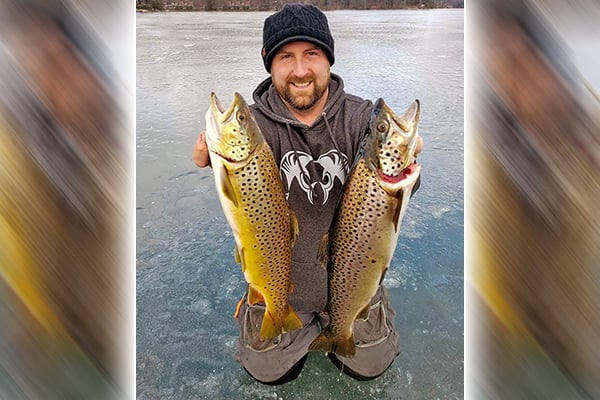
First-ice trout fishing holds a special place in my heart. Trout action always seems to be the best on ice 6 inches or less.
Adequate sunlight penetration keeps the trout’s metabolism running high as underwater weed growth is still receiving sunlight to keep the photosynthesis process going strong, in turn keeps the surrounding water rich and oxygenated, which keeps trout actively feeding.
The rig
Over the last few seasons I have refined my trout-specific ice gear; and for good reason. I tend to use tip-ups for most ice fishing escapades utilizing a live bait presentation.
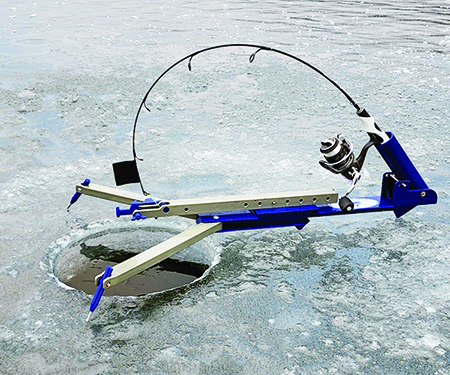
This is not the case with trout. I now exclusively use Jaw Jackers. If you are unfamiliar with Jaw Jackers they are basically an auto hook setting device that uses an ice rod. There are a few different companies that make a similar product and they are all OK, but I tend to favor the original Jaw Jacker.
Picking the proper rod to accompany the Jaw Jacker base is crucial as well. You want to use a 28- to 30-inch rod in a medium power for most trout applications. This size and power gives the ample hook setting ability, without being overkill for a rather short amount of line under the ice. Medium-to-light is okay as well, but I prefer straight medium.
When setting up rods to use for Jaw Jackers, this is one time I actually prefer a regular old monofilament line versus a non-stretch braid. Something like Berkley XL or Maxima Ultragreen in 6-pound test works fabulously as a main line.
The amount of line off the tip of the rod (which is right at the top of the ice) is typically only a few feet. There is no need for a non-stretch braid in this application. I have tried braid in the past and the hook up/landing ratio was not nearly as good as mono.
MORE ICE FISHING COVERAGE FROM OUTDOOR NEWS:
So you want to be an ice angler? Here’s how to get started
Targeting these nontraditional species through the hard water can be fantastic fun
Comfort, mobility, efficiency: Top ice-fishing gear for 2024-25
Now that rods are set, let’s talk leaders and terminal tackle. I like a tiny barrel swivel off the main 8-pound mono. This helps immensely with line twist. A lively bait on a short set right under the ice will wreak havoc on a setup without a barrel swivel.
As for leaders I like approximately 18 inches of 6-pound Seaguar Blue Label. I have tried many different leader materials over the years and always fall back on Blue Label.
As for hooks, a VMC 9649 round bend treble in size 14 is a workhorse hook that gets sticky sharp with a little TLC from a hook file. I have also used Owner Stinger trebles in the past, but the price versus value just isn’t even close.
The stingers are a short shank, black nickel finish hook as well, and for whatever reason I feel more takes occur on the regular bronze finish of the VMCs. The regular shank on the VMCs also seems to provide better hookup and hold ratios than the short shank hooks as well.
Another worthy mention is the connection between leader and hook. I really like a non-slip loop knot for two reasons. The first being, it gives a small bait much more freedom of movement to swim unrestricted and naturally; and second, the way it has freedom to move in any way during the rather violent hook-setting action of a Jaw Jacker helps a lot with achieving a solid hookset on trout.
The fish
First ice trout sets will almost always be shallow setups. Six feet or less; more than likely less. I start my setting up with small live bait (two inches or less) in the dark of the morning, 18 inches to four feet under the ice.
As the morning progresses, I gradually lower a few baits a bit. Six-to-eight feet under the ice over deep water always seems to produce a few customers. As the sun gets high overhead, I will continue to drop baits farther down… maybe 10-to-15 feet under the ice provided the water depth is more than twice that value. I will also keep a few up high and tight to the ice as well.
In lakes where there is an abundance of sand bottom close to shore, I also like to do some super shallow water sets. Trust me when I say 18 inches of water is not too shallow! The quality of fish that can come from super shallow sets can be mind-blowing!
Switching Gears
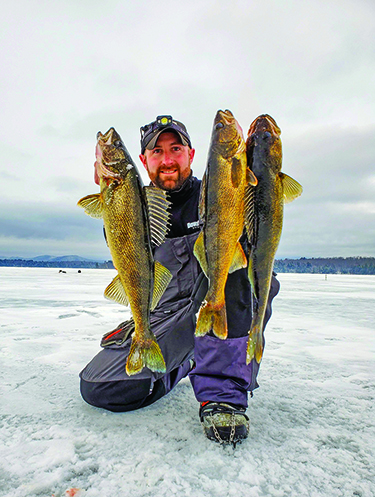
‘Eyes, Walters, Gravel Lizards, Rock Melons, whatever you choose to call them, walleyes will always be a priority target for ice anglers.
It always helps to understand the nature of the beast in which you are pursuing. Walleyes are an extremely crepuscular fish, meaning their activity level peaks during periods of low light. Don’t expect to crush ‘Eyes at noon on a sunny day, it just is not going to happen. Sure, you may pluck a few off here and there, but it will never be something to write home about.
Catching them is the easy part. Finding them is the more difficult portion of the equation.
Targeting first-ice walleyes starts with a scouting mission; just like hanging a treestand for a big buck, you need to do your homework. Locating live weeds and weed edges is your first task. If those edges are in a transitional zone changing from deep water to shallow, all the better. Dense weeds with an abrupt edge are dynamite.
Keep in mind the difference between having a slaughterfest and being skunked because your offering was tangled within the weeds, can be the difference of only a few feet. Set up accordingly and with extreme care in aspect to location.
Another focal point can be troughs within the bottom contour leading from deep to shallow water. Think of them as funnels that fish will naturally follow on their way from deeper water-holding areas to nighttime feeding areas.
This is where navigational apps such as Navionics or Active Captain shine. These will also be the first area to produce fish as the sun starts to slowly slink below the horizon.
The majority of locations will still be the same no matter if you are a tip-up fishermen or a jigger, however, a full nighttime setup adjacent to shallow water weed edges calls for strategic tip-up placement with live bait.
The first ice night bite isn’t for the faint of heart but can be absolutely incredible. Everything is more difficult; and colder, but it can pay huge dividends in the form of walleye fillets!
Pennsylvania’s hunting license sales down so far this year
Hunting license sales are down nearly 4.5% at the end of August, although Pennsylvania Game Commission officials believe there is
Origin of road-killed armadillo in southwest Ohio a mystery
An armadillo found as roadkill in southwest Ohio has researchers scratching their collective heads wondering from where the non-native mammal
Bowhunt gets started in Ohio with additional opportunity in CWD surveillance area
Hunters in Ohio’s chronic wasting disease (CWD) surveillance area have additional dates this season to pursue white-tailed deer. The Ohio
